IN Brief:
- Havant Thicket will store up to 8.7 billion litres and provide up to 21 million litres of water daily during dry periods.
- One million cubic metres of clay has been placed as major embankment work progresses alongside a 7km pipeline programme.
- The project is becoming a reference point for a wider generation of planned English reservoir and water-transfer schemes.
Portsmouth Water is advancing Havant Thicket Reservoir through its main construction phase as bulk earthworks, embankment formation, and the associated pipeline programme progress across the Hampshire site.
The reservoir will hold up to 8.7 billion litres and provide up to 21 million litres of water a day during prolonged dry periods. It is being developed as an alternative source for the South East, allowing Southern Water to reduce abstraction pressure on the River Test and River Itchen while increasing regional storage capacity.
Future Water MJJV, the joint venture between Mackley and Jones Bros Civil Engineering UK, is constructing the reservoir, while Ward & Burke Construction is delivering the pipelines that will fill the new asset and draw water down when required. Southern Water is funding the project over time through its water-supply arrangements with Portsmouth Water.
The scale of the earthworks has become clearer during 2026. Future Water reported at the end of July that one million cubic metres of clay had been placed across the main embankment and wetland areas, forming part of the impermeable structure needed to retain water safely over the reservoir’s operating life.
Clay placement on that scale is a production process in its own right. Material has to be excavated, transported, conditioned, placed in engineered layers, and compacted to specified densities and moisture ranges, with quality-control records built up as the embankment rises. The work leaves little room for shortcuts because defects buried inside a completed reservoir structure are difficult and expensive to investigate later.
Earlier stages of the programme concentrated heavily on ground improvement. Future Water lowered parts of the site by around two metres before rebuilding the formation layer by layer, placing more than 1.5 million tonnes of clay and around 160,000 tonnes of sand before works progressed above natural ground level in June.
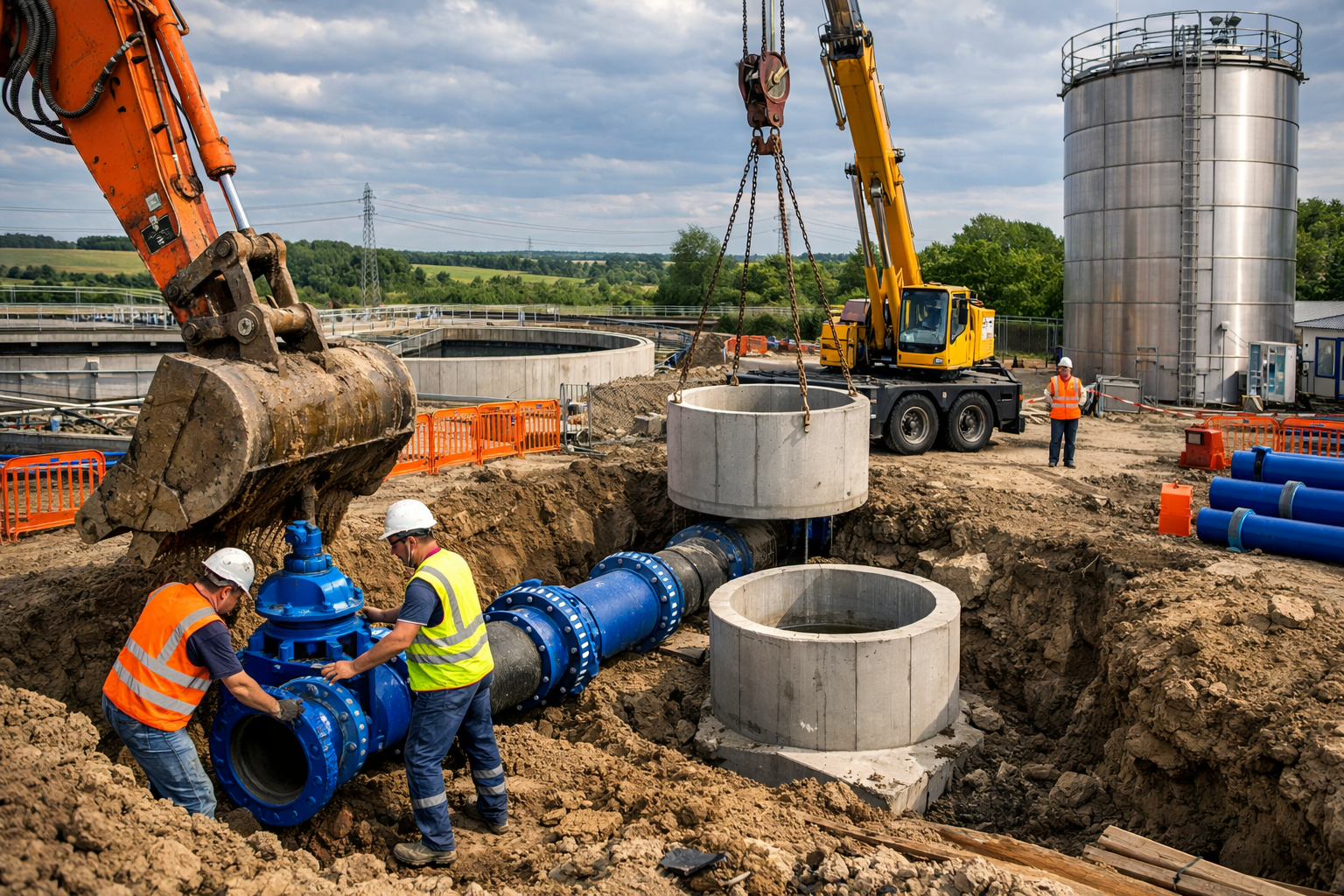
The project also includes major buried infrastructure. Portsmouth Water began the next phase of its pipeline programme in May, covering two large-diameter pipes with a combined route length of about 7km. Each pipe is around 1.7 metres in diameter and will form part of a system capable of moving roughly 40 million litres of water per day.
Most of the route is planned to be installed using microtunnelling rather than continuous open-cut excavation. The method is intended to reduce disruption where the alignment passes roads, developed areas, and other constraints, while still requiring shafts, tunnelling equipment, pipe-jacking operations, groundwater management, and careful control of settlement.
Pipeline construction is scheduled to continue to 2029, giving the programme several years in which reservoir earthworks and network connections will advance in parallel. Coordination between those packages is critical because the storage basin has little operational value until the transfer system can move water into and out of it at the required rate.
The national context has hardened while construction has progressed. Government data published on 4 September showed that 71.3% of England was in drought, more than 30 million people were subject to water-use restrictions, and national reservoir storage stood at 58% — 19.2% below the long-term average for the time of year.
Those conditions are immediate, but the infrastructure programme is being driven by a longer deficit. Without additional action, England is projected to face a public water-supply shortfall of five billion litres per day by 2055, equivalent to around a third of current public supply.
The government expects Havant Thicket, nine further planned reservoirs, and associated water-transfer schemes to add around 700 million litres per day by 2050. Demand management, leakage reduction, metering, recycling, and other new supply schemes will still be needed to cover the wider gap, leaving reservoir construction as one part of a much larger water-resilience programme.
That pipeline of projects is likely to test a construction market that has seen little recent domestic demand for strategic reservoirs. Havant Thicket requires bulk earthmoving, geotechnical control, large-diameter pipelines, tunnelling, concrete structures, monitoring, environmental mitigation, and long-term asset assurance, drawing together skills that are usually distributed across separate infrastructure sectors.
The delivery model is already being watched beyond Hampshire. Future Water brings together two civil-engineering contractors with specialist supply chain partners, while Portsmouth Water has been cited by the Institution of Civil Engineers as an example of the long-term collaboration that future infrastructure programmes will require.
Environmental and public-realm commitments add another layer to the construction scope. The completed reservoir is planned to include wetlands, a visitor centre, and a network of footpaths, cycle routes, and bridleways, so the finished site has to function as both regulated water infrastructure and a permanent landscape asset.
The work now visible on site is only part of a programme that runs through the end of the decade and beyond. Earthworks, embankment construction, tunnelling, pipeline installation, structures, testing, environmental works, and commissioning all have to converge before the reservoir can begin supporting regional supplies.
Havant Thicket has spent years as the often-cited exception to Britain’s long pause in reservoir building. With the embankment rising and pipeline works under way, it is now becoming the practical reference point for the reservoir programme expected to follow.