IN Brief:
- Amey Rail has been allocated the DLR Thamesmead early works package through Transport for London's Infrastructure Improvement Framework.
- Only Stage 1.1 is initially committed, covering mobilisation, programme review, risk assessment and the definition of subsequent works.
- The £41.8m notice value includes estimated future stages, with further commitments dependent on affordability, approvals and contractual conditions.
Amey Rail has been selected for early works on the proposed Docklands Light Railway extension from Gallions Reach to Beckton Riverside and Thamesmead, establishing the next stage of engineering development for a new railway crossing beneath the River Thames.
Docklands Light Railway Limited, part of Transport for London (TfL), has allocated the package under its Infrastructure Improvement Framework. The initial commitment covers mobilisation, programme review, risk assessment and the definition of surveys and subsequent early works, rather than construction of the complete extension.
The procurement identifies an estimated overall value of £41.8 million excluding VAT, incorporating potential expenditure across three delivery stages. Only Stage 1.1 is initially committed. Prices for Stage 1.2 and Stage 2 have not been agreed, and progression depends on further approvals, affordability and satisfaction of the relevant contractual conditions.
Under Stage 1.1, Amey will review the scheme programme and its underlying assumptions, examine risks and proposed mitigation measures, define potential early works and establish the scope of investigations needed to support subsequent decisions. These activities will provide a basis for assessing the practical requirements of construction before larger commitments are made.
The proposed Stage 1.2 would involve completion of agreed surveys and investigations, development of the Stage 2 scope, progressive cost estimating and further work on the programme and contractual arrangements. Stage 2 would then deliver defined early works, subject to the necessary authorisation.
Separating those activities allows the scope of physical work to develop alongside the engineering evidence. Ground conditions, existing utilities and the interfaces with operational railway infrastructure can influence construction methods, temporary works and the space required for machinery and materials.
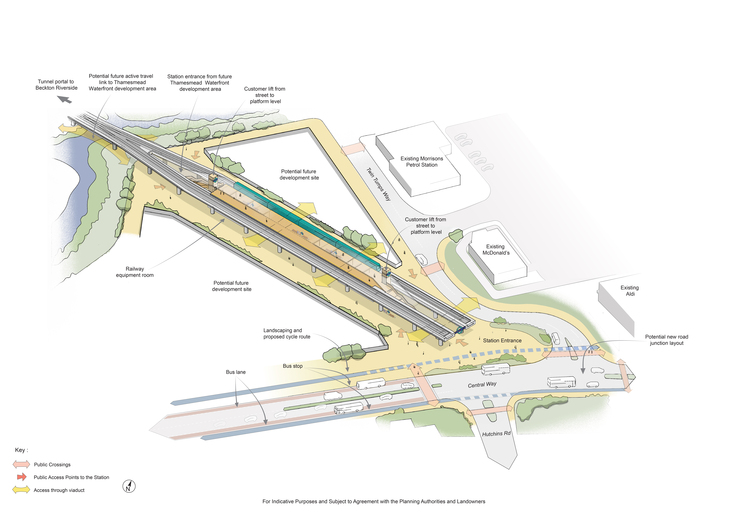
The proposed DLR extension would branch east of Gallions Reach, serving new stations at Beckton Riverside and Thamesmead. The crossing between the two areas is planned as a pair of bored railway tunnels beneath the Thames, with associated shafts, viaduct structures and connections to the existing railway.
At Beckton Riverside, the current construction concept includes a tunnel launch area where boring machinery could be assembled and operated. The tunnel boring machine would advance beneath the river towards Thamesmead, with excavated ground removed and precast tunnel lining segments installed as the drive progresses.
Transport for London’s design envisages a reception shaft on the Thamesmead side, where the machine would be recovered, turned and prepared for the second tunnel drive. The shaft would subsequently form part of the railway’s emergency access and evacuation arrangements.
Ground investigation is particularly important for a bored tunnel because the chosen excavation method must accommodate the soil and groundwater conditions along its route. Investigations also inform assessments of potential ground movement and its effect on buildings, foundations, buried services and other infrastructure.
TfL has already undertaken ground investigations involving planned exploratory holes at depths of up to 60 metres. The new early works appointment concerns the definition and potential delivery of further activities needed as the project develops, rather than the first investigation ever carried out along the route.
The proposed stations introduce separate construction requirements. Beckton Riverside would need to accommodate its station structure and railway approaches, while Thamesmead would require a station, tunnel reception infrastructure and connections with the surrounding streets and planned development areas.
Temporary construction compounds must provide space for machinery, workforce facilities, material deliveries and the handling of excavated ground. Their location and operation will affect the proposed traffic management arrangements, especially where construction vehicles would share existing roads with residents and businesses.
TfL has been assessing options for transporting construction materials and excavated soil by road, river or rail. Its environmental assessments consider the effect of vehicle movements, noise, vibration and working hours, with the eventual construction logistics strategy dependent on the final design and available transport arrangements.
Connecting a new branch to the existing DLR also creates requirements for track, traction power, signalling and communications. The operational railway must remain appropriately protected while connection works are undertaken, with testing and commissioning required before trains could use the new infrastructure.
The main civil engineering programme remains conditional on statutory approval. TfL intends to submit an application under the Transport and Works Act 1992 in early 2027, seeking powers to construct and operate the railway and obtain associated property rights where required.
The authority’s latest consultation attracted 553 responses, including 26 from stakeholder organisations. Issues raised included construction traffic, environmental impacts, station access and connections with the surrounding transport network. TfL is using the findings to develop its proposals before submitting the application.
The completed extension is intended to support regeneration at Beckton Riverside and Thamesmead, where improved public transport links could help enable up to 25,000 new homes. This housing figure describes the wider development potential associated with the transport project, not accommodation already authorised or under construction through Amey’s appointment.
Subject to the required permissions and a funding agreement, TfL’s current indicative programme could see main construction begin in 2029, with the extension opening in the early 2030s. Those dates remain dependent on decisions affecting the whole scheme.
Amey’s immediate responsibility is the initial engineering and programme definition work. Further surveys and physical early works can proceed only when their scope, commercial terms and authorisations have been agreed, with the final construction contract and wider railway investment remaining separate decisions.