IN Brief:
- SBS is delivering several Warm Homes: Social Housing Fund Wave 3 programmes.
- Current schemes span Coventry, Burton, Nottingham, Derby, and the Black Country.
- Measures include external insulation, solar PV, ventilation, windows, doors, and loft insulation.
Sustainable Building Services is expanding its delivery of Warm Homes: Social Housing Fund Wave 3 programmes across the Midlands, with thousands of occupied properties scheduled for energy-efficiency improvements by 2028.
The principal retrofit contractor is working with several housing providers on PAS 2030 and PAS 2035-compliant programmes incorporating solar photovoltaic systems, external-wall insulation, loft insulation, ventilation upgrades, replacement windows and doors, and hot-water cylinder improvements.
Its current portfolio follows delivery of Social Housing Decarbonisation Fund Wave 2 work across the region. In March, SBS completed an approximately £22m Wave 2.1 programme for Coventry-based housing provider Citizen, covering more than 1,000 occupied homes.
The installed measures are expected to save more than four million kWh of energy annually. Delivery also supported 53 full-time and part-time jobs within the local supply chain, and SBS is now working with Citizen on the next stage of its programme under Wave 3.
Tracy Troiolo, retrofit technical officer at Citizen, said: “People are at the heart of everything we do, so it’s hugely rewarding to see and hear about the differences that these energy efficiency measures are making to our customers.”
She added that Citizen intended to undertake further energy-efficiency work across the West Midlands through continued collaboration with its delivery partners.
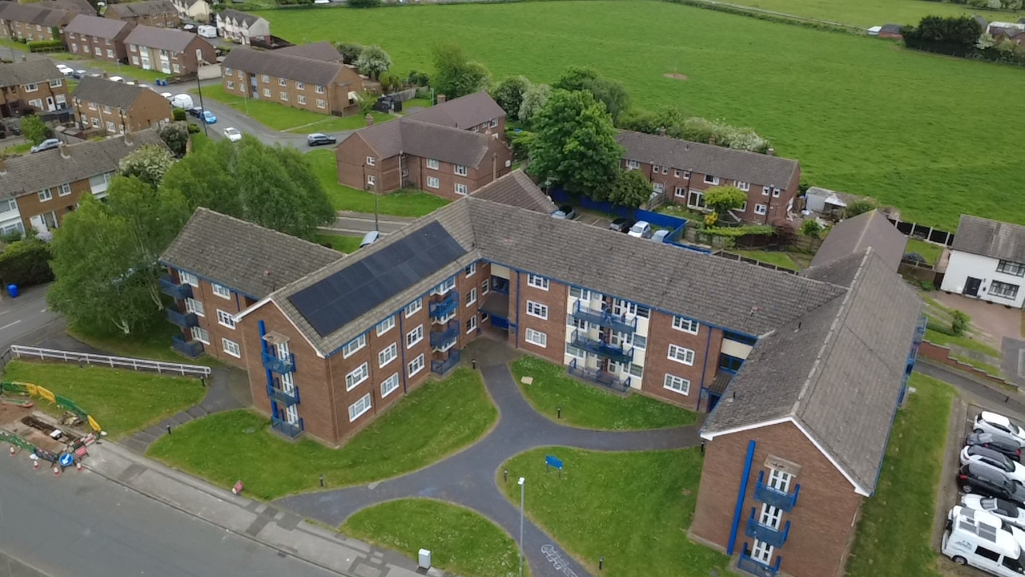
At Burton upon Trent, SBS has completed the first year of a Wave 3 programme for Trent & Dove Housing. Teams delivered work to 104 properties within two occupied three-storey blocks over 13 weeks, with the opening year carrying a projected cost of approximately £1.7m.
The project included rooftop solar arrays with electrical feeds running to ground-floor level. Routing the systems through occupied floors and ceilings created a fire-protection and access challenge, particularly where new cabling could have required disturbance of compartment walls or work inside individual flats.
By identifying redundant bin chutes as a central location for the inverters and associated distribution, the team avoided unnecessary penetrations through occupied areas. The proposal was agreed with the fire service and the client’s compliance team, allowing installation without breaching fire walls or requiring access to each home.
Steve Roberts, regional director at SBS, said: “The bin chute solution is just one example of what’s possible when the right people come together early and approach challenges with a practical mindset. It protected the integrity of the building’s fire safety design, minimised disruption to tenants and delivered a cleaner, more efficient installation overall.”
The contractor is now moving into the second year of the Trent & Dove programme, extending work to individual houses and bungalows.
SBS is also operating across more than 140 Nottingham Community Housing Association properties in the East Midlands. Two phases include external-wall insulation, solar PV, windows and doors, loft insulation, and ventilation upgrades.
A further programme for Metropolitan Thames Valley Housing covers approximately 140 homes across Nottingham and Derby, with current measures including solar generation, loft insulation, and ventilation. Contracts with Black Country Housing Group and PA Housing add further properties to the regional pipeline.
Working across several clients creates opportunities to standardise surveys, resident communication, procurement, installation, and quality control, although each stock profile still requires its own design. Wall construction, roof geometry, existing ventilation, electrical capacity, occupancy, condition, and earlier alterations can vary significantly within a single estate.
Occupied delivery places resident engagement directly on the programme’s critical path. Missed appointments, unresolved access, incomplete preparation, or poor communication can leave external and internal work out of sequence, increasing scaffold periods and requiring teams to return to individual properties.
Photovoltaic work on flats adds another layer because generation must be connected through a technically compliant and equitable distribution arrangement. New shared-solar systems, including equipment designed to allocate rooftop generation across multiple apartments, are widening the options available to multi-occupancy retrofit programmes.
Fire strategy remains fundamental wherever new cables, ducts, insulation, windows, or ventilation components cross existing compartment lines. The Trent & Dove bin-chute solution avoided unnecessary penetrations, although comparable routes will not exist in every block.
Contractors must coordinate retrofit design with current fire-risk information, intrusive surveys, cavity-barrier locations, asbestos records, and the maintenance requirements of both new and retained systems. Energy improvement cannot be allowed to introduce a new safety, condensation, or moisture defect.
Ventilation performance is particularly sensitive. Insulation, draught reduction, and replacement windows can lower uncontrolled air movement, increasing the need for correctly specified, installed, commissioned, and maintained ventilation.
Resident understanding of controls and maintenance forms part of the completed system. Filters, background ventilators, boost functions, heating controls, and solar equipment must remain accessible and understandable after contractors leave.
Large programmes also depend on predictable materials. A social-housing supply initiative using property-level forecasting and coordinated material packs reflects growing efforts to reduce aborted visits, surplus stock, and inconsistent product availability.
Wave 3 delivery will test whether the retrofit sector can convert substantial funding allocations into consistent work across occupied homes while maintaining design quality and resident trust. The volume of activity creates a stronger pipeline for specialist contractors, but it also places pressure on coordinators, assessors, designers, electricians, ventilation installers, insulation teams, and quality-assurance staff.
Roberts said the breadth of the Midlands portfolio reflected both the scale of social-housing decarbonisation plans and client confidence in the contractor’s delivery model. All current Wave 3 programmes are targeting completion by 2028.
Across the next two years, SBS and its housing-provider partners will need to maintain output across several live programmes without allowing standardisation to override building-specific risks. The Burton solution demonstrates the value of early technical coordination; repeating that discipline across thousands of occupied homes will determine the quality and durability of the wider programme.