IN Brief:
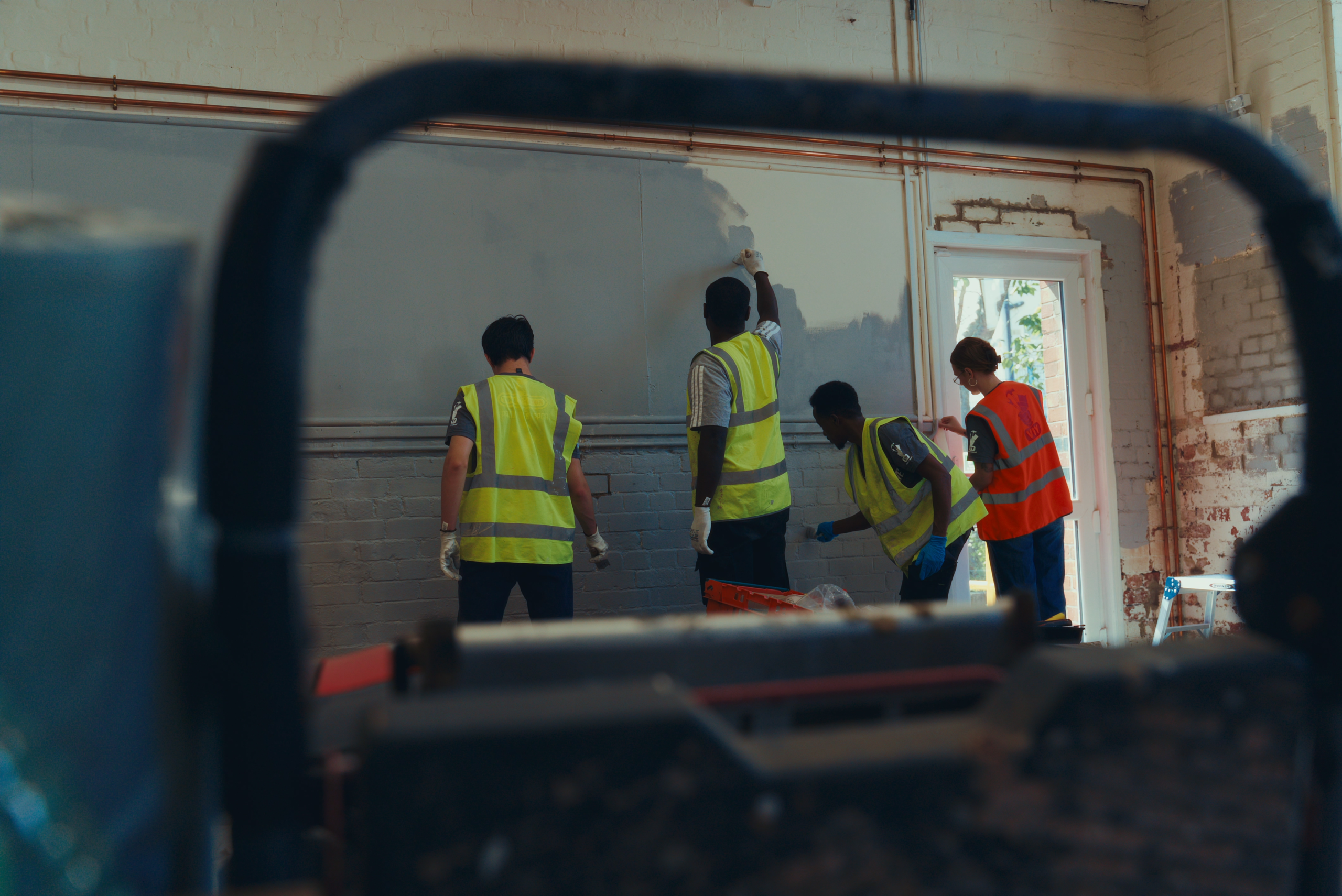
- Eleven VIY volunteers worked with Toolstation to refurbish Avonmouth Community Centre.
- Works included repointing, damp proofing, decorating, and improvements to external walls.
- Participants achieved 12 City & Guilds accreditations across two subjects.
Toolstation and Volunteer It Yourself have completed a refurbishment of Avonmouth Community Centre with a team of 11 young volunteers.
Combining improvements to the community building with practical trade experience and accredited training, the project brought VIY participants together with Toolstation volunteers and materials donated by the retailer.
Construction work included repointing, damp proofing, internal preparation and painting, and improvements to external walls. The programme was intended to create warmer, more energy-efficient, and more comfortable internal spaces while addressing visible deterioration within the building fabric.
Avonmouth Community Centre Association operates the facility as a local hub offering a library, outdoor and gardening areas, health and wellbeing classes, event space, community meals, and other activities.
A board of volunteers and trustees oversees the centre with a small paid team. As expectations around comfort, accessibility, condition, and energy performance increased, the building required a coordinated programme rather than a series of isolated repairs.
The 11 young people participated through VIY’s model of combining improvements to community facilities with trade and employability training. Twelve City & Guilds accreditations were awarded across health and safety and painting and decorating.
Chris Other, customer director at Toolstation, said: “We believe that supporting communities involves creating positive change where it’s needed most. Partnering with VIY means we can help improve living conditions and share valuable skills with the volunteers from the local area.”
He added: “We believe that this project will encourage young people to develop confidence and learn practical trade and building skills and to consider a career in the trade.”
Toolstation has supported VIY since 2020 and expects to work with the social enterprise on further community projects during 2026. The partnership connects donated materials and employee volunteering with supervised work that gives participants evidence of practical competence.
Ed Sellwood, chief operating officer and co-founder of VIY, said: “We’re proud of our long-term partnership with Toolstation, helping to inspire and diversify the next generation of tradespeople over the past five years, whilst helping to improve spaces that matter to communities where resources for improvements are scarce.”
The British Heart Foundation, Toolstation’s charity partner, has also agreed to provide CPR training sessions at the refurbished centre, extending the programme beyond the physical building work.
Community refurbishment occupies a difficult part of the construction market. Buildings are frequently heavily used but operate with limited capital budgets, allowing minor defects to remain unresolved until damp, decoration, thermal comfort, or external fabric require a coordinated intervention.
Although the scope is modest beside a major redevelopment, effective delivery still depends on diagnosis, safe sequencing, competent supervision, suitable materials, and a clear understanding of the tasks volunteers can undertake.
Damp treatment requires particular care because decorative improvement alone will not resolve an underlying moisture source. Repointing and external-wall repairs can reduce water penetration where mortar joints or local defects have deteriorated, while internal preparation determines whether new coatings remain serviceable.
Those measures must operate together if a visible improvement is to be matched by a durable change in building condition. Incorrectly applied impermeable finishes, unresolved leaks, or inadequate ventilation could otherwise allow moisture problems to return.
The programme also provides a route into construction for young people who may not initially pursue a conventional classroom-led pathway. Working on a live building introduces habits that are difficult to reproduce through isolated exercises, including protecting occupied areas, preparing surfaces, organising tools, maintaining housekeeping, and checking completed work.
Accreditation gives that experience more transferable value. Employers need evidence that new entrants understand basic safety and can complete work to an expected standard, while participants need a recognised step towards further training, apprenticeships, or employment.
Short, supported programmes can broaden the range of people exposed to the trades. They carry less initial commitment than a full apprenticeship and allow participants to establish whether they are suited to physical, practical, and team-based work.
Construction continues to face persistent shortages across skilled occupations, yet recruitment cannot be separated from the quality of early experience. Poorly supervised placements can discourage entrants, whereas structured work producing a visible community benefit can build confidence and provide a clearer view of the occupation.
Social-value requirements are also becoming more common within larger public and housing contracts, covering local employment, training, work experience, volunteering, and investment in community facilities. A Hartlepool refurbishment programme has similarly combined physical housing improvements with local employment and community commitments.
Rachel Haig, chief executive of Avonmouth Community Centre, said the improved space had already received positive feedback as groups returned. The centre has invited VIY and its partners to support further work.
The completed programme leaves Avonmouth with renewed community facilities while providing 11 young people with supervised experience of building maintenance. Toolstation and VIY now plan to repeat the model on additional projects during the remainder of the year.