IN Brief:
- Khosla Ventures led Monumental’s $32m Series B funding round.
- More than 150 robots have worked on housing, education, hotel, and infrastructure projects.
- Funding will support European growth, a larger UK operation, and US pilot schemes.
Monumental has raised $32m in Series B funding to expand its fleet of autonomous bricklaying robots across Europe, strengthen its UK operation, and begin pilot projects in the United States.
Khosla Ventures led the investment round, with existing backers Plural and Hummingbird also participating. The Amsterdam-based company plans to increase its engineering workforce, manufacture more machines, and develop additional construction capabilities beyond its current masonry operation.
Monumental now operates a fleet of more than 150 electrically powered robots. Its machines have worked on the walls of more than 100 homes, as well as a school, community centre, hotel, and sections of canal infrastructure in the Netherlands and UK.
Using sensors, computer vision, autonomous navigation, and compact lifting equipment, the robots move bricks and mortar before placing masonry in accordance with a digital model. A software platform called Atrium maintains a digital representation of the site and coordinates the movement and tasks of the fleet.
Rather than selling machines to contractors, Monumental operates as a specialist subcontractor and charges for the completed wall. It retains responsibility for ownership, transport, maintenance, software, operation, and the performance of the robotic system.
That model removes a substantial adoption barrier for main contractors and masonry businesses. They do not need to invest capital in unfamiliar equipment, recruit specialist robotics staff, or carry the risk that a purchased machine remains idle between suitable projects.
Monumental assumes those risks itself, with margins determined by robot utilisation, mobilisation cost, site productivity, maintenance, operator support, material consistency, and the difference between planned and actual output under live construction conditions.
The funding follows a broader increase in task-specific construction robotics. Automated drilling systems working from coordinated building models have already been deployed on a Frankfurt office scheme, while other manufacturers are testing robots for layout, surveying, lifting, inspection, and work from mobile elevated platforms.
Bricklaying remains a demanding application because sites are less controlled than manufacturing plants. Ground levels change, access routes become obstructed, materials arrive with tolerances, weather affects mortar and traction, and other trades continue working around the machine.
Productive deployment therefore depends on site preparation as much as robotic capability. Foundations and slabs must be within tolerance, bricks and mortar need to arrive predictably, work areas require sufficient clearance, and digital design information must be complete before laying begins.
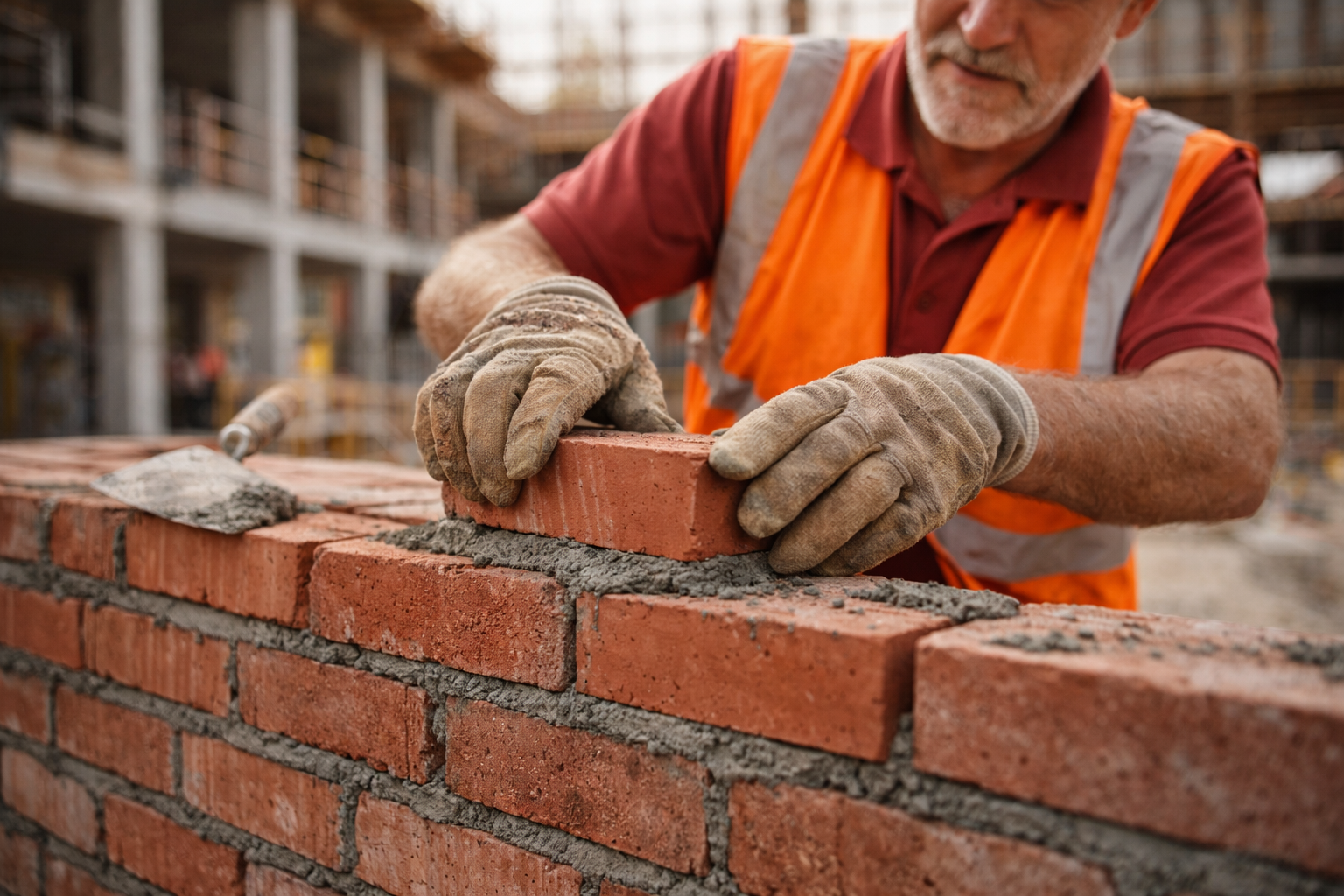
The system is unlikely to remove every manual activity. Corners, openings, ties, insulation, cavity trays, lintels, interfaces, temporary protection, snagging, and unusual details may still require skilled workers, while operatives remain necessary to supervise the work, manage materials, and resolve exceptions.
Overall productivity will be determined by the combined team rather than the headline speed of an isolated robot. A machine that places bricks rapidly but waits for materials, access, design clarification, or inspection may produce little improvement across the wider programme.
Persistent labour shortages nevertheless give contractors a strong incentive to examine alternative delivery methods. UK housing ambitions require tens of thousands of additional bricklayers, while apprenticeship completions remain well below the projected demand.
Robotics can add capacity by taking on repetitive physical work and allowing experienced tradespeople to concentrate on setting out, quality, interfaces, and complex details. It can also create roles in maintenance, site planning, digital coordination, fleet support, and robotic supervision.
The outcome-priced subcontract model should make performance comparatively transparent. Contractors can assess the cost, programme, quality, and reliability of completed robotic masonry against conventional delivery without calculating the ownership cost of the underlying technology.
Expansion into the United States will expose the system to different brick dimensions, building codes, labour structures, contracting models, climate conditions, and housebuilding methods. Growth within Britain will present a separate challenge, requiring local support capacity and enough simultaneous projects to keep a larger fleet productively deployed.
Manufacturing more robots will not automatically create a scalable construction business. Fleet logistics, servicing, spare parts, remote support, operator training, insurance, commercial estimating, and project selection must all expand at the same pace as machine numbers.
Site selection will remain particularly important during the next stage. Repetitive elevations, clear access, reliable material supply, and mature digital information offer stronger conditions than highly irregular projects with restricted workfaces and frequent design change.
Monumental has moved beyond a single prototype, but scaling from demonstrations into routine subcontracting will test manufacturing, maintenance, commercial control, and deployment planning as heavily as the robotics. The new capital provides additional engineering and fleet capacity; sustained adoption will depend on predictable finished walls under ordinary site conditions.