IN Brief:
- Pick Everard has overseen delivery of Nottingham’s new Waterside Bridge over the River Trent.
- The 87-metre, 160-tonne structure links Victoria Embankment and Colwick Park for walking and cycling.
- The bridge supports future homes, public realm, leisure, and commercial development in the Waterside Regeneration Zone.
Pick Everard has overseen delivery of Nottingham’s new Waterside Bridge, unlocking core infrastructure for future development within the city’s 250-acre Waterside Regeneration Zone.
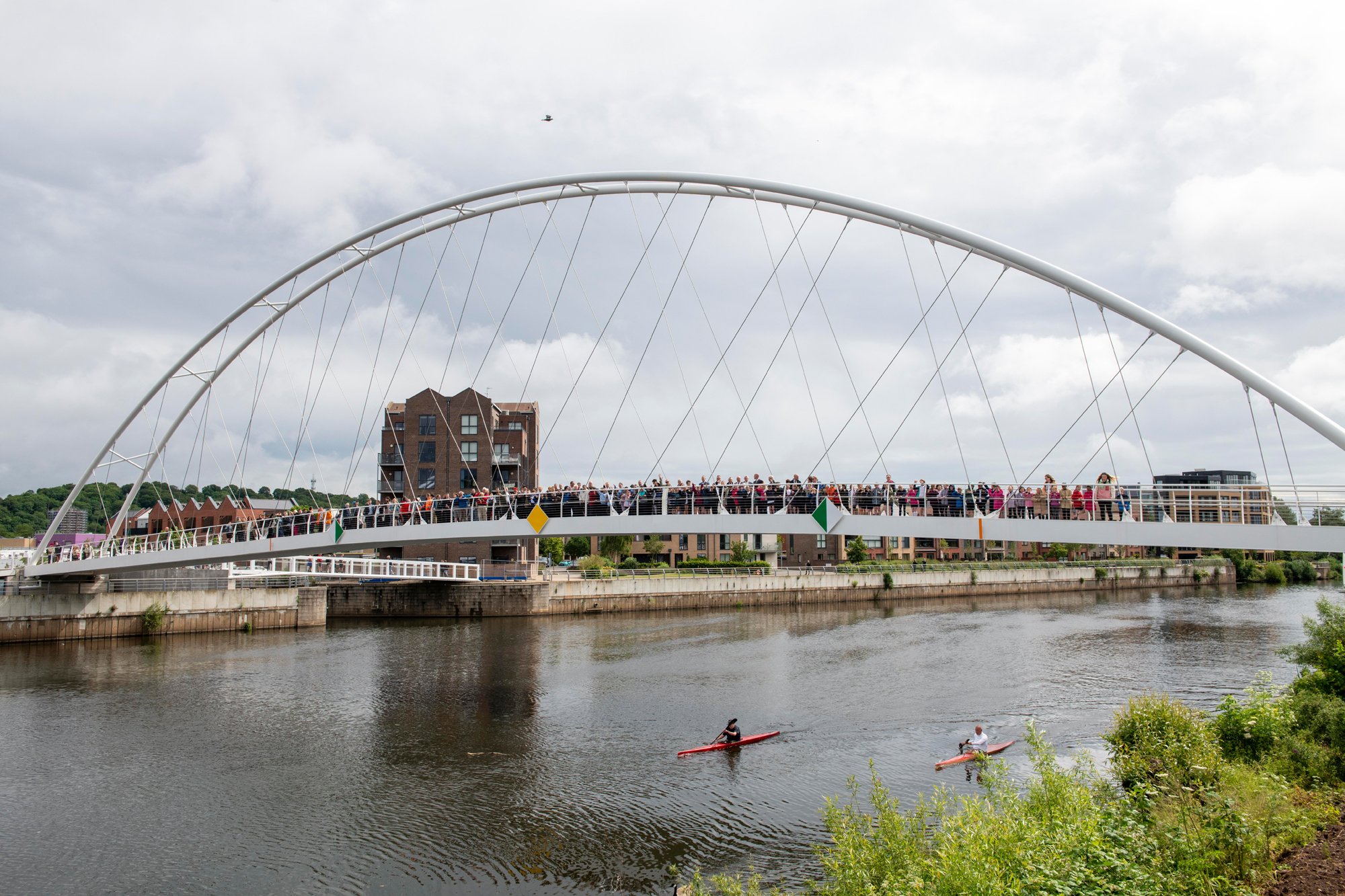
The walking and cycling bridge spans the River Trent, linking Victoria Embankment and Colwick Park. It improves connections between communities on both sides of the river and creates safer access to homes, employment areas, leisure destinations, and major sports venues including Nottingham Forest’s City Ground, Notts County’s Meadow Lane, and Trent Bridge Cricket Ground.
The 87-metre, 160-tonne bridge was fabricated using British steel by Britons Ltd in Hucknall. It is the first new bridge to be built over the River Trent in Nottingham since the 1950s.
Pick Everard was appointed to provide project management, cost management, and health and safety services. The consultancy worked under Perfect Circle and was appointed through the SCAPE Consultancy framework.
The project was delivered with Nottingham City Council, main contractor Balfour Beatty, and partners including Ramboll, Britons, the Canal and River Trust, the Environment Agency, Pedals, Blueprint, Geldards, Active Travel England, and the Department for Transport. The bridge was the final project in Nottingham City Council’s £160m Transforming Cities Fund programme, which was set up to improve sustainable travel and city connectivity.
Waterside Bridge is intended to open up former industrial land for future development, including homes, retail areas, public spaces, leisure uses, and commercial opportunities. It connects emerging waterfront neighbourhoods on the north side of the river to the south, creating a more coherent active-travel route through the regeneration area.
Although the main span is the most visible part of the project, the surrounding connections will determine how well it functions. Ramps, steps, walkways, public realm, access points, and the smaller Basin Bridge linking the landing with Trent Basin all help turn the structure into everyday infrastructure rather than a standalone landmark.
Former industrial zones rarely move straight into residential, commercial, or leisure development. They first need access, utilities, flood-risk management, public realm, remediation, transport integration, planning confidence, and stakeholder alignment. In that context, a bridge can carry development value well beyond its physical span.
The Waterside Regeneration Zone depends on converting disconnected riverside land into plots with clear access, visible public routes, and confidence for private and public investment. Without that enabling infrastructure, developers face higher risk, while communities see fewer immediate benefits from long-term regeneration plans.
Active travel has also become a more practical requirement within urban development. Walking and cycling routes are now tied to planning policy, public health, carbon reduction, congestion management, and place-making. For a riverside regeneration area, safe links to parks, schools, leisure, employment, public transport, and sports venues can influence both the appeal of future schemes and the quality of the completed neighbourhood.
The delivery structure shows the complexity behind even apparently straightforward city infrastructure. A public client, framework procurement, consultancy support, a major contractor, local fabrication, statutory bodies, transport organisations, campaign groups, and national funding all had to align around design, cost, programme, risk, and public access.
Framework procurement has become a regular route for public-sector clients seeking speed, assurance, and pre-established access to consultants and contractors. Its value depends on whether it can maintain quality, cost control, transparency, and local supply-chain benefit while reducing procurement time. On a project with public visibility and multiple stakeholder interfaces, project management and cost management are as important as the construction sequence itself.
The use of British steel fabricated in Hucknall adds a local supply-chain dimension to the project. Regional fabrication can support skilled employment, reduce some logistics complexity, and strengthen the link between public investment and local economic activity. That connection is especially relevant where infrastructure is intended to enable regeneration rather than simply solve a movement problem.
Nottingham’s bridge project also sits within a wider pattern of enabling works preparing former industrial and infrastructure land for new uses. Large sites often require years of clearance, access, remediation, and infrastructure planning before new development becomes deliverable, as seen in the redevelopment work surrounding Ratcliffe power station.
Waterside Bridge gives Nottingham a new crossing and a stronger platform for development along the Trent. Its long-term value will depend on the next phases of land assembly, housing, public realm, commercial investment, and local services. The crossing is complete; the regeneration test now moves to the land it has helped unlock.