IN Brief:
- A 16.4m-diameter Herrenknecht machine will excavate both Lower Thames Crossing road tunnels.
- The 5,000-tonne TBM will operate as deep as 60m beneath the Thames.
- Components will arrive through Tilbury before assembly and tunnelling begin in 2028.
National Highways has selected a 16.4m-diameter tunnel-boring machine to excavate the twin road tunnels at the centre of the Lower Thames Crossing programme.
Built by Herrenknecht, the variable-density machine will be the largest TBM used in Europe and the third largest manufactured globally. At approximately 120m long and weighing more than 5,000 tonnes, it will be operated by the Bouygues Travaux Publics–Murphy joint venture to drive two parallel 2.6-mile tunnels beneath the River Thames.
Rather than deploying separate machines for the northbound and southbound bores, the project team intends to use the same TBM for both drives. Once the first tunnel is complete, the machine will be turned, inspected, prepared, and relaunched in the opposite direction.
Although that approach reduces the number of machines requiring manufacture, transport, assembly, and eventual removal, it places considerable weight on the reliability of a single unit. The first drive, turnaround, maintenance programme, and second launch will form one connected sequence, with limited scope to recover lost time through parallel excavation.
Because the route passes through changing chalk and clay conditions beneath the estuary, the machine must be capable of adjusting excavation pressure and spoil handling as the geology changes. Tunnelling will reach depths of up to 60m below the Thames, where the cutting head, face-support system, conveyors or slurry treatment equipment, and segment installation systems must operate continuously under substantial groundwater pressure.
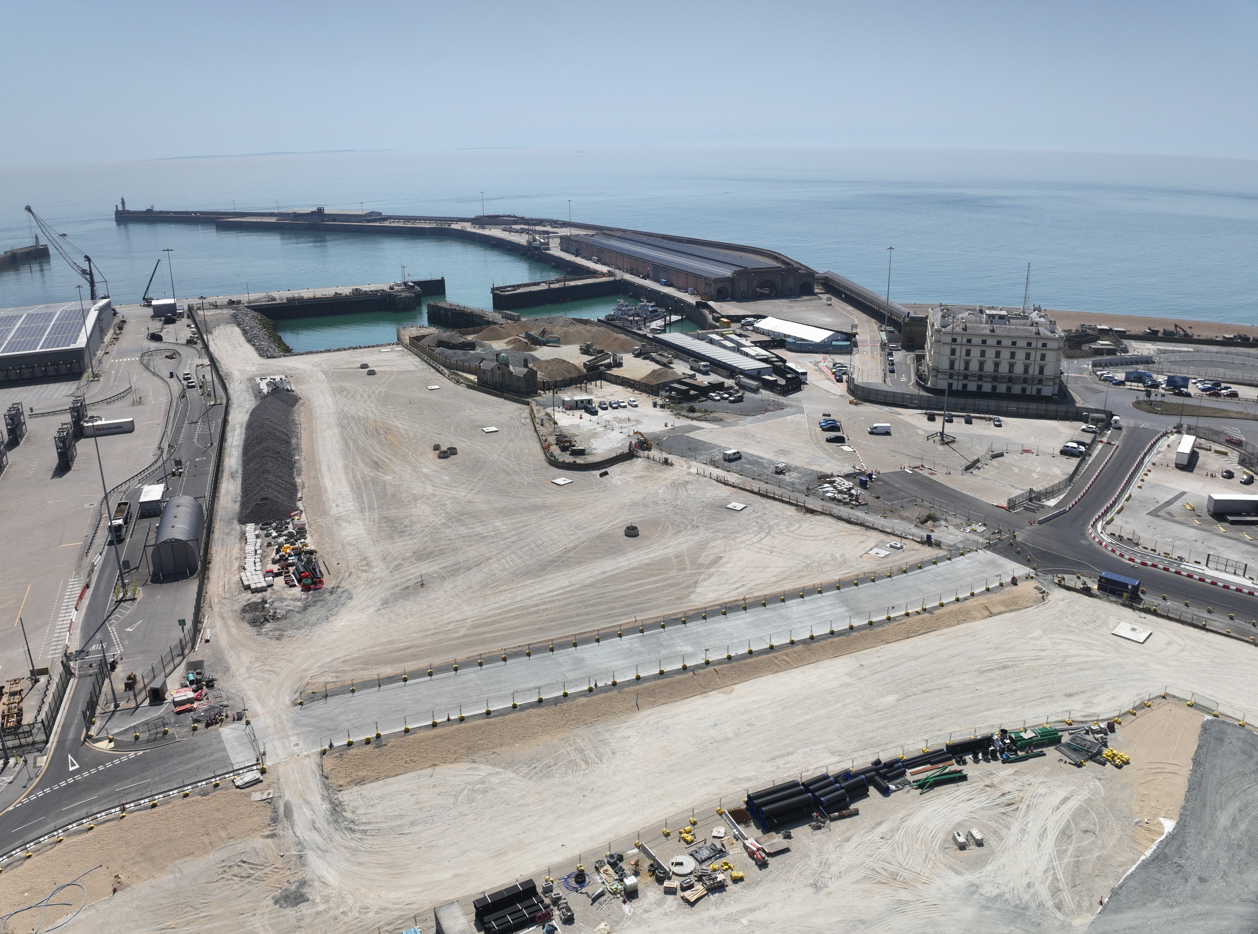
Once manufacturing is complete, Herrenknecht will dismantle the machine into transportable sections and ship them to the Port of Tilbury. From there, the components will move to the construction site for assembly, testing, and commissioning, avoiding exceptionally large road movements while making use of the marine logistics infrastructure surrounding the Thames estuary.
Before the TBM arrives, the launch site must be ready to support a tunnelling operation expected to continue for several years. Excavation chambers, power supplies, ventilation, spoil treatment, water management, segment storage, maintenance facilities, emergency systems, and internal logistics all need to be coordinated around the machine’s operating sequence.
While the TBM will run on renewable electricity, lower-carbon concrete is also planned for the precast tunnel lining segments. Those measures sit within a wider construction programme involving substantial earthworks, structures, drainage, highways, utilities, and materials movements across the 14.3-mile route.
Main construction began earlier in 2026 following years of planning, consenting, procurement, and design development. Around 80% of the new road will run through tunnels, cuttings, or behind landscaped embankments, reducing its long-term visual presence while increasing the quantity of excavation, retaining structures, drainage, and ground engineering required during delivery.
By committing to a machine of this scale, the project has fixed one of its most technically consequential procurement decisions. Large-diameter TBMs are designed around specific geology, tunnel geometry, lining configuration, operating pressure, spoil characteristics, available power, and the physical constraints of the launch and reception sites.
Late changes to any of those assumptions can carry a high cost once manufacture is under way. Cutting-head design, bearing capacity, screw conveyors, slurry circuits, segment erectors, trailing gear, and control systems are integrated around a defined ground model and production strategy rather than assembled as interchangeable components.
Since one machine will complete both drives, wear rates and maintenance planning will influence more than the first tunnel. Cutter tools, seals, bearings, pumps, conveyors, and electrical systems will need to remain serviceable through the initial excavation, turnaround, and second bore, with planned interventions balanced against the programme.
The same sequencing places pressure on the precast lining supply chain. Rings must reach the machine in the correct order and at a rate matched to excavation, while storage capacity must absorb changes in production speed without creating excessive handling or congestion at the launch site.
Quality failures in individual segments can halt installation even when the main excavation equipment remains operational. Dimensional control, concrete performance, reinforcement placement, gasket installation, curing, transport, and inspection will therefore have a direct influence on daily tunnelling output.
Although the cutting head will dominate the machine’s public profile, continuous excavation depends on a much broader production system. Spoil removal, temporary transport, power distribution, surveying, monitoring, ventilation, water treatment, maintenance access, and emergency provision must all function reliably if the TBM is to advance at its planned rate.
As a strategic road connection between Kent and Essex, the crossing is intended to relieve pressure on the Dartford Crossing and support freight routes serving ports, distribution hubs, and industrial sites around the Thames. Tunnelling performance will influence the later installation of road systems, testing, commissioning, and integration with the approach highways on both sides of the river.
With opening still planned for the early-to-mid 2030s, the machine order begins a visible countdown towards excavation in 2028. Before then, the project team must convert an exceptionally large piece of equipment into a controlled production system capable of maintaining ground stability, lining quality, safety, and programme certainty beneath a live estuary.