IN Brief:
- Imperial has revealed emerging designs for a 30-storey replacement St Mary’s Hospital in Paddington.
- The proposed hospital would provide more than 800 beds, major trauma care, teaching, and research space.
- The scheme will require complex live-site delivery on one of London’s most constrained healthcare estates.
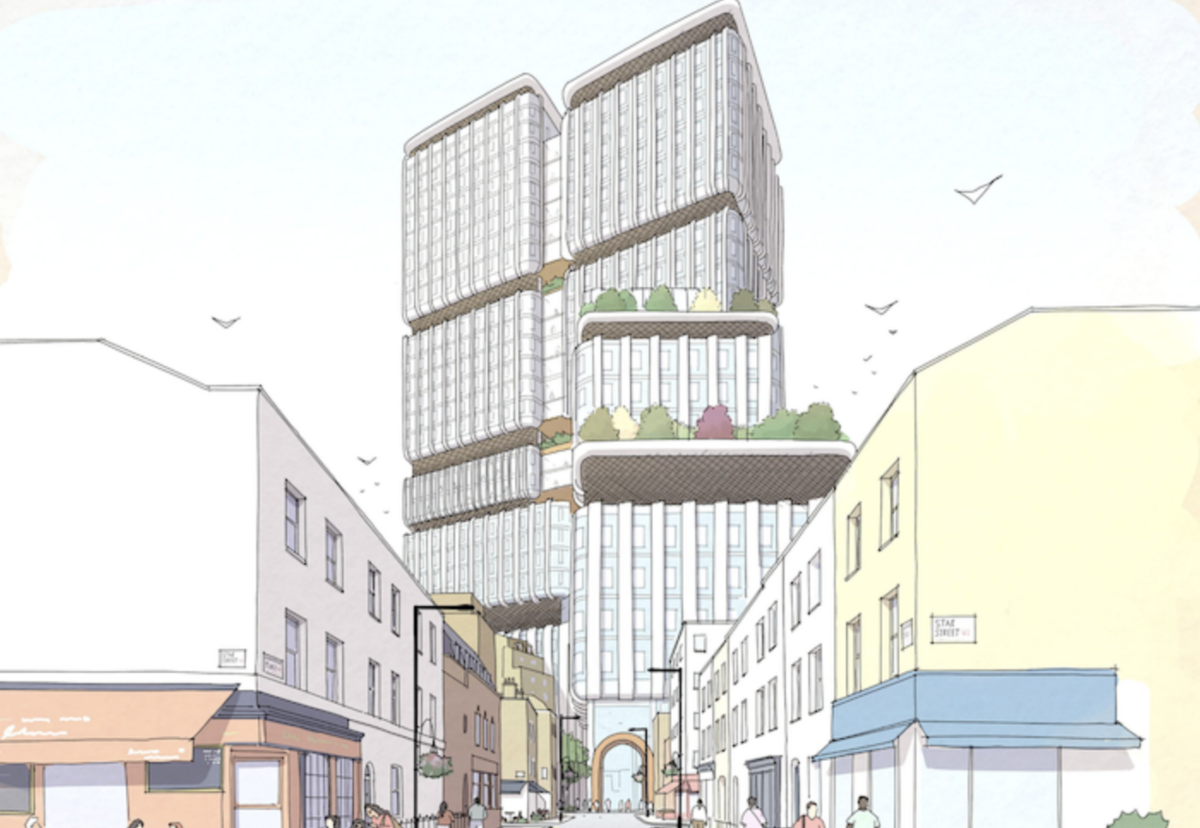
Imperial College Healthcare NHS Trust has advanced emerging designs for a 30-storey replacement St Mary’s Hospital in Paddington, setting out a major vertical hospital scheme intended to replace ageing estate infrastructure on the west London site.
The proposed hospital would provide more than 800 beds, major trauma and acute care services, teaching facilities, research space, and a rooftop helipad. It would bring services currently spread across several buildings into a single high-rise facility on South Wharf Road, while releasing parts of the wider estate for public realm, regeneration, and life sciences development.
Rising to around 156m above ground level, the building would become one of the tallest hospital schemes in the UK. The trust is targeting a planning application in spring 2027, with construction potentially starting around 2030 and completion by 2035 if approvals and funding are secured.
St Mary’s is one of the oldest major acute hospital sites in the NHS estate, with parts of the Paddington campus dating back to the 19th century. Maintenance pressures have increased sharply in recent years, while the discovery of reinforced autoclaved aerated concrete has added urgency to the case for redevelopment.
Delivering a hospital of this scale on a live city-centre site will place heavy demands on design coordination, enabling works, construction logistics, and clinical continuity. The existing hospital will need to remain operational while major works proceed around it, requiring careful phasing around emergency care, ambulance access, staff movement, patient routes, utilities, and existing neighbouring buildings.
A high-rise acute hospital also carries a different technical burden from a conventional low-rise campus. Clinical adjacencies, lift strategy, evacuation planning, plant distribution, riser space, resilient power, ventilation, digital systems, medical gases, and maintenance access all become central to the building’s long-term performance. The design will need to accommodate specialist services while remaining adaptable to future models of care.
The plan also sits within a broader shift in UK healthcare construction, where large NHS estates are being asked to deliver more capacity, better energy performance, and greater operational resilience without the benefit of simple greenfield sites. Urban hospital rebuilding is increasingly a question of working vertically, consolidating functions, and sequencing construction around assets that cannot be taken offline.
St Mary’s wider masterplan also supports Paddington’s growing life sciences cluster, with the trust seeking to combine clinical care, research, education, and commercial innovation around the hospital estate. That creates opportunities for stronger collaboration between healthcare and research institutions, but it also adds complexity around public access, servicing, security, and long-term estate management.
The next stage of planning work will determine how the scheme balances clinical requirements with the surrounding urban fabric. If the programme moves forward on the proposed timetable, St Mary’s will become a test case for how major NHS hospital renewal can be delivered in dense, high-value, infrastructure-constrained parts of London.