IN Brief:
- MRP has confirmed practical completion of Broadway Studios, a 432-bed student development in central Glasgow.
- McAleer & Rushe delivered the project, with development finance provided by Puma Property Finance.
- The building has an EPC A rating and is targeting BREEAM Excellent, with MRP reporting performance above Glasgow's energy efficiency requirements.
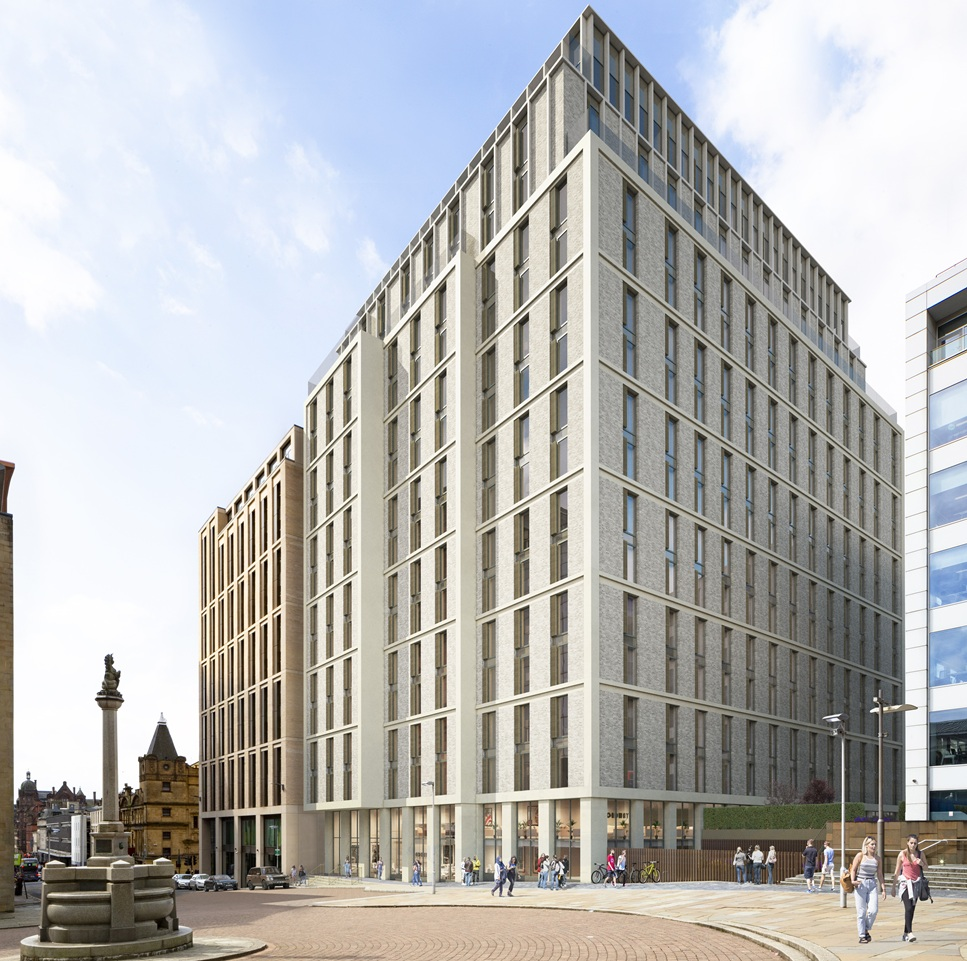
MRP has confirmed practical completion of Broadway Studios, a 432-bed student accommodation development in Glasgow city centre, following the main construction programme on the former brownfield site.
The MRP scheme was built by McAleer & Rushe Contracts, with development finance provided by Puma Property Finance. Located on Renfield Street, the 16-storey building completes the redevelopment of a city block that also includes the Maldron Hotel.
The development has already welcomed students, with occupation beginning in September 2026. The latest announcement confirms the practical completion milestone rather than the first opening of the accommodation.
Practical completion is a contractual stage indicating that the works have reached the required condition for handover, subject to the terms of the relevant construction agreement. It does not necessarily mean that every minor outstanding item has been resolved or that all post-completion obligations have ended.
The November confirmation follows a topping-out milestone earlier in 2026, when the structure reached its full height. Between those stages, the project progressed through building enclosure, internal accommodation works, building services installation, finishing, and the activities required to prepare the building for operation.
Broadway Studios contains 432 studio apartments supported by communal facilities. These include a gym, fitness and leisure spaces, cinema lounge, games area, dining facilities, and a roof terrace, together with other spaces intended for use by residents.
The accommodation has been developed in accordance with Glasgow City Council’s revised spatial standards for purpose-built student accommodation. MRP describes the project as the first student development in the city to align fully with those requirements.
The standards influence the design of accommodation and supporting facilities, making internal space planning a significant part of the development process. The relationship between individual studios, communal amenities, access, and circulation areas affects both the building layout and the construction work needed to deliver it.
A 432-bed development also requires extensive coordination of repeated building services installations. Each accommodation unit must be connected to the appropriate electrical, water, drainage, ventilation, and other systems, while shared facilities introduce different operating requirements from the individual studios.
Vertical service distribution is particularly important in a building of this height. Risers and associated routes must accommodate services between floors, with connections into individual accommodation units arranged around the structural layout and the space available for installation.
Repeated room designs can support consistent installation methods and inspection procedures, but the final construction quality still depends on the accuracy of individual installations and their compatibility with adjoining elements.
Variations in structural geometry, service routing, and accommodation layout may require different details even where rooms have similar intended functions. Testing and inspection must therefore establish that the completed arrangements meet the applicable requirements rather than assuming uniformity across the building.
The development also incorporates measures intended to improve environmental performance. MRP reports that Broadway Studios exceeds Glasgow City Council’s energy efficiency requirements by 20%, meets the relevant Gold Level standard, and exceeds the city’s 20% renewable energy target.
The building has an EPC A rating and is targeting BREEAM Excellent certification. These are different forms of assessment and should not be treated as interchangeable measures of operational performance.
An energy performance certificate provides a rating based on an approved assessment methodology. BREEAM considers a wider range of building characteristics and management requirements, with certification dependent on the relevant evidence being assessed against the scheme’s criteria.
The EPC A rating has been reported as achieved, while BREEAM Excellent remains a target. Neither establishes the amount of energy that residents will consume once the building is operating under normal occupancy conditions.
Air-source heat pumps form part of the building’s energy strategy, alongside high-performance construction materials. Heat pumps transfer energy from the outside air into a building’s heating system, using electrical input to operate the refrigeration cycle.
Their efficiency varies with external temperature, the required heating output temperature, and the operating characteristics of the connected equipment. The final performance of the installed system therefore depends on the building’s heating demand and the conditions under which the equipment operates.
The building envelope affects that demand. Insulation, glazing, airtightness, and the treatment of thermal bridges influence heat loss, while ventilation requirements and internal heat gains affect the amount of heating and cooling required.
The project has been designed to bring these elements together within the stated energy performance strategy. No measured annual energy consumption or independently verified operational carbon reduction has been disclosed in the practical completion information.
The scheme was financed through a £58m development facility provided by Puma Property Finance. That figure describes the financing arrangement and should not be presented as the confirmed construction contract value or total project expenditure.
MRP developed Broadway Studios alongside the wider McAleer & Rushe group, with Prestige Student Living responsible for managing the accommodation following completion.
The construction site occupies a central Glasgow location within an established urban block. Building a 16-storey development in that environment requires coordination of access, deliveries, lifting operations, and construction activity around surrounding streets and properties.
The published project information does not provide a detailed account of the structural construction method or the temporary works arrangements. Those elements should not be inferred from the completed building’s height or the contractor’s wider project experience.
With residents already using the accommodation, the development has moved beyond the principal construction phase. Building operation will now provide the conditions under which the installed systems, maintenance arrangements, and communal facilities can be assessed over time.
Broadway Studios completes a substantial brownfield redevelopment in central Glasgow and provides a built example of accommodation designed around the city’s updated student housing standards.
The outstanding environmental milestone is the targeted BREEAM Excellent certification. Its achievement, alongside subsequent operating data, will provide further evidence of how the completed building performs beyond the assessments and specifications reported at handover.