IN Brief:
- Main demolition of the A167 Gateshead flyover is now under way.
- The structure is being removed in stages using mechanical demolition, not explosives.
- The job reflects the growing workload around ageing UK transport assets in dense urban settings.
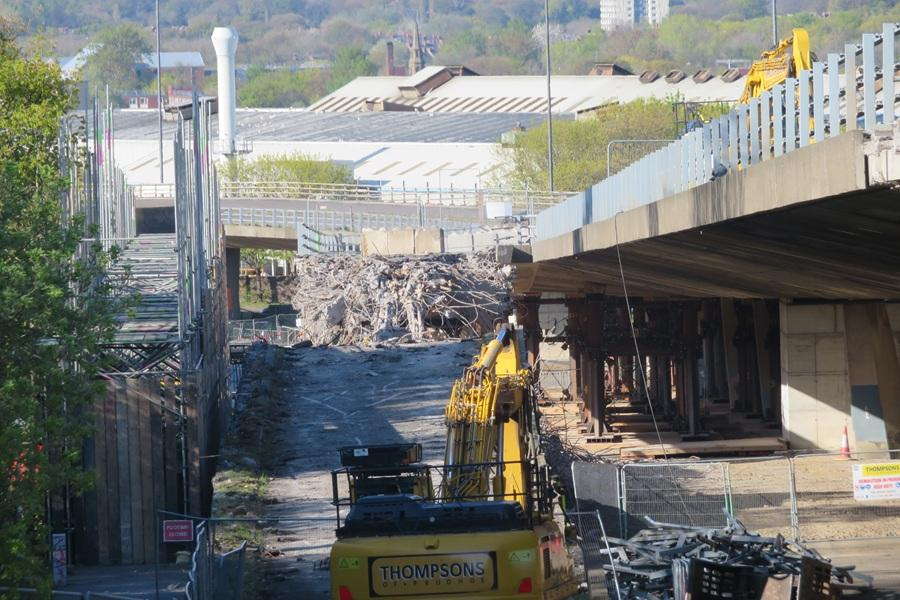
Gateshead Council has moved into the main demolition phase of the A167 Gateshead Highway flyover, with BAM leading the work alongside demolition specialist Thompsons of Prudhoe on a programme expected to run for around six months.
The first sections to be removed are the central on and off ramps, with the structure being dismantled in the reverse order to how it was built. The flyover is being taken down progressively using mechanical demolition methods rather than explosives, reflecting the complexity of the site and the need to maintain close control over the sequence of removal.
The structure sits within a tightly constrained urban corridor, with surrounding roads, adjacent commercial premises, nearby homes, and Tyne and Wear Metro infrastructure all shaping the demolition strategy. Protective works, access controls, temporary supports, and carefully managed working zones have all formed part of the preparation for the main phase.
The flyover has been closed since December 2024 after concerns over its condition. The closure brought an abrupt end to the working life of a structure that had carried traffic into central Tyneside for decades, and the decision to remove it rather than repair it points to the increasingly difficult choices facing local authorities managing older transport assets under pressure from cost, condition, and changing urban priorities.
For the project team, the demolition is as much about engineering control and sequencing as it is about heavy breaking-out. The order in which sections are removed is critical to structural behaviour, load redistribution, and public safety, particularly where the work sits above or alongside live transport routes and sensitive infrastructure. In urban bridge and flyover removal, the visible stage of demolition is only one part of the job; the rest lies in temporary works, structural assessment, access planning, and risk management.
That pattern is becoming more common across the UK. A generation of post-war road structures is reaching the point where patch repairs and short-term interventions no longer offer a convincing route forward. Some assets can be strengthened and retained, but others are moving into a different category altogether, where removal, replacement, or wider network redesign become the more practical long-term option.
Contractors operating in this space are increasingly dealing with schemes that blur the line between demolition, civils, and urban redevelopment. Removing an elevated road in a built-up area is not simply a clearance exercise. It is often the first step in a broader reshaping of land use, traffic circulation, and future development potential. Once the structure is gone, the site becomes part of a wider conversation about what a town or city centre is for, and how land once dominated by highway engineering can be reused.
In Gateshead, that wider context is already present. The demolition opens up land and visual space at a gateway location, while also drawing attention to the long-term future of urban transport corridors first designed around traffic flow rather than regeneration or mixed-use development. The removal of the flyover is therefore both a stand-alone infrastructure job and the beginning of a different phase of urban change.
For now, the immediate focus remains on safe delivery through a technically constrained programme. The next six months will test the project team’s control over sequencing, logistics, and traffic interface management. Once the structure has gone, the significance of the job will extend well beyond demolition itself.