IN Brief:
- Two Liverpool residential schemes worth a combined £70m are heading to market.
- The projects would add 258 homes plus commercial and shared amenity space.
- Davos is advancing activity in a part of the city still attracting dense urban residential investment.
Davos Property Developments, the property arm of TJ Morris, is moving two Liverpool residential projects toward contractor selection after securing planning approval for schemes in the city’s Baltic Triangle worth a combined £70m. The developments, at Greenland Street and Blundell Street, would deliver 258 homes and continue a run of mid- and high-density residential activity across the district.
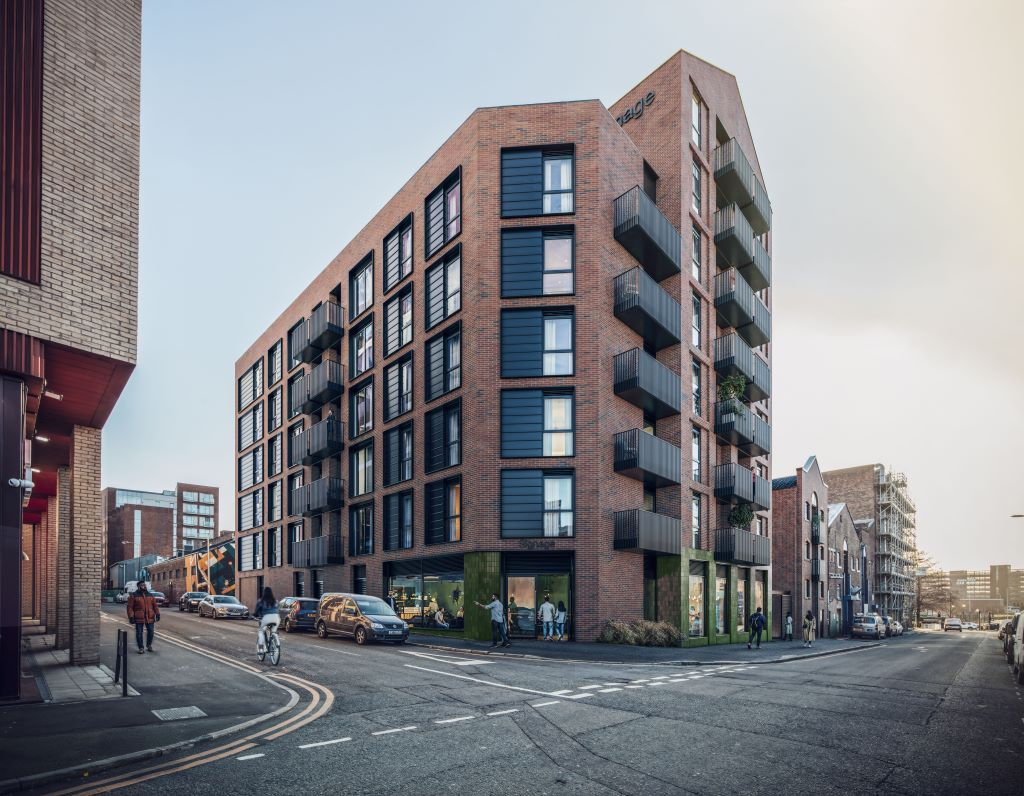
The larger of the two schemes is the £57m Greenland Street development, designed by Falconer Chester Hall’s Liverpool studio. It rises to 13 storeys and includes 199 homes made up of one-bed, two-bed, and townhouse formats, alongside commercial units, a gym, and co-working space. The second scheme, a £13m project at Blundell Street, would provide 59 apartments and three ground-floor commercial units, with the massing stepping between five and seven storeys before tying into a neighbouring warehouse that is due to be converted into new homes. A bridge would connect the new-build element to the converted structure.
The next phase for both schemes is procurement, which is increasingly where city-centre residential projects are tested most severely. Planning permission remains an important milestone, but rising build costs, higher finance costs, and more selective contracting conditions have made the route from consent to site start more demanding than in previous cycles. Projects with viable planning positions can still stall if the commercial balance no longer holds once contractors are priced in.
The Baltic Triangle remains one of the places where developers continue to push ahead. The area has shifted steadily toward a mixed urban model combining apartments, commercial uses, workspace, and reuse of older structures, and that formula continues to attract interest where schemes can be made to work. Greenland Street’s combination of homes, amenity space, and active ground-floor use reflects that pattern, while the Blundell Street proposal points to a continued appetite for integrating new-build residential space with retained industrial fabric.
Across regional cities, the strongest residential schemes are tending to share similar characteristics. They are located in established urban quarters rather than marginal sites, make room for non-residential uses at ground level, and aim to support neighbourhood activity beyond simple occupation numbers. The commercial case has become tighter, but investors and developers are still backing projects that can demonstrate a more durable mixed-use setting.
That has implications for procurement strategy as well as design. Contractors are being asked to price city-centre schemes with more complex interfaces, more detailed amenity requirements, and more constrained sites, all while managing tighter margin expectations and heightened scrutiny over programme certainty. Developments that proceed are likely to be the ones where design ambition and commercial discipline remain in balance as procurement progresses.
Davos now has two approved schemes moving into that test. If both advance smoothly, they will add to the sense that well-located regional city residential work can still find a delivery route in a difficult market. If they slow, the reasons will be familiar across the sector. Either way, the projects provide a sharp measure of how much confidence remains in urban residential delivery outside London where regeneration continues to be driven plot by plot.