IN Brief:
- Faresin Industries has signed a strategic agreement with Bergerat Monnoyeur in France.
- The deal expands access to Faresin telehandlers for construction, industrial, and agricultural users.
- The partnership strengthens distribution and service capacity as buyers assess electric and lower-emission site equipment.
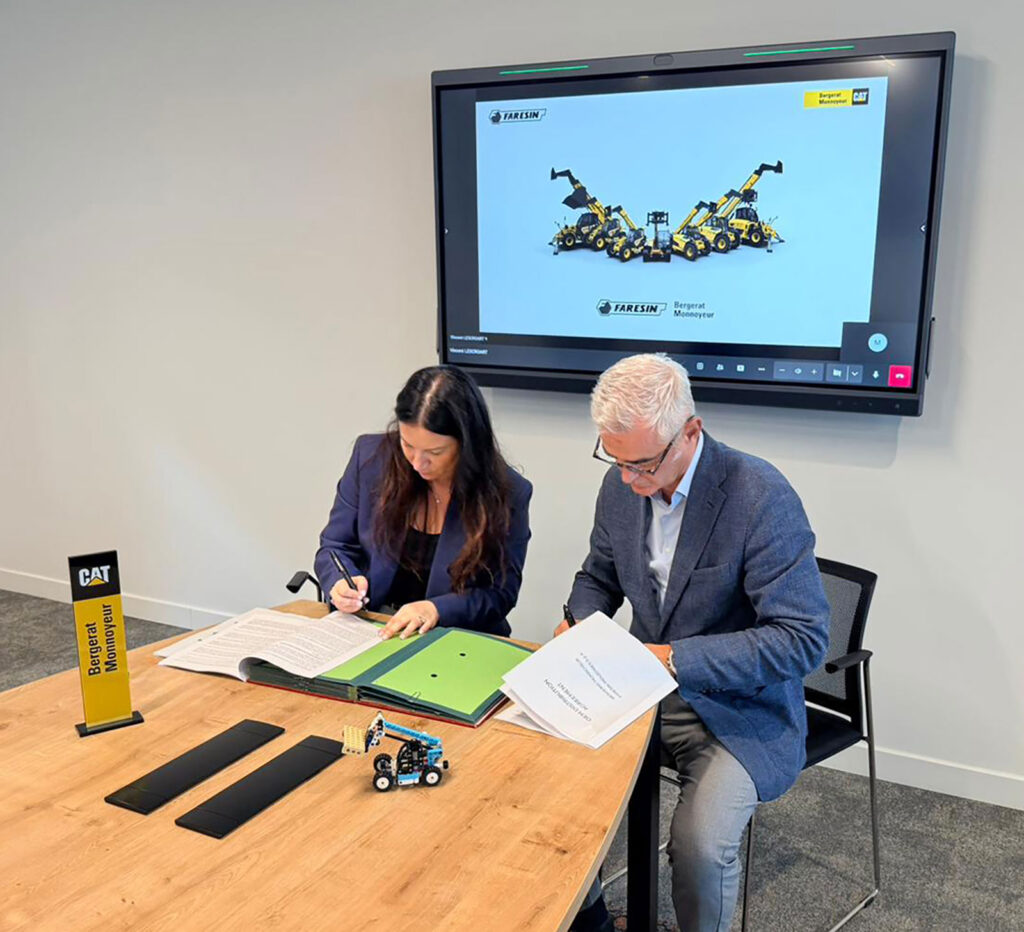
Faresin Industries has signed a strategic agreement with Bergerat Monnoyeur to develop the telehandler market in France.
The agreement gives Bergerat Monnoyeur an expanded telehandler offer across construction, industrial, and agricultural sectors, adding Faresin machines to a distribution network already strongly associated with Caterpillar equipment in France.
Faresin said the partnership will strengthen its presence in one of Europe’s major equipment markets. The Italian manufacturer produces a range of telescopic handlers, including 100% electric models designed to reduce emissions and noise in sensitive urban and industrial environments.
Bergerat Monnoyeur will provide a dedicated organisation to support the sales network and technical service across France. The agreement combines product supply with technical support, connected services, and local presence rather than operating as a standalone sales arrangement.
The companies signed the agreement in Amblainville, France, with the launch phase expected to include joint participation in major French trade fairs. Faresin said the distribution strength of Bergerat Monnoyeur would improve customer proximity and support levels in the French market.
Telehandlers sit at the centre of many site logistics decisions. They are used across housing, commercial construction, refurbishment, industrial sites, agriculture-linked construction, and materials handling operations, where lifting reach, manoeuvrability, attachment compatibility, maintenance support, and residual value all influence buying decisions.
Distribution depth can be as important as product specification. Contractors and rental companies judge equipment suppliers on uptime, parts availability, field service, finance options, telematics support, and the ability to keep mixed fleets working under time pressure.
A strong local service network can determine whether a machine becomes attractive to hire companies and major fleet buyers. Telehandlers are often moved between jobs and applications, which makes dealer coverage, technical support, and parts response central to ownership cost.
The agreement also reflects a wider shift in plant procurement. Electrification is no longer limited to compact excavators and small site machines. Telehandlers are being drawn into the same discussion as contractors face low-emission zones, indoor or partially enclosed work, urban noise restrictions, client sustainability targets, and pressure to reduce diesel use on site.
Electric telehandlers are not a direct replacement for every diesel machine. Duty cycle, charging provision, load profile, battery management, and site power availability remain important constraints. They are becoming more relevant, however, where work involves predictable movements, shorter travel distances, depot-based charging, indoor logistics, or locations where diesel emissions and noise create operational limits.
Heavy plant manufacturers are still investing in conventional high-output machines, as shown by JCB’s largest X Series excavator debut, but the market is also shifting around service, digital support, and alternative powertrains. Distribution agreements now need to support that mixed fleet reality.
For France, the partnership should increase competition in the telehandler sector and give buyers another route to machines with a broader emissions profile. For Faresin, Bergerat Monnoyeur provides a stronger platform in a mature market where dealer coverage, service confidence, and access to rental channels can decide whether a product range scales beyond niche demand.