IN Brief:
- Donaldson Timber Systems has introduced a 16-house-type affordable housing range.
- The homes are based on the Sigma II closed-panel timber frame system.
- The launch comes as housing providers seek faster delivery, stronger fabric performance, and lower on-site labour demand.
Donaldson Timber Systems has launched a new Affordable Housing Range, bringing a more standardised offsite offer into a market that continues to balance delivery targets, labour constraints, and tightening performance requirements. The range comprises 16 architect-designed house types, covering one-, two-, three-, and four-bedroom layouts across terraced, semi-detached, and detached formats.
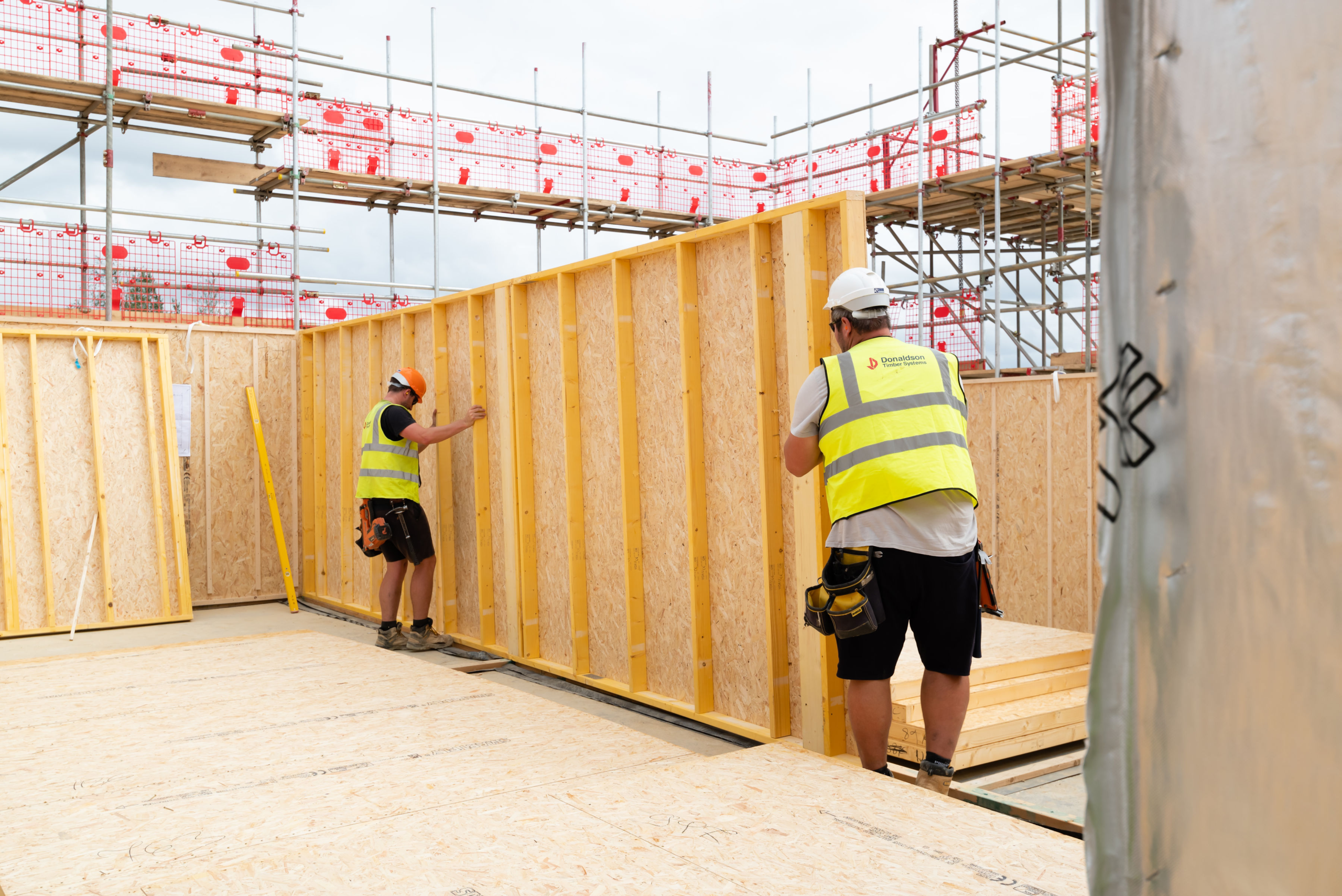
The homes are based on Donaldson’s Sigma II closed-panel timber frame system, which is designed to move more of the build process into the factory and reduce the amount of labour, sequencing, and weather exposure required on site. By packaging the offer into a defined range, the company is aiming to give housing providers and local authorities a more repeatable route through design, procurement, manufacture, and installation.
Standardisation has become more attractive in affordable housing as delivery teams look for ways to shorten programme durations and reduce avoidable variation without limiting layout choice altogether. A closed-panel system allows insulation, membranes, and key structural elements to be incorporated earlier in the process, with a greater share of the work completed under factory conditions. That brings greater consistency, tighter tolerances, and a clearer link between specification and as-built performance.
Donaldson’s position is that Sigma II can support current and incoming performance expectations, including Future Homes Standard-related requirements, while also helping clients meet funding criteria and pre-manufactured value thresholds. Those factors carry more weight in affordable housing than they once did. Delivery now sits under greater scrutiny from funders, planners, providers, and regulators, while operational energy performance has become harder to separate from long-term housing viability.
The launch comes at a point when the sector continues to search for more dependable routes to volume delivery. National housing output remains below the level required to satisfy long-term demand, and the workforce challenge has not eased. Site labour remains under pressure in many trades, while programme certainty is still vulnerable to weather disruption, supply-chain issues, and regional constraints in subcontractor capacity. Systems that reduce the number of trades and tasks required on site are therefore drawing sustained interest, particularly where they can be deployed at scale across repeat housing formats.
Affordable housing is also one of the hardest environments in which to make offsite work commercially. Margins are constrained, defects carry long-term consequences, and technical teams need confidence that what is bought can be procured, warranted, and repeated without introducing fresh uncertainty. That has pushed the MMC conversation away from novelty and towards practical delivery questions — how quickly homes can be enclosed, how reliably systems can hit thermal and airtightness targets, and how well standardised designs stand up in real procurement pipelines.
Donaldson’s new range sits squarely in that part of the market. Rather than asking clients to start from scratch with each scheme, it offers a framework of tested types that can be used more quickly where land, funding, and planning conditions support it. The appeal lies in reducing reinvention. In housing delivery, that is often where time and money are lost.
The wider significance is that offsite housing is now being judged less on broad claims about modernisation and more on whether it can absorb current market pressures cleanly. Energy performance, cost certainty, labour availability, and programme control are all being tested on live schemes. Products that can show a credible route through those pressures are likely to find space in affordable delivery programmes, especially where repeatability matters as much as headline speed.
Donaldson’s launch reflects that change in tone. The market for standardised offsite housing remains competitive, but it is also becoming more disciplined. Providers want delivery systems that hold up under procurement scrutiny and building-performance demands, not just in concept, but in practice.