IN Brief:
- Cedral’s survey of 250 construction professionals highlights growing interest in retrofit, refurbishment, and modular delivery.
- Climate change is influencing façade design, material specification, insulation priorities, and the use of planting and building orientation.
- Cost, standardisation, and training remain key barriers to more sustainable housebuilding practices.
By Lisa Grosse, brand manager at Cedral UK
We are witnessing several major trends that are reshaping building design in the residential sector. These have been driven by a growing urgency to meet sustainability targets, the need to adapt to climate change, and advances in technology.
Cedral surveyed 250 architects, building specifiers, and construction professionals who are involved in the materials sourcing process to gain deeper insights into industry perspectives on challenges and opportunities in key areas including new builds, retrofitting, modular construction, climate-conscious design, and sustainability.
Could refurbs and retrofits hold the key to future sustainable building?
Three in 10 (30%) of survey respondents have noticed a heightened focus on retrofitting in the past five years and half (50%) of those we surveyed expect to see an increase in refurbishment and retrofit projects in the next two years.
The main reasons include:
- Boosting property value: Half (50%) of survey respondents say they expect to see an increase in these types of projects because they can increase the value of a building.
- Sustainability: Just over two in five (41%) survey respondents say the number of these types of projects will increase because they are deemed more sustainable. A third (33%) expect to see more retrofit and refurb projects because of their importance for meeting net zero targets.
- Rise in office-to-residential developments: With many office spaces now sitting vacant, these spaces now represent a major opportunity when it comes to tackling the UK’s housing shortage. Two in five (40%) respondents expect to see an increase in the number of refurb and retrofit projects due to the rise in office-to-residential developments.
Additionally, three in 10 (31%) respondents say they expect to work on more refurb and retrofit projects because of the government’s commitments to remediate non-conforming cladding on high-rise residential buildings.
The industry is embracing modular construction as a means of delivering high-quality, efficient, and environmentally responsible buildings. Not only do half (50%) of survey respondents report an increased focus on modular projects in the past five years, but almost half (49%) expect this momentum to continue in the next five years.
Climate change is having a significant impact on building exterior design and specification
Almost all (96%) respondents say climate change is affecting façade design and specification choices in one or more ways. 59% of respondents say climate change is affecting the choice of materials chosen. 56% say there is greater importance placed on insulation and 41% say there is greater use of surrounding planting. Over a third (35%) say there is greater consideration of the building’s orientation.
Over seven in 10 (72%) respondents agree that climate change has a significant influence on building design from an aesthetic perspective. Respondents are most likely to say that the main façade design trend they expect to see in the next three years is exterior living walls. Smart façades (39%), minimalism (32%), and a return to traditional materials such as brick or stone (32%) are also expected to prove popular.
More needs to be done to achieve long-term sustainability
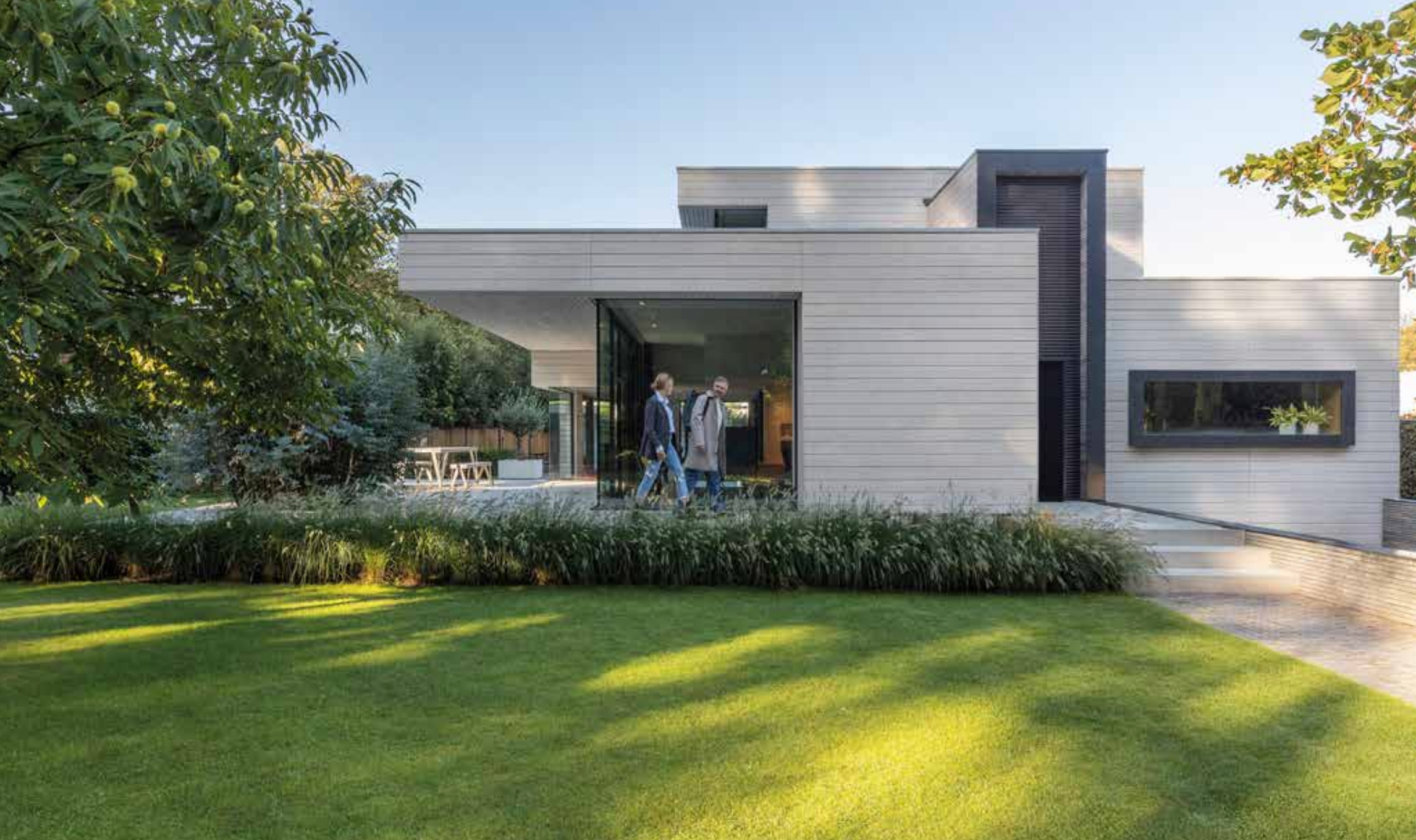
Discussions around sustainability, futureproofing, and a fabric-first approach have become increasingly prominent for housebuilding. One of the trends we are seeing for the exterior is more natural products such as fibre cement cladding. A strong, versatile, and sustainable material containing cement and fibres, it uses fewer raw materials and less energy in its manufacture and produces less waste than some traditional building materials.
However, almost all (97%) survey respondents report that they are experiencing one or more challenges when it comes to innovating new ways to improve the sustainability of building projects.
The obstacles that the architects and building specifiers are most likely to be facing are caused by economic factors outside of their control such as the cost of materials (65%) and the cost of construction (62%).
Challenges which the industry has more control over include:
- A lack of standardisation or guidance on sustainable building practices (35%).
- A lack of training and awareness of sustainable design principles (34%).
- A lack of operative training and awareness of sustainable building practices (29%).
To download the full report, go to: https://www.cedral.world/en-gb/professionals/-/whitepapers/
This article originally appeared in the February 2026 edition of IN Site. Read the full issue here.