IN Brief:
- City Reach will provide 84 homes, comprising 45 council properties and 39 homes for private sale.
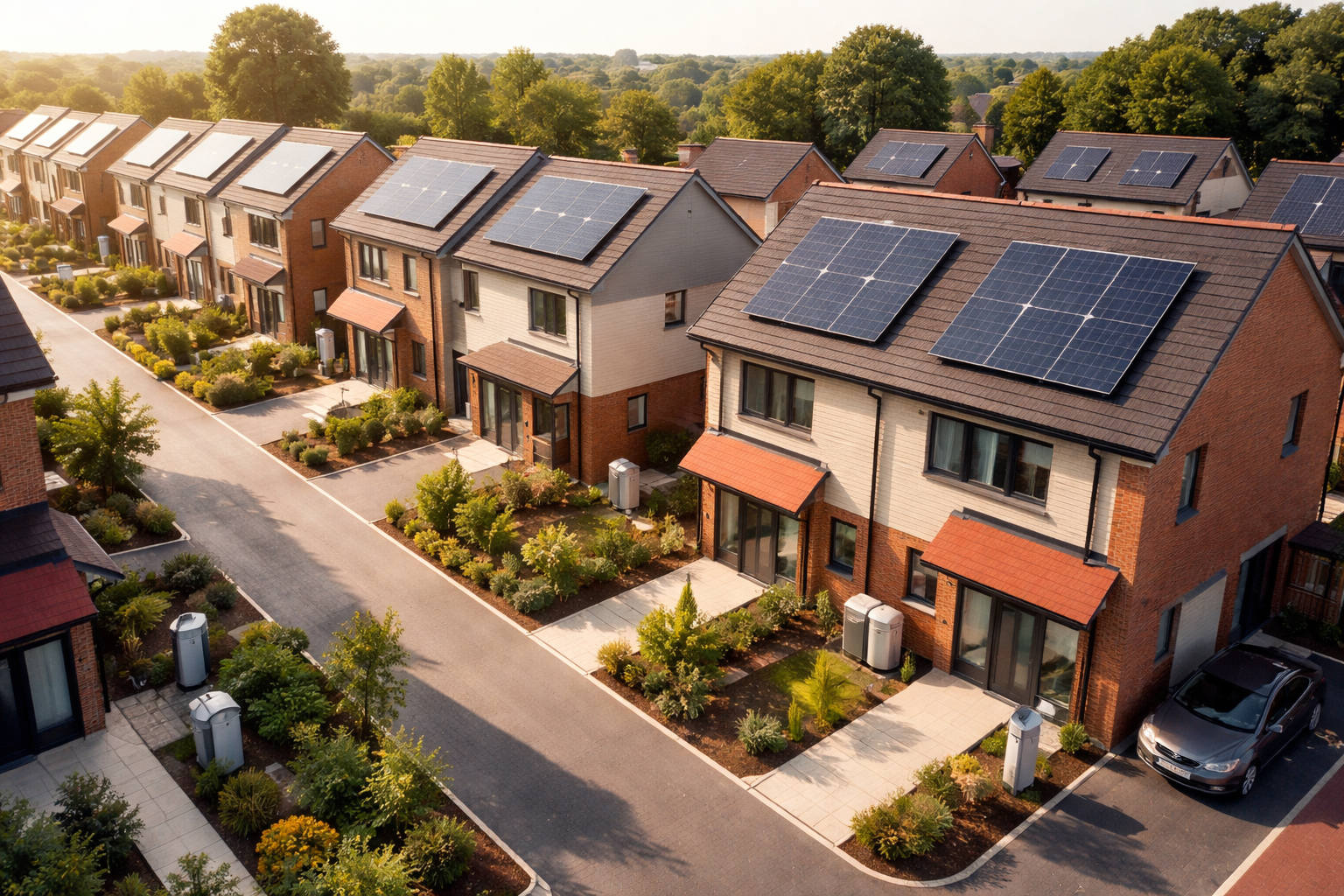
- The gas-free scheme combines communal air-source heat pumps, solar panels, enhanced insulation, and mechanical ventilation with heat recovery.
- Landscaping is designed to achieve a 35% net biodiversity gain alongside green roofs, active-travel routes, and a new green corridor.
Cambridge Investment Partnership has marked progress at its City Reach development on Fanshawe Road, where 84 low-carbon homes are being delivered through the joint venture between Cambridge City Council and The Hill Group.
The Coleridge scheme will provide 45 council homes and 39 homes for private sale. The affordable element replaces 30 ageing former council properties, increasing the number of council homes on the site while sales receipts from the private units are intended to support further housing and community investment.
City Reach is being delivered as a gas-free development. The council homes will be built to Cambridge City Council’s Cam Standard and will use communal air-source heat pumps, solar panels, high-performance insulation and mechanical ventilation with heat recovery to reduce operational energy demand while maintaining controlled ventilation.
The housing comprises 76 homes in four apartment buildings and eight houses positioned on the eastern and western edges of the site. Four homes are being designed as fully accessible properties for disabled residents, while external works include secure cycle parking, electric vehicle charging, landscaped public space and a children’s play area.
The landscape strategy is expected to deliver a 35% net biodiversity gain. Measures include 27 new trees, wildflower planting, bat and bird boxes and green roofs on the apartment buildings, together with a new green corridor linking Fanshawe Road with Coleridge Recreation Ground and improved walking and cycling routes.
The energy systems place a greater coordination burden on the construction programme than a conventional gas-heated development. Communal heat pumps depend on plant sizing, distribution temperatures, electrical capacity, acoustic control, metering and maintenance access being resolved before the building services design is fixed.
Fabric performance is equally important. Heat pumps operate most effectively when heating demand is controlled, so insulation, airtightness and thermal bridging have a direct effect on plant performance rather than sitting as separate architectural specifications. Poor workmanship at façade, roof or window interfaces can therefore affect both comfort and the energy system intended to serve the completed homes.
MVHR adds another layer of coordination. Duct routes, terminals, fire stopping, access for maintenance and final commissioning all influence whether the installed systems perform as designed. In more airtight homes, ventilation has to be deliberate and balanced because uncontrolled leakage can no longer compensate for poorly commissioned mechanical systems.
The external environmental measures also create practical construction interfaces. Green roofs add waterproofing, drainage and loading requirements, while habitat areas and new trees need protection from later site traffic if they are established before all heavy works are complete. Walking and cycling links also have to be coordinated with levels, drainage, lighting and boundary treatments.
Cambridge City Council says 34 of the 45 council homes will be let at a mid-level affordable rent set at 60% of market rent, with the remaining 11 offered at 80% of market rent to households that may not qualify for traditional council housing but still struggle with the city’s private market.
The private-sale element also has a role beyond funding City Reach itself. Cambridge Investment Partnership says income generated from those homes will be reinvested into further council housing and community facilities, allowing development value to be recycled into later projects rather than ending with the completion of the site.
Since its creation in 2017, the partnership says it has delivered more than 1,150 homes across 24 sites, including more than 850 council homes. It is targeting a further 1,000 council homes and 1,000 homes for sale by 2030, making repeated delivery methods increasingly important across design, procurement and commissioning.
A recurring pipeline also creates an opportunity to refine details that regularly cause problems on low-carbon housing schemes. Heat-pump plant, ventilation layouts, façade interfaces, roof-mounted equipment, metering and resident handover can all benefit from lessons carried between projects, provided completed-building performance is fed back into later designs.
City Reach has now progressed far enough for its energy, fabric, biodiversity and accessibility measures to be treated as a coordinated construction package rather than planning commitments. The remaining test is operational: the buildings will have to deliver the intended performance once 84 households begin using the heating, ventilation and shared infrastructure every day.