IN Brief:
- Seaway7 is the preferred supplier for approximately 90 fixed-bottom foundations and inter-array cables at Berwick Bank B.
- SSE expects the proposed agreement to create or support 465 UK roles, including 400 in Scotland.
- Final contract award and an SSE investment decision, targeted for late 2027, remain ahead of possible offshore preparation in 2028.
SSE has named Seaway7, based in Aberdeen, as preferred supplier for turbine foundations and inter-array cables at its proposed 1.4GW Berwick Bank B offshore wind development. The selection covers design, procurement, construction and offshore installation, while the agreement remains conditional on final contract award and SSE’s investment decision.
Seaway7, part of the Subsea7 group, would provide around 90 fixed-bottom turbine foundations and the submarine cables connecting turbines in the array. The site is in the outer Firth of Forth, approximately 38km off the Scottish Borders coastline, and forms one phase of SSE’s proposed 4.1GW Berwick Bank wind farm. The work packages involve foundations, heavy offshore installation and power connections within the array, rather than construction of the entire wider project.
SSE gives average water depth at the foundation positions as 52 metres, rising to a maximum of 59.7 metres. It says Berwick Bank B could be the deepest fixed-bottom offshore wind farm in the world if delivered to those specifications. Water depth affects installation vessel access, foundation loading and subsea construction methods, although the company has not published final engineering details for every turbine position.
For fixed-bottom turbines, loads from the tower and rotor pass through a support structure into the seabed. Designers must account for wind and wave forces, repeated cyclic loading, currents and the strength of the local ground. The structure also needs to be compatible with lifting and positioning methods available to the installation vessels, since tolerances achieved offshore affect later turbine assembly and the lifetime condition of the asset.
SSE has described the foundations as fixed-bottom but has not confirmed whether every turbine position will use the same foundation type. Geological and geotechnical survey findings, turbine selection and installation constraints inform that decision. The preferred supplier agreement gives Seaway7 an early role in resolving the design and procurement interfaces, before foundation fabrication and the offshore installation method can be finalised.
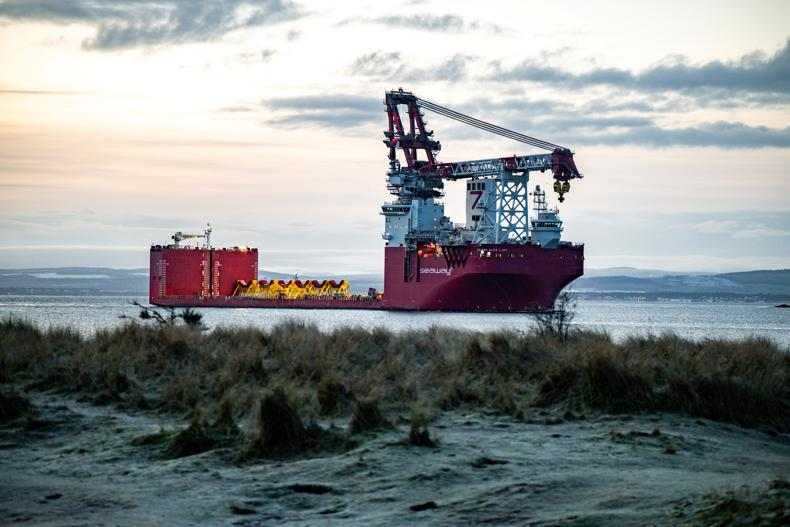
The proposed campaign would use Seaway7’s vessels Seaway Alfa Lift, Seaway Strashnov and Seaway Phoenix. Their participation identifies the contractor’s intended installation resources, with foundation positioning and subsea cable laying forming different phases of the marine operation. Vessel sequencing will need to coordinate port marshalling, offshore weather windows and the delivery of components from manufacturing sites; dates are expected to be set through the later contract programme.
Inter-array cables collect electricity between individual turbines and the offshore collection system. Each route must be engineered against seabed conditions, permitted corridors, burial or protection requirements and the connection points on the foundations. Cable installation also needs to fit around completed foundations and other seabed work so that crossings, bend radii and exposed sections can be controlled during commissioning and subsequent operation.
Offshore installation interfaces begin before a foundation is lowered into position. Survey teams verify seabed conditions and setting out; the marine contractor must then manage lifting, placement and inspection before turbine erection can follow. Cable routes and foundation positions have to be coordinated so later work does not compromise installed assets. Those practical constraints help explain why the agreement covers engineering and procurement alongside the offshore construction campaign.
SSE estimates that the Seaway7 agreement would create or support 465 jobs across the UK, including 400 in Scotland. It allocates around 160 direct posts to Seaway7, another 105 indirect roles to the domestic supply chain, and 200 direct and indirect roles to foundation marshalling at a Scottish port. These figures mix expected new employment with existing roles supported by project work; they are a forecast for the proposed delivery programme.
The foundation marshalling port is still to be named. It would need storage and handling areas suitable for very large steel components, appropriate quayside capacity and access for loading into heavy installation vessels. The location affects the marine logistics plan because foundations must arrive, be inspected, stored and transferred offshore in the order required by the installation sequence.
SSE has separately selected Montrose as Berwick Bank B’s planned operations and maintenance base. That decision concerns the support and servicing of turbines once the project is operating, whereas foundation marshalling is a temporary construction logistics function. Naming Montrose for the former does not establish the location of the latter, which SSE expects to announce separately.
The wider Berwick Bank project received offshore consent in July 2025. Berwick Bank B secured a Contract for Difference lasting 20 years in January 2026 for approximately 1.38GW of capacity, giving the proposed generation a defined revenue support mechanism. That financial milestone supports the investment case, while detailed engineering, supply agreements and the developer’s final decision still have to be completed before major marine construction can be authorised.
SSE is targeting its final investment decision for late 2027. On its current programme, preparatory offshore work could begin in 2028, with installation of the foundations and inter-array cables taking place between 2029 and 2031. Those dates establish the intended sequence from preparatory work to the heaviest marine packages; the project has not yet entered the installation phase.
The selection extends Seaway7’s work with SSE on Beatrice and Seagreen, while the company is involved in turbine installation at Dogger Bank. The projects provide experience in offshore construction logistics and vessel operation, but Berwick Bank B’s relatively deep foundation locations bring their own design and installation requirements. The new preferred supplier agreement establishes the companies’ proposed division of work ahead of a binding construction contract.