IN Brief:
- The £64m Holy Trinity redevelopment is scheduled to run from August 2026 until late 2029.
- Bouygues will deliver a 9,300 sq m teaching block, refurbish existing accommodation, and upgrade sports and external areas.
- The live-site programme targets BREEAM Excellent and includes solar generation, ground-source heating, and passive ventilation.
Bouygues UK has secured a £64 million contract to rebuild Holy Trinity CofE Secondary School in Crawley, beginning a phased programme that will keep the existing school operational while a new teaching building is constructed alongside it.
Work is due to start in August 2026, with completion targeted for late 2029. The principal new element is a three-storey, 9,300 sq m teaching building on land south of the current campus, with pupils and staff scheduled to move into the new accommodation before older buildings are demolished.
The contract also includes refurbishment of the existing 1,500 sq m Young Building, five multi-use games areas, landscaped recreation space, and a new car park. Once complete, the school is expected to increase capacity from around 1,410 pupils to 1,500, adding an assembly hall, sixth-form hub, library, and specialist teaching spaces.
The scheme forms part of the Government’s School Rebuilding Programme and follows planning approval earlier this year. Crawley Borough Council has also allocated £137,195.43 of Section 106 education funding collected from residential developments to support the expansion, linking the project directly to additional demand created by housing growth in the town.
Phasing governs the live-site programme
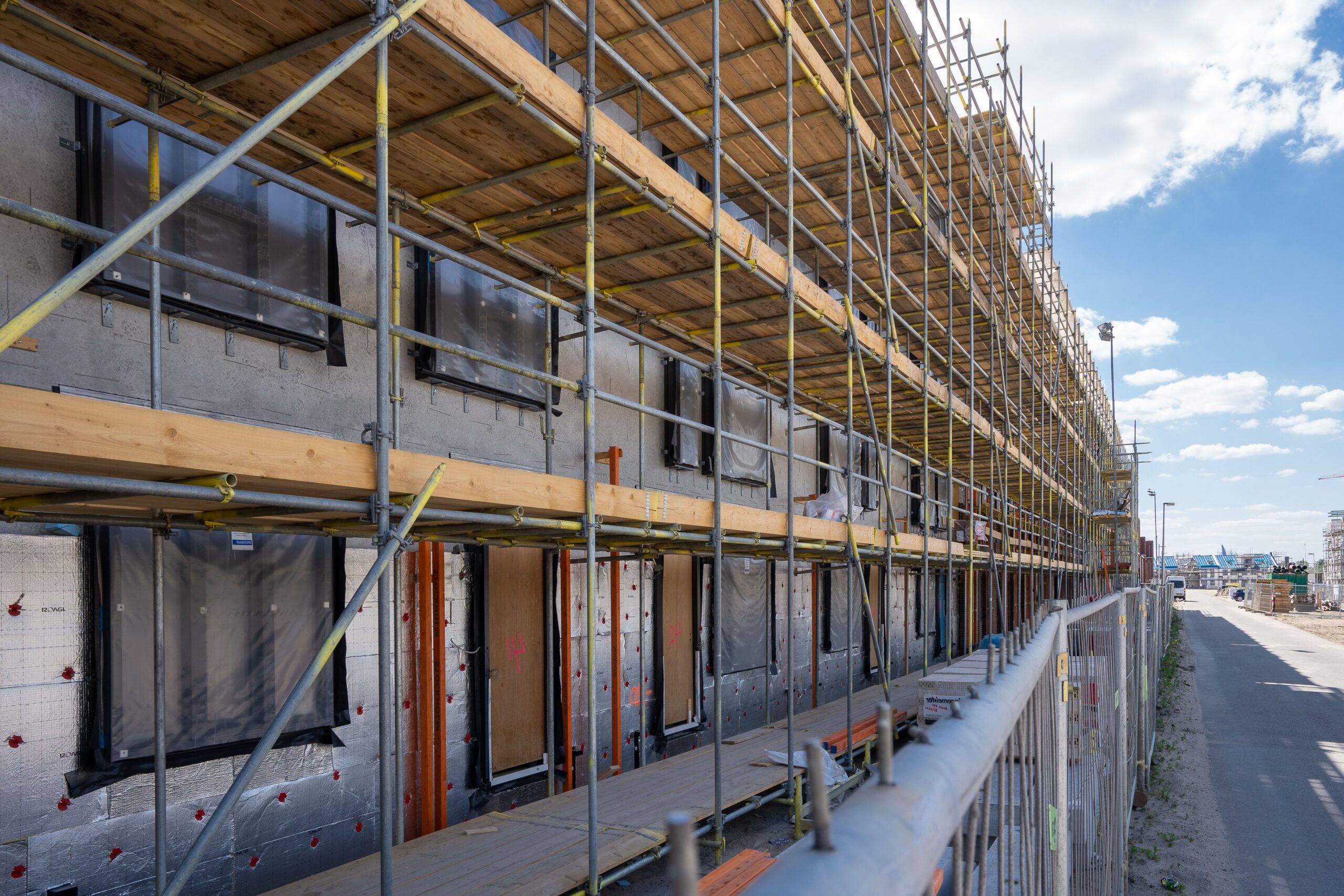
Keeping a secondary school running throughout a multi-year redevelopment places logistics and sequencing at the centre of the construction plan. Delivery routes, site compounds, temporary pedestrian paths, hoarding, crane operations, noisy work, and utility changes all have to be organised around pupils, staff, examinations, and the school day rather than around an empty development plot.
The planned sequence reduces one of the largest risks by providing the replacement teaching block before existing accommodation is removed. That avoids trying to create the whole new campus within a cleared site, but it also means Bouygues must work through a series of interfaces between live buildings, temporary arrangements, retained facilities, and new construction as each phase is handed over.
Refurbishment of the Young Building adds a further interface between new and existing fabric. Retained accommodation can reduce demolition and embodied carbon, although it also brings the usual survey and coordination issues around structure, fire strategy, accessibility, services, and connections to new systems. Those conditions are easier to manage when design information is settled before work reaches occupied areas.
Bouygues has a substantial education portfolio and experience of school rebuilding programmes. Live-site delivery places particular weight on early coordination with the school and project stakeholders, because disruption has to be controlled across several academic years rather than concentrated into a single construction period.
Energy systems raise the coordination load
Holy Trinity is targeting BREEAM Excellent and is specified with rooftop photovoltaic panels, a ground-source heat pump, and passive ventilation. Those systems move a significant part of the environmental strategy into the mechanical, electrical, structural, and envelope coordination that has to be resolved during design rather than left to the end of the build.
Ground-source infrastructure has to be coordinated with foundations, drainage, below-ground services, and external works, while rooftop generation affects electrical distribution, roof loading, maintenance access, and fire strategy. Passive ventilation depends on the architecture and services strategy working together, particularly where classroom occupancy and overheating risk can change markedly across the school year.
The project also sits within a broader shift in public-sector education construction towards lower operational energy and more predictable building performance. School clients inherit the running costs for decades, so poorly coordinated services can turn a capital saving into a long-term maintenance or energy penalty after handover.
For the supply chain, the contract offers work across structural construction, building services, refurbishment, sports facilities, landscaping, external works, and specialist education fit-out. Live-site constraints mean package interfaces will need to be planned around both programme and safeguarding requirements, with temporary access and sequencing carrying almost as much importance as the permanent works.
The late-2029 completion target gives the team a lengthy programme, but much of that duration is consumed by the need to phase construction around continued school operation. A long contract does not necessarily mean generous float when each move, demolition phase, and new work package depends on the previous accommodation being safe and ready for use.
Holy Trinity combines a replacement-school brief with a demanding delivery problem: build a 9,300 sq m teaching block, refurbish retained accommodation, upgrade the wider campus, and introduce lower-energy systems without shutting the school that the project exists to improve. The finished facilities will be visible in 2029; the effectiveness of the phasing will be tested throughout the three-year build.