IN Brief:
- Barhale will deliver a storm overflow reduction scheme at Micker Brook in Bramhall for United Utilities.
- The works include a 1,000 cu m shaft tank, sewer diversion, pumps, controls, telemetry, and power supplies.
- The project forms part of a wider wastewater investment cycle driven by water quality, storm resilience, and constrained urban construction.
Barhale has been appointed by United Utilities to deliver a water quality improvement project at Micker Brook in Bramhall, Stockport.
The civil engineering and infrastructure specialist will construct a new detention tank at Bramhall Precinct car park to reduce the frequency of storm overflow discharges into the brook, which is a tributary of the River Mersey. The shaft tank will intercept a sewer feeding the existing Briarlands combined storm overflow.
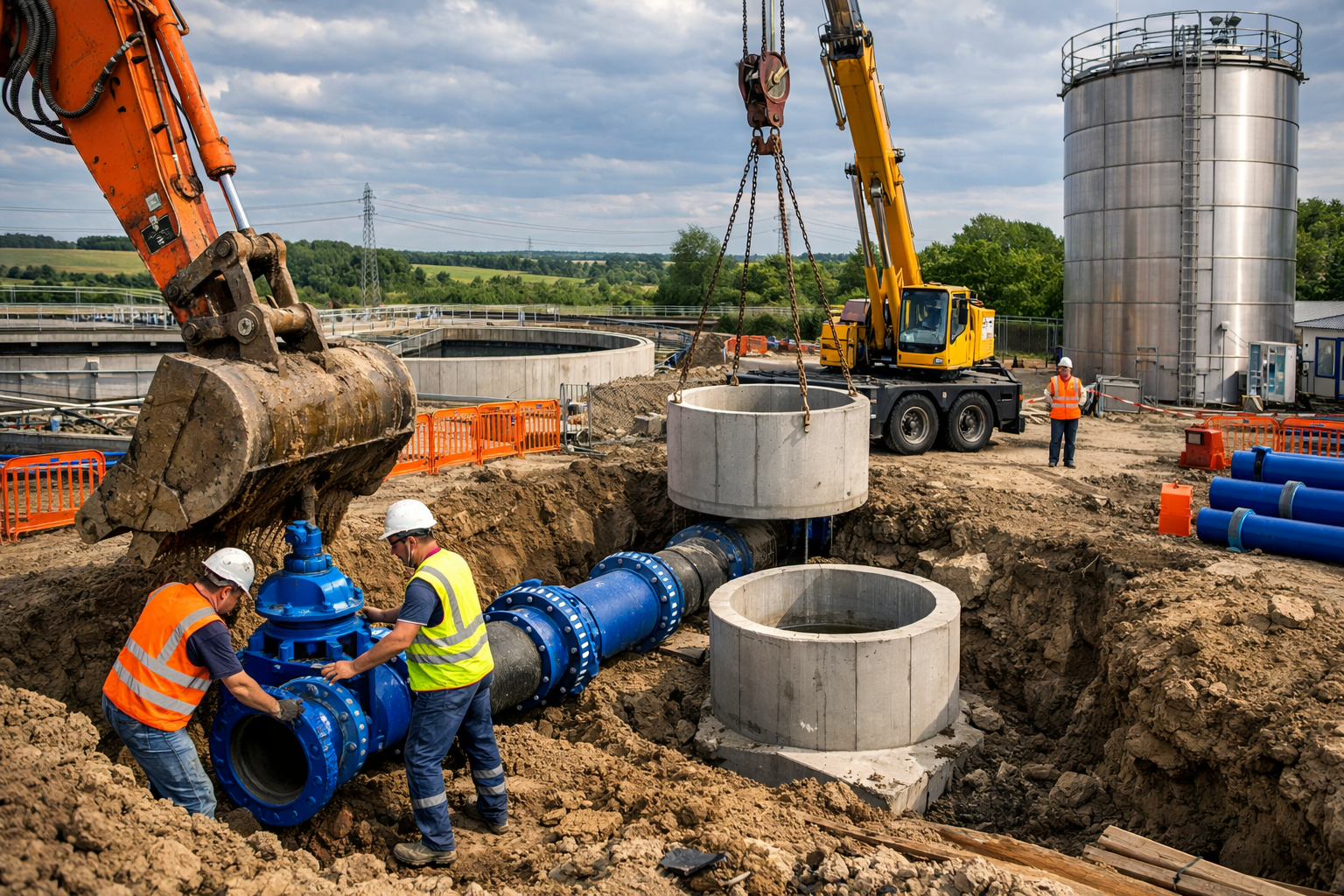
The scheme includes diversion of an 825mm diameter sewer running at a depth of 4m. That diversion will allow construction of a 1,000 cu m shaft tank using a 12.5m diameter segmented caisson sunk to an invert depth of 13.3m. Barhale will also deliver MEICA works, including pumps, control equipment kiosks, control panels, telemetry systems, incoming power supplies, and a dual rising main connected to the upstream network.
Work is scheduled for completion in summer 2027 and forms part of United Utilities’ wider wastewater investment programme across the North West. The utility is investing heavily to improve water quality, reduce storm overflow operation, and strengthen network capacity during periods of intense rainfall.
The Bramhall project combines constrained urban working with deep excavation, sewer diversion, mechanical and electrical systems, and live wastewater interfaces. Schemes of this type demand more than civil engineering capability. Temporary works, ground engineering, plant access, public safety, electrical controls, telemetry, commissioning, and network operations have to be coordinated around a site that remains close to businesses, residents, pedestrians, and local traffic.
Building a shaft tank in a precinct car park places tight constraints on site logistics. Compound space, deliveries, craneage, spoil removal, welfare, public access, and traffic management all need careful planning. Deep excavations also require rigorous edge protection, temporary works control, emergency planning, and monitoring where groundwater or variable ground conditions may affect progress.
The project reflects the practical shape of the AMP8 workload now moving into construction. Water companies are entering one of the most intense investment periods in the sector’s history, driven by regulatory pressure, environmental scrutiny, ageing assets, population growth, climate volatility, and public concern over river quality. That is translating into a heavy pipeline of storage tanks, sewer diversions, treatment upgrades, pumping stations, outfall works, monitoring systems, and control upgrades.
Storm storage is a common response where combined sewer systems cannot handle intense rainfall without discharging. Excess flows are held during storm events and returned to the network once capacity becomes available. The engineering principle is simple enough, but construction demands accuracy. Shafts must be safely installed, connected to live sewers, equipped with pumps and controls, and commissioned to perform under hydraulic conditions that may only occur during severe weather.
The Bramhall scheme’s target of reducing spills to fewer than one-in-ten-year events shows how performance requirements are becoming more specific. Utilities are being pushed towards measurable environmental outcomes, not just asset upgrades. That places greater weight on hydraulic modelling, monitoring, controls, and post-completion evidence.
For contractors, the water sector offers a strong pipeline but also exposes the limits of specialist capacity. AMP8 programmes will compete with rail, highways, energy, housing, and data-centre projects for civil engineers, groundworkers, MEICA specialists, planners, project managers, electrical contractors, and materials. Utilities and their delivery partners will need to phase work carefully to avoid overheating regional supply chains.
Barhale’s appointment also shows the value of contractors with water-sector depth. Working around live sewers, constrained sites, deep shafts, pumps, telemetry, and operational assets requires experience that cannot be created quickly. The interface between civils and MEICA is particularly important because a storage tank that is structurally complete still has to function as part of a live wastewater network.
For Bramhall, the works will bring disruption before environmental benefit. For the wider market, the project is one of many local schemes that together form a major national construction programme. Storm overflow reduction has moved from a policy and public concern into a sustained engineering workload that will shape civils, tunnelling, MEICA, and utility contracting throughout AMP8.