IN Brief:
- Jan De Nul has deployed two dredgers to create Anaklia’s 17.5-metre-deep access channel and new vessel turning basin.
- A joint venture with Prime Concrete is constructing a 1,380-metre breakwater to create sheltered water for port operations.
- Phase one is targeted for 2029 with annual container capacity of at least 600,000 TEU, with later expansion planned.
Jan De Nul has accelerated marine construction at Georgia’s Anaklia Deep Sea Port, deploying two dredging vessels to form the access channel and turning basin while work progresses on a 1,380-metre breakwater intended to shelter the new Black Sea facility.
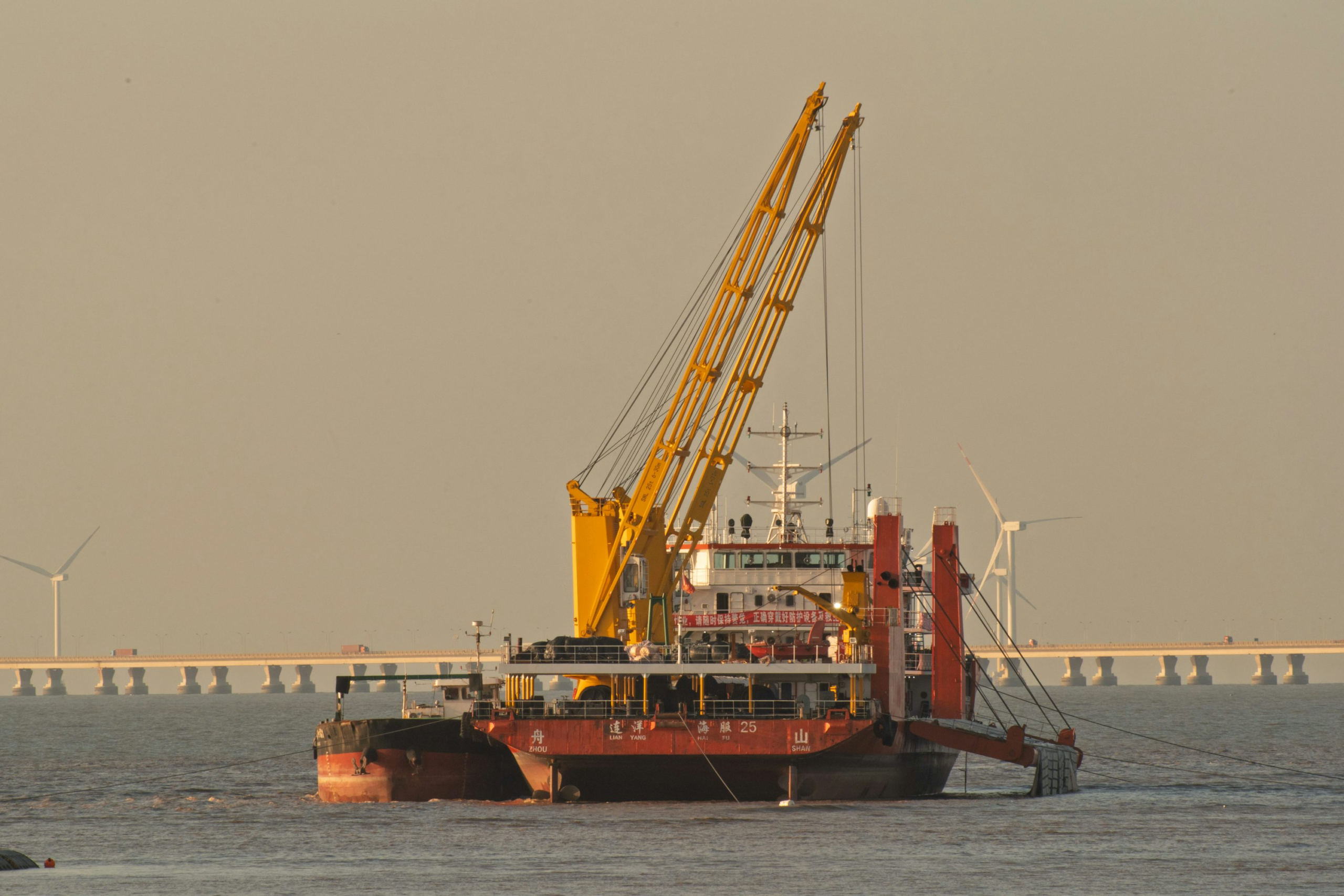
The contractor’s Tristão da Cunha and Al-Idrisi are dredging an access channel to a depth of 17.5 metres, allowing the planned port to accommodate large Panamax and Post-Panamax vessels. The same programme includes formation of the turning basin required for ships to manoeuvre before approaching the future berths.
Jan De Nul is also delivering the breakwater through a joint venture with Georgian contractor Prime Concrete. The 1.38km structure will protect the harbour area from Black Sea wave conditions, creating the calmer water required for vessel movements and later terminal operations.
Dredging is scheduled to continue until the end of 2026, while breakwater construction is expected to run through 2027. Completion of the first port phase is targeted for 2029, when the project expects to receive its first vessel.
That initial development is designed for annual container capacity of at least 600,000 twenty-foot equivalent units. A later expansion is intended to raise throughput to at least one million TEU annually by 2035.
The immediate construction challenge lies almost entirely in the marine environment. Before cranes, storage areas, terminal buildings, and cargo systems can operate effectively, the project has to establish the water depth, navigation geometry, and coastal protection on which every later port function depends.
The access channel determines which vessels can physically reach the harbour, while the turning basin controls whether those ships can manoeuvre once inside. Achieving the target depth is only one part of the work because the dredged profile also has to meet the required width, alignment, and tolerances across areas exposed to continuing sediment movement.
Hydrographic surveying is therefore central to production control. Much of the completed work lies below the waterline, where conventional visual inspection is impossible, making accurate survey data essential for confirming dredged levels and identifying sections that require additional passes.
Breakwater construction presents a different engineering problem. Large quantities of rock and other materials have to be transported and placed in a controlled sequence, with each layer contributing to the structure’s stability and its ability to absorb or redirect wave energy.
Weather and sea state can directly affect those operations. Marine plant may be unable to work safely under conditions that would have little effect on a conventional land-based construction programme, adding natural variability to productivity and material placement.
The breakwater and dredging packages also depend on one another. A sheltered basin is of limited value without a sufficiently deep approach, while a deep channel does not provide safe harbour conditions if the port remains exposed to excessive wave action.
That makes programme integration more important than the progress of either package viewed in isolation. By the time terminal construction accelerates, the principal marine geometry must already support the quay layout, vessel design assumptions, navigation requirements, and future cargo-handling operation.
Anaklia is intended to strengthen Georgia’s position on the Middle Corridor, the trade route connecting Central Asia and China with Europe through Kazakhstan, the Caspian Sea, Azerbaijan, Georgia, and onward Black Sea links.
Port capacity is one of the physical constraints on that chain. A deep-water facility capable of handling larger container ships is intended to increase the volume that can transfer between rail and road networks and maritime services without the draught limitations of shallower ports.
The commercial ambition therefore depends directly on civil-engineering output. Freight forecasts and route strategies can support investment, but they cannot substitute for the dredged depths and sheltered water required by the ships expected to use the facility.
Jan De Nul is also active on related port infrastructure elsewhere along the broader trade corridor, including work at Kuryk in Kazakhstan. That gives the contractor experience across several marine interfaces serving the developing east-west logistics route.
At Anaklia, however, the near-term measures remain basic construction quantities rather than container throughput. Dredged material, completed channel geometry, and breakwater length will determine whether the project can move into its later terminal phases on programme.
Marine work also carries risks that can be difficult to recover late in the schedule. Unfavourable ground conditions, slower dredging production, restricted vessel availability, or prolonged bad weather can affect later packages because quay and terminal systems depend on the same marine layout being ready.
The 2029 first-vessel target remains several years away, but the critical physical conditions for that date are being created now. Dredging through the end of 2026 and breakwater construction through 2027 place much of the marine risk in the current phase.
If those works remain on programme, Anaklia will move from a long-planned transport development towards a functioning deep-water port. The visible terminal will come later; for now, two dredgers and a kilometre-scale breakwater are creating the navigable and sheltered water on which the whole project depends.