IN Brief:
- Uisce Éireann has completed a €2m water and wastewater upgrade intended to support development in Skerries.
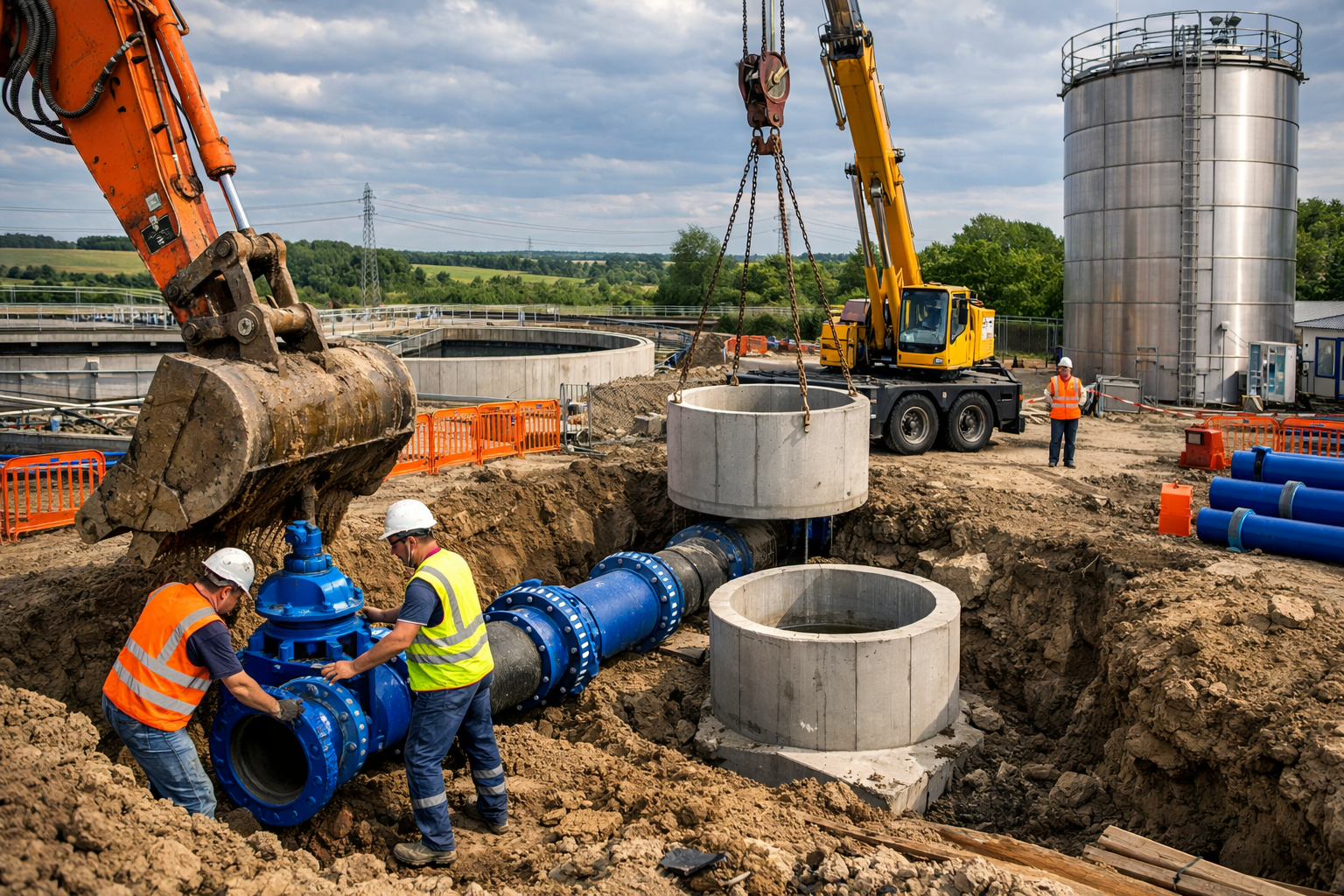
- GMC Utilities Group installed approximately 540 metres of water mains and more than 200 metres of gravity sewer.
- The utility estimates the additional network capacity can support up to 900 homes while strengthening services for existing customers.
Uisce Éireann has completed a €2m water and wastewater upgrade in Skerries, increasing local network capacity to support future development while strengthening services for existing homes and businesses.
The project was delivered through the utility’s Growth and Development Programme by GMC Utilities Group. It included approximately 540 metres of upgraded water mains and more than 200 metres of gravity sewer infrastructure.
Uisce Éireann estimates that the additional capacity can support up to 900 new homes. That figure represents the amount of development the reinforced network is intended to accommodate rather than a commitment that the same number of dwellings will immediately move into construction.
Water and wastewater capacity sit alongside planning, land ownership, finance, roads, electricity, and market demand in determining whether housing sites can advance. A development may hold planning consent and still remain unable to start if the utility network serving it lacks sufficient capacity.
The Skerries work addresses both water supply and wastewater removal. Increasing water-main capacity supports future customer demand, while the gravity sewer provides additional capacity for flows generated as the town expands.
The two systems impose different constraints during construction. Water mains have to be installed, tested, connected, and commissioned while existing customers continue to receive supply, requiring controlled intervention in the live network.
Gravity sewers depend heavily on level and alignment. Pipe gradients, chamber positions, connection points, and ground conditions have to be managed accurately because the finished system relies on gravity rather than continuous mechanical pumping to move wastewater through the network.
Installing either type of infrastructure in an established urban area also introduces interfaces with existing utilities, traffic, property access, and road reinstatement. A project measured in hundreds of metres of pipe can therefore involve considerably more construction complexity than its length alone suggests.
GMC Utilities Group delivered the works for Uisce Éireann. Its role covered the linear civil-engineering activity needed to install the new pipework as well as the testing, connections, reinstatement, and coordination required to integrate the assets into operating water and wastewater systems.
The project is part of a wider attempt to link utility investment more directly with housing delivery. Uisce Éireann’s Growth and Development Programme targets network interventions where capacity constraints could otherwise restrict new homes and commercial development.
That approach matters because individual bottlenecks are often comparatively small when measured against national infrastructure budgets. A short section of undersized sewer or water main can nevertheless prevent a much larger residential scheme from progressing until reinforcement is completed.
The reverse is also true. Delivering utility capacity ahead of development can remove one of the more difficult programme uncertainties before substantial expenditure has been committed to construction.
For developers, that improves visibility at feasibility and procurement stage. Site-specific connection works may still be required, but a stronger wider network gives project teams greater confidence that regional infrastructure will not become the final unresolved dependency after planning and design work is complete.
Timing therefore matters as much as total investment. If several housing schemes reach the same local capacity limit before network improvements are commissioned, development can accumulate behind a utility constraint that was not obvious when the projects entered planning.
Completing reinforcement earlier allows growth to be phased against known infrastructure rather than waiting for the network to catch up afterwards. That reduces the chance of contractors, consultants, and suppliers being mobilised around programmes that subsequently stall for reasons outside the development boundary.
The €2m Skerries project also serves existing customers. Uisce Éireann says the works will support future development while improving the resilience of water and wastewater services already operating within the town.
That distinction between capacity and resilience is important. Infrastructure installed solely for future growth still has to function as part of a live network from the moment it is commissioned, while existing homes and businesses may benefit from stronger or more reliable systems before new development reaches full build-out.
The government has increased funding for Uisce Éireann during 2026, linking additional investment directly with the need to remove water-services constraints on housing delivery. Local projects such as Skerries are where that national funding ultimately becomes physical capacity in the ground.
The construction work may be modest beside a motorway, rail scheme, or major treatment plant, but its value is measured partly by what it enables. A relatively short section of new mains and sewer can unlock a development pipeline worth many times the civil-engineering contract used to create the capacity.
Completion now moves the project from construction into operation. The installed assets have to perform as part of the wider network, while individual developments seeking to use the additional capacity will still progress through their own planning, design, connection, and delivery programmes.
The next useful measure will therefore be the number of schemes that convert the new headroom into connected homes. At Skerries, the utility constraint has been reduced; the remaining task is turning that infrastructure capacity into construction on the sites it was intended to support.