IN Brief:
- The Glebe Avenue phase starts on 31 August and is expected to continue for approximately 12 weeks.
- Caledonia Water Alliance is installing a new wastewater pipeline and additional manholes as part of Scottish Water’s Bothwell programme.
- The wider project combines new sewer infrastructure with storm storage intended to reduce flooding around Laighlands Road.
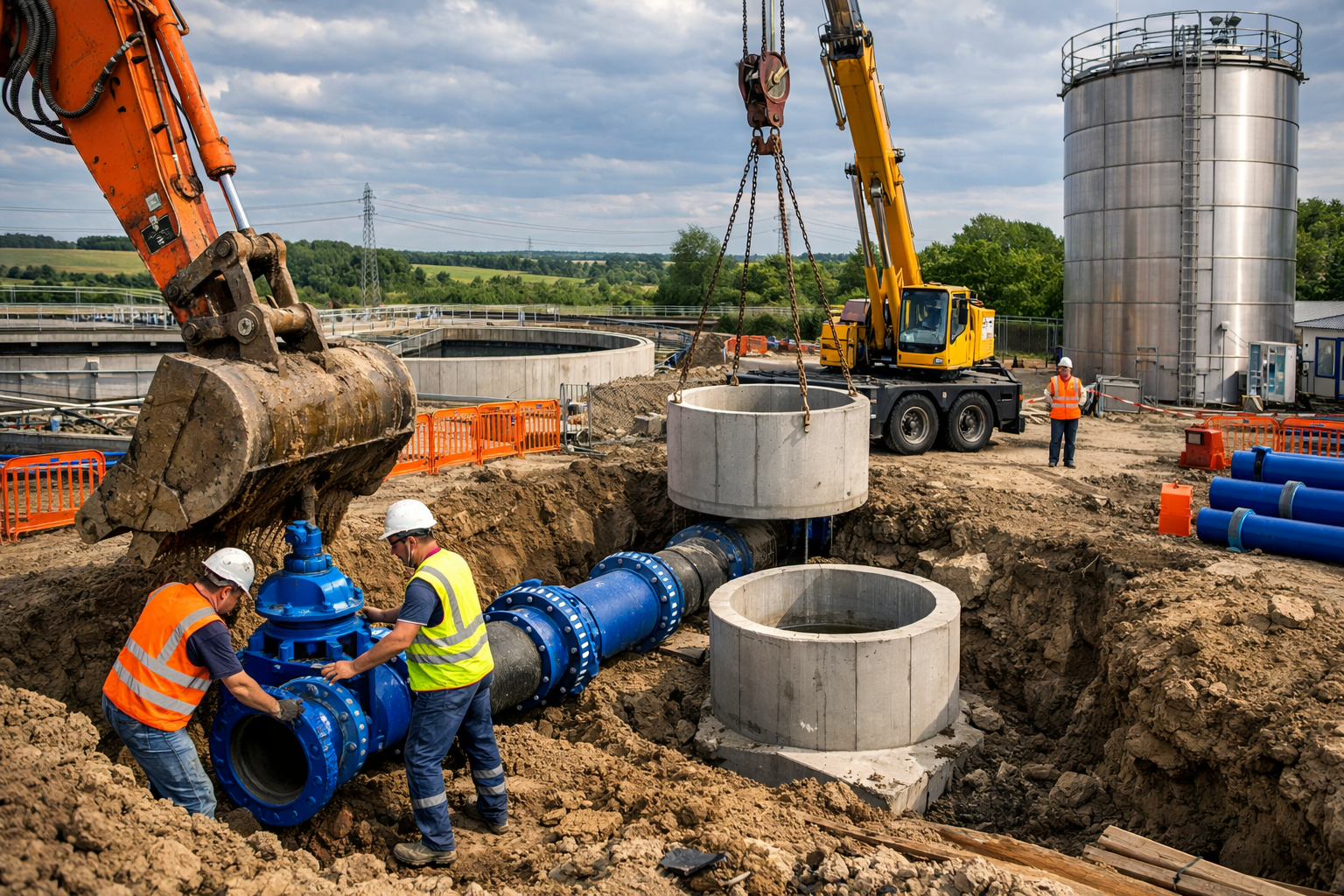
Scottish Water has moved its Bothwell sewer-flooding project into Glebe Avenue, where Caledonia Water Alliance will install new wastewater pipework and additional manholes during a construction phase expected to last around 12 weeks.
The work began on 31 August and forms part of a wider programme centred on Laighlands Road, where Scottish Water is increasing wastewater storage and network capacity to reduce the risk of sewer flooding during periods of heavy rainfall.
Construction on the overall scheme started in October 2025 and was originally programmed over approximately 16 months. Earlier stages included creation of a temporary access road and compound near Langside Road, followed by work on a new storm storage tank and pipeline through fields beside Laighlands Road.
The programme will eventually continue onto Langside Road for installation of a new rising main. The Glebe Avenue phase therefore sits between the principal storage works and the final section of network reinforcement, connecting the larger civil-engineering elements with the existing urban sewer system.
Scottish Water says temporary traffic lights may be required while work progresses along Glebe Avenue. Moving the project into the road brings excavation, pipe installation, manhole construction, utility interfaces, traffic management, and reinstatement into a comparatively constrained residential environment.
That changes the practical delivery conditions from work carried out within a field or compound. Excavations have to be sequenced around existing underground services and property access, while spoil removal, pipe deliveries, plant movements, and temporary works all compete for limited road space.
Manholes add further coordination because chamber positions and connection levels must align accurately with both new pipe gradients and the existing sewer network. Errors in level or alignment can affect hydraulic performance and may be difficult to correct once backfilling and road reinstatement have progressed.
The engineering objective is to provide additional capacity when rainfall drives peak flows through the local wastewater system. Scottish Water has identified the Laighlands Road area as vulnerable to sewer flooding, with existing infrastructure unable to accommodate some periods of high demand.
The storm tank is designed to provide temporary storage when those flows exceed normal network capacity. New pipework then forms part of the route through which wastewater can be carried and managed more effectively, making the individual construction packages dependent on the performance of the completed system rather than their value as standalone assets.
That places testing and connection work on the critical path alongside visible excavation. A pipeline can be physically installed but still require pressure or integrity testing, tie-ins, commissioning, and checks against the live network before it delivers the intended operational benefit.
Existing services must remain available throughout most of the programme. Wastewater infrastructure cannot simply be taken out of operation for an extended construction period, so new sections and connections have to be introduced through controlled interventions while the surrounding network continues to serve homes and businesses.
Ground conditions and service congestion can also affect production rates once trenches are opened. Records provide the starting point, but unidentified utilities, groundwater, unsuitable material, or differences between mapped and actual service positions can require changes to excavation or temporary support.
For Caledonia Water Alliance, the programme consequently combines straightforward linear civil engineering with a series of operational constraints. Crews need enough working room for excavation and lifting while maintaining safe public access, managing deliveries, protecting adjacent services, and keeping construction within the traffic-management footprint.
The 12-week Glebe Avenue period is also short enough that disruption has to be controlled without sacrificing the sequence needed for safe pipe installation and reinstatement. Opening too much road at once would increase public impact and temporary-works requirements, while working in very small sections can reduce productivity and extend the overall programme.
Urban wastewater projects frequently depend on balancing those competing pressures rather than maximising output from a single activity. Excavation, bedding, pipe installation, chamber construction, testing, backfilling, and surfacing have to move as a coordinated production line if road occupation is to remain proportionate.
The Bothwell project also illustrates why flood-resilience work is often disruptive despite much of the completed asset remaining invisible. Additional storage and pipe capacity sit below ground, but delivering them requires temporary occupation of roads, fields, access routes, and public space.
Once the Glebe Avenue section is complete, attention will move towards the remaining rising-main work and final integration of the new infrastructure. The project will then need to demonstrate that the storage tank, pipelines, manholes, and connections operate together as intended under real network conditions.
The immediate milestone is more modest but measurable: roughly three months of road-based construction now separates the project from completion of another major section of the Bothwell network upgrade.