IN Brief:
- Siniat Universal MR combines H2 moisture resistance with fire, acoustic, and impact performance.
- Published systems include severe-duty configurations offering up to 120 minutes of fire resistance.
- The product targets multi-residential, education, healthcare, and other high-use internal environments.
Siniat has expanded its Universal plasterboard range with a moisture-resistant board intended to simplify internal wall specifications where fire, acoustic and impact requirements have to be combined with protection against humid conditions or occasional moisture.
Universal MR is classified for H2 moisture resistance under EN 520 and is intended for applications including multi-residential buildings, schools and healthcare environments. The manufacturer positions it as a multi-performance alternative for areas where designers might otherwise change board specification because of moisture requirements.
The product retains the wider Universal range’s focus on fire, acoustic and impact performance while adding moisture resistance. Siniat says that using one consistent board across a larger number of room types can reduce both specification complexity and the risk of installation errors on site.
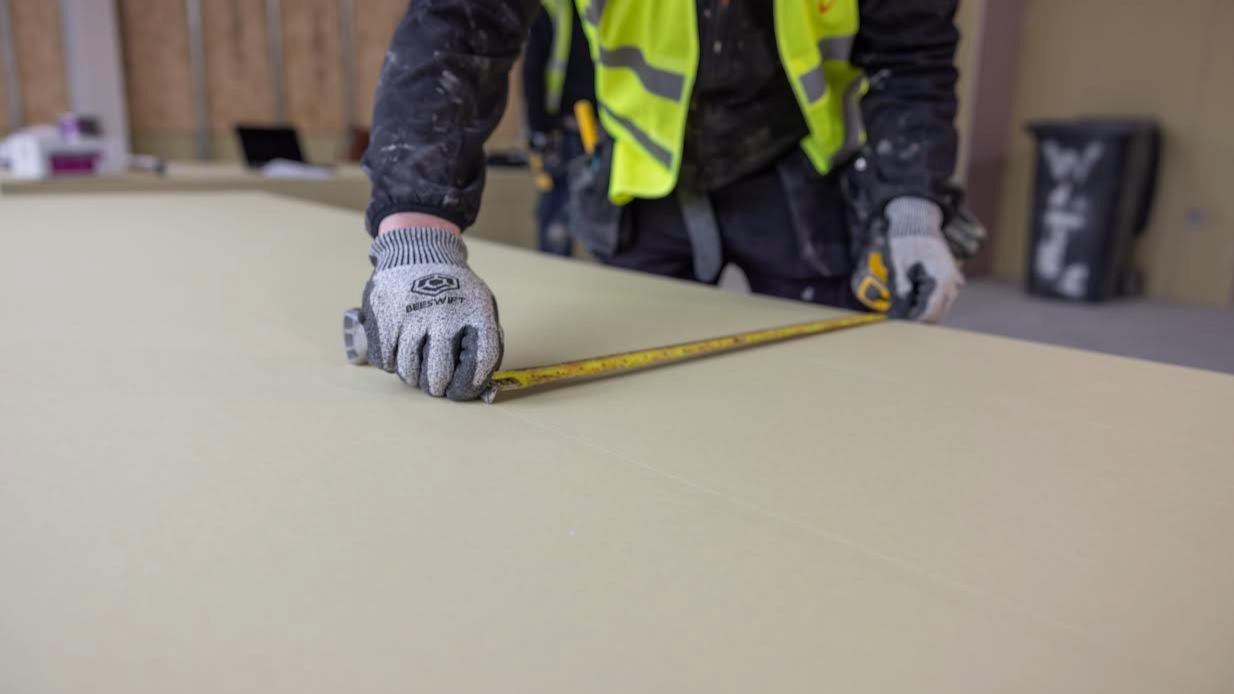
That is a practical consideration on large fit-out programmes. Plasterboards can appear visually similar once delivered and stacked, while projects may contain several specialist types for fire, acoustics, impact resistance and wet or humid areas. Every change of product creates another opportunity for the wrong board to be ordered, stored or fixed in a particular wall build-up.
Universal MR is therefore being presented less as an isolated board product than as part of a tested partition system. Published Siniat configurations include severe-duty assemblies and systems achieving up to 120 minutes of fire resistance, depending on the complete arrangement of board layers, studs, insulation and associated components.
The distinction matters because a plasterboard sheet does not establish the performance of a wall on its own. Fire resistance, acoustic insulation and impact classification are properties of tested or classified systems, and changing one component can move the completed partition outside the evidence supporting the original design.
Siniat says its Universal MR systems can meet acoustic requirements associated with Approved Document E without the additional plasterboard layers sometimes introduced simply to provide moisture resistance. For multi-residential projects, the manufacturer has developed configurations around common internal and separating-wall acoustic requirements.
Education and healthcare are another focus because both sectors routinely combine acoustic, impact and durability demands within the same building. Schools may require robust walls in circulation and teaching areas while also working to BB93 acoustic criteria, while healthcare environments can add more demanding cleaning, moisture or security requirements.
Stjohn Peters, Substantiation Manager at Siniat, said: “By expanding the Universal™ board range to include a moisture-resistant option, we’re giving specifiers confidence in clearly defined system performance across a broader range of internal conditions.”
The emphasis on clearly defined system performance is increasingly important as construction-product information comes under greater scrutiny. A board described as moisture resistant cannot simply be assumed to behave identically to another board when incorporated into a fire-rated wall, particularly where different additives or manufacturing formulations are involved.
Fire classification therefore depends on evidence for the actual system being specified. Siniat’s published Universal MR configurations include assemblies classified to EI 120, with the manufacturer also providing severe-duty impact classifications for relevant systems.
Those published configurations give designers a route to select complete assemblies rather than combining individual product claims and assuming the result will perform as required. That becomes particularly important where project teams make substitutions during procurement or try to rationalise wall types late in the design process.
The broader Universal range has also been developed for demanding impact applications, including systems using plywood backing for higher-security environments. Siniat has cited applications such as SEND and mental-health facilities where robustness, acoustics and fire performance may all need to be considered within the same partition.
Adding H2 moisture resistance extends that system approach into bathrooms, utility areas and other spaces exposed to humidity or occasional splash risk. Siniat explicitly distinguishes those conditions from continuous wet exposure, meaning the board remains a specified internal lining product rather than a universal substitute for systems designed for permanently wet environments.
From an installation perspective, the main advantage is rationalisation. Fewer wall types can simplify take-offs, delivery sequencing and storage, while reducing the number of transitions where one plasterboard specification changes to another.
There can also be a material and labour benefit where the required moisture performance can be achieved without an additional sacrificial layer. Any saving, however, depends on the complete tested build-up chosen for the project rather than the board being treated as a direct one-for-one replacement in every existing specification.
That caveat is central to the product’s value. The construction-products market is moving towards more explicit evidence about exactly what has been tested, classified and installed, leaving less room for apparently minor substitutions based on assumptions about similar materials.
Universal MR therefore enters the market with a relatively simple proposition — fewer board changes across demanding internal environments — but its practical success will depend on disciplined specification. The benefit comes when project teams use the published systems as tested, not when a multi-performance label is treated as permission to improvise wall build-ups on site.