IN Brief:
- Deck and stay-cable installation is progressing after completion of the bridge’s two 196-metre diamond-shaped pylons.
- The cable-stayed section spans 860 metres, extending to 1,618 metres with approach viaducts and carrying an eight-lane deck.
- The wider Başakşehir–Nakkaş motorway programme had already exceeded 80% physical completion by 1 July 2026.
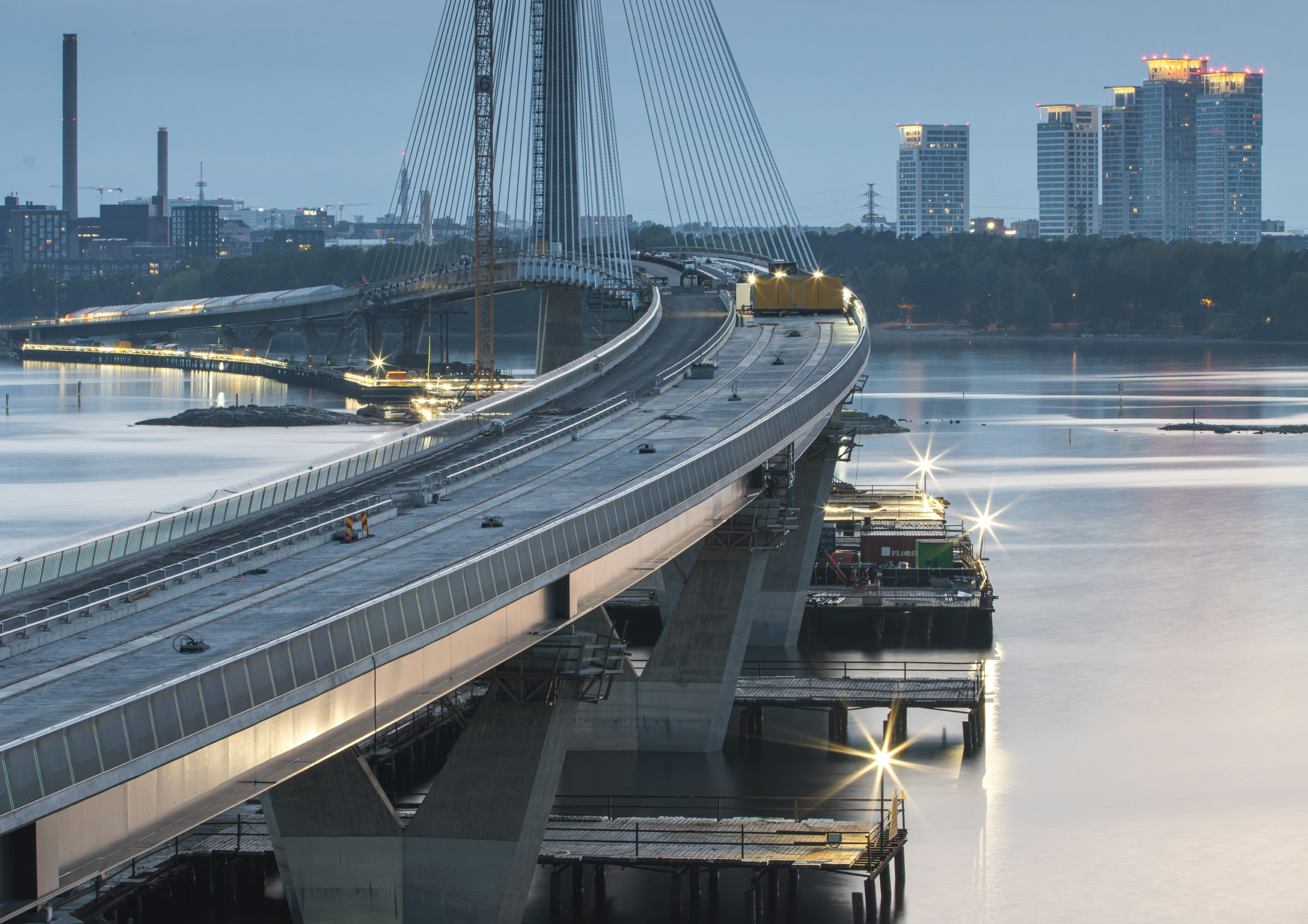
Construction of Turkey’s Sazlıdere Bridge is progressing through deck and stay-cable installation, with its two 196-metre diamond-shaped pylons complete on the major crossing forming part of Istanbul’s Başakşehir–Nakkaş motorway programme.
The bridge is the most prominent structure on the remaining section between Başakşehir and Nakkaş, a 45-kilometre development comprising 24.2 kilometres of main motorway and 20.8 kilometres of connecting roads.
Turkey’s Ministry of Transport and Infrastructure reported on 1 July that physical progress across the wider road project had already exceeded 80%. At that stage both principal pylons had reached their full height and approximately 25,000 cubic metres of concrete had been placed in their construction.
More recent reporting shows work continuing on the deck and inclined stay cables, shifting the structural sequence away from the towers and towards the elements that will form the final road crossing between them.
The bridge has a 440-metre main span flanked by two 210-metre side spans, giving a cable-stayed length of 860 metres. Including approach viaducts measuring 249 metres and 509 metres, the complete structure extends for approximately 1,618 metres.
Its 46-metre-wide deck is designed to carry eight traffic lanes, arranged as four in each direction. The stay system comprises 136 inclined cables connected through 272 anchorage points, transferring loads from the deck into the two principal pylons.
That makes the current construction phase one of the more sensitive parts of the programme. Cable-stayed decks advance through a controlled sequence in which temporary stability, permanent structure, cable installation, geometry, and stressing have to develop together.
As deck sections extend away from the pylons, additional stay cables progressively take load. Their forces influence deck alignment and structural behaviour, so installation sequence, temperature, survey results, and construction tolerances all have to be controlled against the design model.
Completion of the pylons can therefore overstate how close the bridge is to opening. Deck erection and cable installation still have to be followed by bearings, expansion joints, surfacing, drainage, barriers, lighting, road systems, inspection arrangements, and final structural testing.
The crossing also sits within a much larger civil-engineering programme. By July, approximately 14 million cubic metres of a planned 16.9 million cubic metres of excavation had been completed, alongside about five million cubic metres from a planned 7.8 million cubic metres of fill.
Three viaducts had reached completion at that stage, while work continued on another structure at Sular Valley. Land acquisition, diversions, and archaeological activities were also progressing across the route.
Those figures show why an overall percentage-complete measure needs context. Major road schemes combine earthworks, drainage, retaining structures, bridges, utilities, pavements, junctions, lighting, traffic systems, and connections to the existing network, with each package progressing at a different rate.
The most complex remaining activity may therefore sit inside the final 20% of a programme. Bridge deck completion, systems commissioning, surfacing, road furniture, testing, and interfaces with existing highways can carry more programme risk than a larger quantity of excavation completed earlier.
The Başakşehir–Nakkaş scheme is intended to complete another part of the Northern Marmara Motorway network around Istanbul. Government planning links the new connection with developing districts including Bahçeşehir, Kayaşehir, and Başakşehir.
The route is also intended to improve motorway access for industrial areas on the western side of the city, including Hadımköy Industrial Zone, Deliklikaya organised industrial zone, and İkitelli organised industrial zone.
That gives the programme a freight and industrial-access function alongside its role in passenger traffic. New motorway capacity can alter the routes available to heavy vehicles serving manufacturing and logistics districts, although the operational effect will depend on how the completed section connects with the wider road network.
Sazlıdere Bridge has also been associated with the proposed Kanal Istanbul development because it was introduced as the first bridge linked with that planned waterway. Its immediate construction context, however, is the Başakşehir–Nakkaş motorway, whose road and structures programme is already well advanced.
For the bridge contractor, current priorities remain structural rather than political. Deck sections, anchorages, and stay cables have to be installed and adjusted within defined tolerances before finishing packages can progress across a continuous roadway.
Wind can impose another practical constraint during that sequence. Long deck components and cables are exposed during erection, while lifting and installation operations may have lower weather limits than routine ground-based construction.
Quality assurance also broadens as the stay system is installed. Anchorage positions, cable protection, stressing records, alignment surveys, and comparison between measured and predicted structural behaviour become part of the evidence required before the completed crossing can be accepted.
The 80% project figure is therefore useful only as historical context: the wider motorway had already passed that threshold by 1 July. The current construction development is the continued move from completed pylons into deck and cable installation.
That phase will increasingly define the bridge’s final profile over the Sazlıdere crossing. The next meaningful milestone is not another recycled percentage, but completion of the structural connection between the two sides and the transition into the road, systems, and commissioning work required before traffic can use it.