IN Brief:
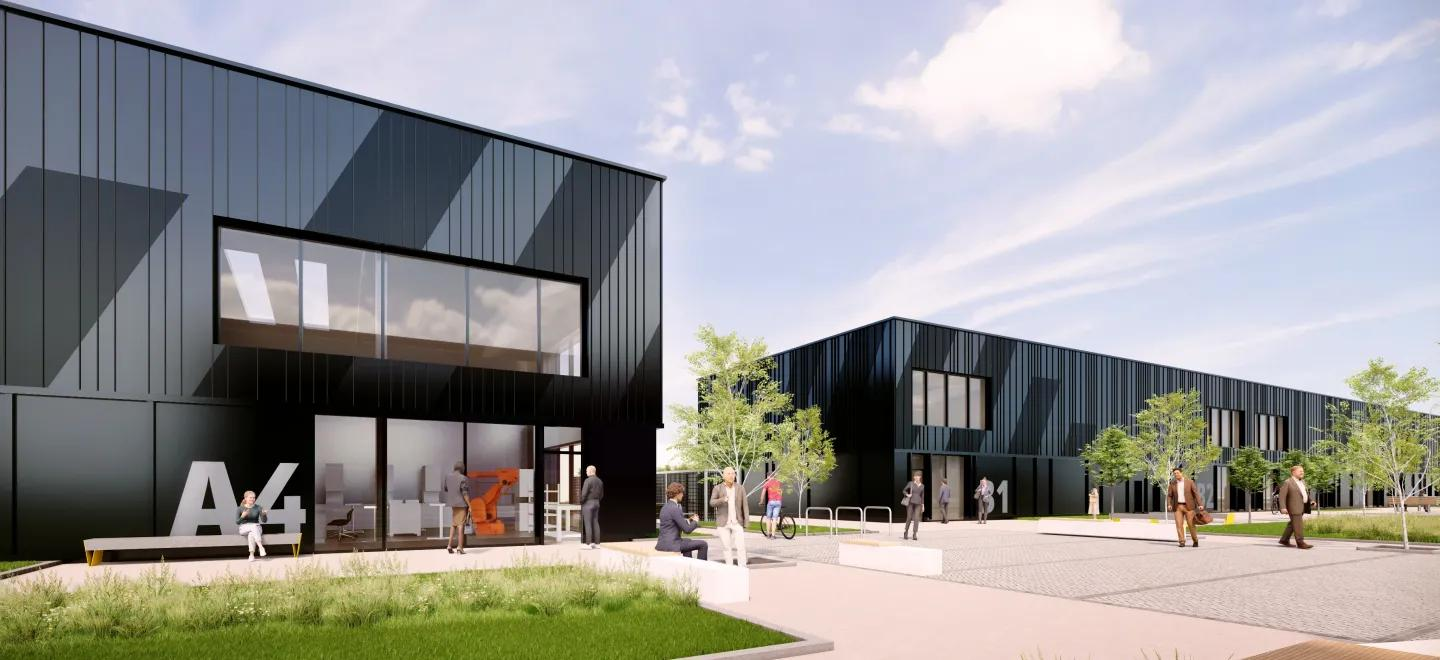
- Tech Terrace will provide 30,000 sq ft of speculative research, development, and advanced-manufacturing accommodation.
- Scottish Enterprise is contributing £4.74m, matched by the AMIDS joint venture between Renfrewshire Council and Buccleuch Property.
- The scheme is intended to give smaller and scaling manufacturers a route into the wider AMIDS industrial cluster.
Detailed planning permission has been granted for Tech Terrace at the Advanced Manufacturing Innovation District Scotland, clearing the way for a £9.7m speculative development intended to fill a gap between small innovation space and larger bespoke manufacturing facilities.
Buccleuch Property is progressing the scheme with Renfrewshire Council through the AMIDS joint venture. Scottish Enterprise is providing £4.74m towards the project, with the development partners matching that funding.
Tech Terrace will provide around 30,000 sq ft of flexible accommodation, with individual footprints beginning at about 2,000 sq ft and larger units capable of supporting companies as their operational requirements expand. Construction is targeted to begin in the latter part of 2026.
The project occupies a different part of the property market from the major research buildings already established at AMIDS. The district includes the National Manufacturing Institute Scotland and CPI’s Medicines Manufacturing Innovation Centre, both of which provide specialist infrastructure for research, process development, and industrial collaboration.
Those facilities can attract companies into the district, but they do not remove the need for conventional commercial floorspace. Manufacturers moving from research or pilot activity into production still require workshops, laboratories, offices, loading space, utilities, and room for equipment without necessarily being ready to commission a large bespoke building.
Tech Terrace is designed to provide that intermediate step. Buccleuch Property has described the scheme as speculative rather than occupier-led, meaning construction can proceed before every unit is committed.
That approach transfers more letting risk to the development partnership, but it also reduces the lead time for businesses considering a move into AMIDS. A company requiring several thousand square feet of specialist accommodation can occupy an available unit far more quickly than it can design, fund, consent, and construct a standalone facility.
The first phase will sit within a much larger development area. AMIDS has planning capacity for substantial additional high-value manufacturing floorspace, allowing occupiers to expand into larger bespoke buildings if their requirements eventually outgrow the terrace units.
Existing infrastructure is a significant part of that proposition. Buccleuch Property says the district already benefits from major public investment in roads and infrastructure, while a district heating network has been installed to support existing and future development.
That makes the scheme less dependent on creating an isolated set of industrial units from scratch. Roads, utilities, neighbouring research institutions, and the broader planning framework are already established, allowing Tech Terrace to function as another layer within an active manufacturing campus.
The project is also located within the AMIDS and Glasgow Airport tax site, where qualifying businesses can access tax incentives intended to encourage investment. Those incentives sit alongside the physical development strategy rather than replacing it: companies still need buildings capable of supporting machinery, technical staff, research activity, servicing, and future expansion.
For the construction market, the 30,000 sq ft project is modest compared with the district’s longer-term development capacity, but its role is more practical than symbolic. Innovation districts can secure major public institutions and flagship research buildings while still struggling to provide ordinary commercial accommodation for businesses that want to locate nearby.
The detailed permission allows the development partnership to address that constraint. The scheme can now progress from funding and design into construction procurement and site delivery, subject to the programme remaining on track.
Technical design will have to accommodate a broad range of potential occupiers rather than one known manufacturing process. Flexible units need adequate power, servicing, loading, floor performance, ventilation options, digital connectivity, and adaptable internal layouts if they are to remain useful across different advanced-manufacturing and R&D applications.
Those requirements are likely to be more important to occupiers than architectural novelty. A scaling manufacturer needs space that can take equipment, support technical staff, provide reliable utilities, and be modified without major reconstruction when processes change.
Tech Terrace is therefore a relatively small project carrying a specific role within a much larger industrial strategy. With planning permission now secured and funding committed, the next test is straightforward: whether construction begins as intended and turns the available land beside Scotland’s major manufacturing institutes into usable commercial space for the companies those institutions are meant to support.