IN Brief:
- Willmott Dixon has started the £28m first phase of Prince's Gate in Oldham.
- Block C will provide 75 affordable homes across six levels on a brownfield town-centre site.
- The homes target energy performance around 70–75% better than current Building Regulations, with completion in summer 2028.
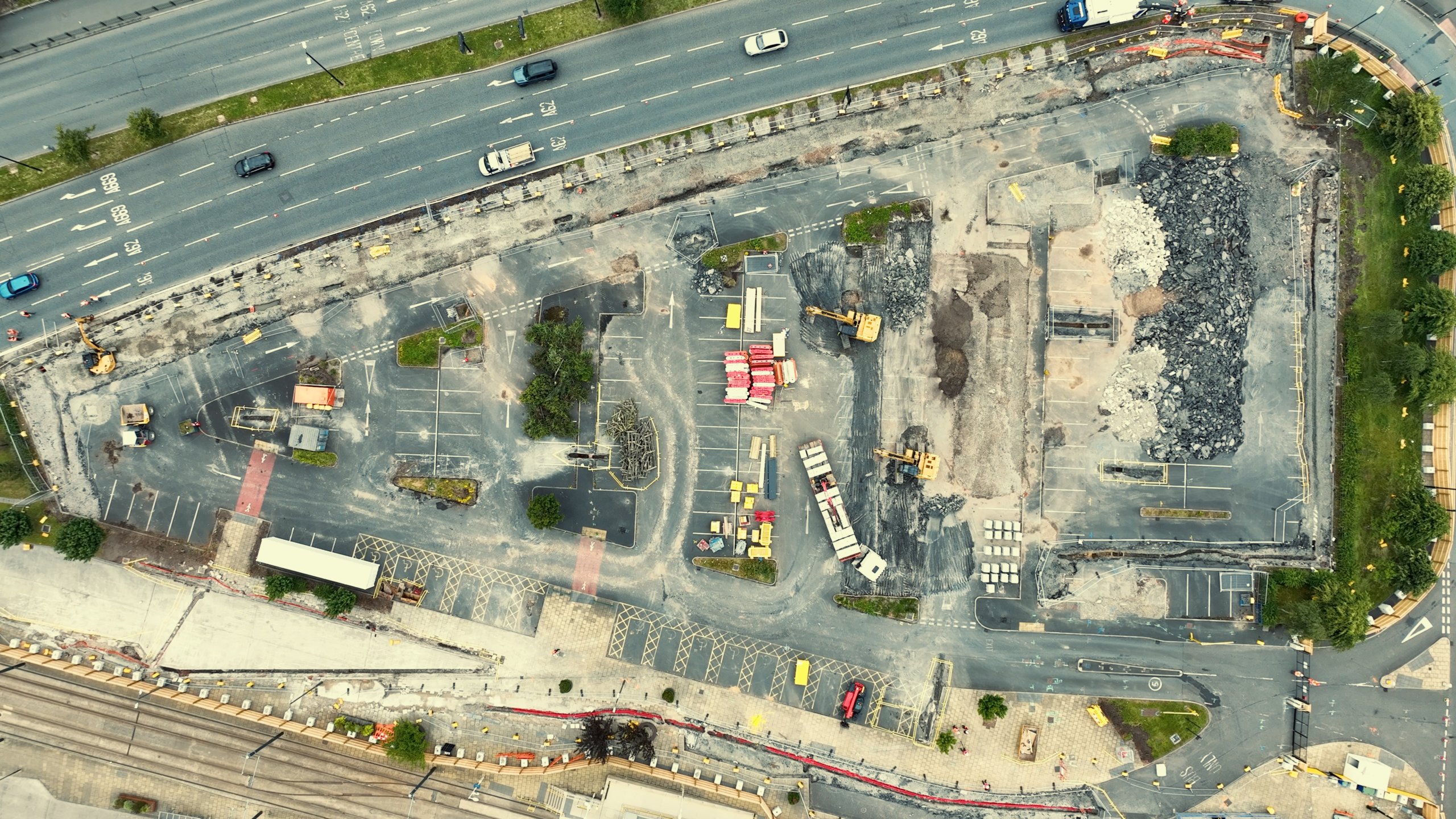
Willmott Dixon has started construction on the £28m first phase of Prince’s Gate in Oldham town centre, delivering 75 affordable homes on the former Prince Street car park beside the Mumps Metrolink stop. The six-level scheme forms part of a wider regeneration programme led by Oldham Council and Muse.
Phase One, also identified as Block C, is intended to turn the brownfield site into a residential gateway on the eastern side of the town centre. The homes are being designed to meet the Future Homes Standard, with the partnership targeting energy performance around 70% to 75% better than current Building Regulations.
Completion is scheduled for summer 2028, giving the contractor a two-year programme in a constrained town-centre location. Access, deliveries, neighbouring roads, and the Metrolink interface will all shape site logistics as structural, envelope, and internal trades overlap.
The start on site moves Prince’s Gate beyond the planning and procurement stages into physical delivery. That changes the position for the local supply chain because commitments around employment, training, and procurement now have to be attached to live packages rather than future intentions.
Willmott Dixon and its supply chain partners plan to support Oldham residents facing barriers to employment, while students will be offered work experience and T Level industry placements. Local micro, small and medium-sized businesses and voluntary organisations are also expected to participate in delivery.
The contractor’s local presence gives those commitments a practical base. Willmott Dixon has already delivered several projects for Oldham Council, including the £63m Spindles Town Square redevelopment and the £13.1m Welcome Building and Forestry Skills Centre at Northern Roots, providing established relationships with local suppliers and the authority.
Prince’s Gate also sits within a wider portfolio of town and city-centre residential work. Willmott Dixon is delivering 81 net zero homes at Station Gardens in Rochdale and 82 homes at the £24m Hough Top development in Leeds, while its £114m Stage appointment in Luton adds another large regeneration scheme.
The Oldham project is smaller in dwelling numbers, but the site creates a different delivery challenge from an unconstrained suburban housing scheme. The former car park is close to public transport and existing streets, leaving less space for storage, vehicle movements, and temporary works.
Brownfield conditions add further uncertainty. Existing utilities, previous site uses, buried obstructions, and interfaces with surrounding public realm can all influence early works, which is why the move into construction is a more useful milestone than another planning announcement.
Energy performance will place its own demands on design coordination. Achieving performance materially above current regulatory minimums requires the envelope, airtightness, ventilation, heating, metering, and controls to operate as a system rather than as separate specification items.
That coordination has to survive procurement and value engineering. A target established during design can be lost through product substitutions, poorly resolved interfaces, or weak commissioning, particularly where several subcontractors share responsibility for the elements that determine heat loss and ventilation performance.
Quality assurance is therefore closely tied to the Future Homes Standard ambition. The completed homes will need consistent installation across repeated details, with testing and commissioning used to confirm that the building fabric and services deliver the intended performance rather than merely matching drawings.
The scheme’s location beside Mumps Metrolink supports the wider regeneration case by placing new residents close to public transport, shops, and existing services. It also means construction has to coexist with those assets throughout the programme, placing greater emphasis on delivery planning and safe pedestrian management.
The two-year timetable provides room for that sequencing, but city-centre programmes can lose time quickly when access or utility issues interrupt the critical path. Early resolution of ground conditions and service connections should reduce the risk of later trades being compressed into shorter windows.
Local employment commitments will also be easier to judge once the project reaches peak activity. Work placements and supply chain participation are measurable only when subcontract packages and site opportunities exist, so Prince’s Gate now provides a live test of the social-value commitments attached to the regeneration programme.
By summer 2028, the project is expected to add 75 affordable homes to a site previously used for parking, with a substantially higher energy specification than the regulatory baseline. The construction phase will determine whether those commitments are delivered together, because programme, quality, and local participation now sit on the same site rather than in separate strategy documents.