IN Brief:
- The European Investment Bank will lend €175m for Costa del Sol water infrastructure.
- The programme will support drinking water, sanitation, wastewater, reclaimed water, and storage assets.
- The investment responds to drought risk, water stress, and climate resilience pressures in southern Spain.
The European Investment Bank will provide €175m in financing for Acosol’s water infrastructure investment programme on Spain’s Costa del Sol.
The financing will support upgrades to water infrastructure in western Andalusia, with a first €75m tranche already signed. The programme is intended to improve drinking water, sanitation, wastewater treatment, reclaimed water networks, collectors, pipelines, and reservoir capacity across 11 municipalities.
The investment is designed to reduce water losses, increase reuse, improve management of water resources, and strengthen resilience in a region exposed to recurring drought risk. The Costa del Sol is a high-demand coastal area, with resident populations, tourism, agriculture, and commercial activity all placing pressure on water systems.
Water infrastructure is becoming a more prominent construction priority across Europe as climate stress exposes older networks and undersized assets. Drought, intense rainfall, population growth, tourism peaks, leakage, pollution controls, and environmental regulation are all forcing utilities and public bodies to upgrade systems that were not designed for today’s operating conditions.
The Costa del Sol programme forms part of a wider shift toward treating water as a strategic infrastructure asset. Resilience is now measured through storage, treatment capacity, reuse, leakage reduction, network control, and service continuity. In water-stressed regions, the ability to capture, treat, move, and reuse water more effectively affects housing, hotels, public health, environmental protection, and economic activity.
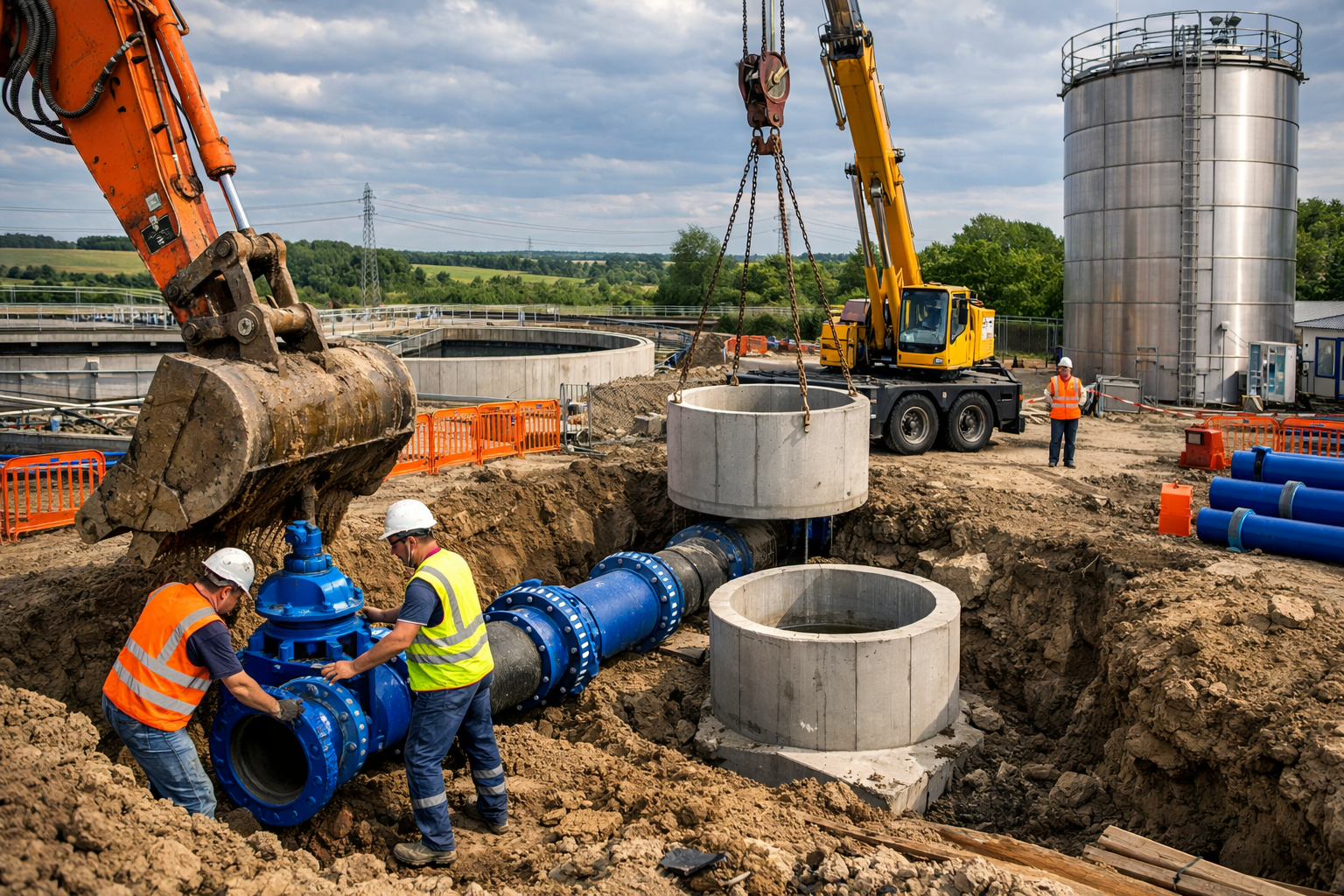
Construction work linked to the programme is likely to span multiple asset classes. Drinking water networks require pipeline renewal, pressure management, storage, metering, and control systems. Wastewater and sanitation projects can involve treatment works, pumping stations, sewer networks, odour control, civil structures, process equipment, and environmental permitting.
Reclaimed water networks add further requirements around treatment standards, distribution, monitoring, and end-use compatibility. Where water reuse is intended for irrigation, municipal uses, or industrial processes, the supporting infrastructure must be designed around quality control, public confidence, and operational reliability.
Linear water infrastructure is logistically demanding because works are often spread across roads, urban areas, coastal corridors, and operational sites. Contractors must manage excavation, traffic, utilities, reinstatement, ground conditions, pumping, temporary flows, and public disruption. In tourist-heavy locations, seasonal constraints can shape programme sequencing as much as technical design.
The financing also shows resilience work moving from emergency response into planned capital programmes. Water losses, drought exposure, and wastewater performance cannot be solved through short-term fixes alone. They require asset data, prioritised investment, framework capacity, and reliable delivery routes across several years.
The UK water market is facing similar pressures as AMP8 drives investment in leakage reduction, storm overflow performance, wastewater treatment, and network resilience. Construction supply chains are already seeing stronger demand for lower-disruption methods, programme-scale procurement, and better coordination between civil engineering, process equipment, digital monitoring, and maintenance planning.
For the European construction sector, the EIB loan adds to a growing pipeline of civil engineering work tied to climate adaptation. Roads, rail, power, and buildings often dominate infrastructure debate, but water assets are increasingly central to whether places can grow, withstand climate variability, and maintain environmental standards.
The Costa del Sol programme will now depend on converting finance into well-sequenced projects. Delivery will require coordination across multiple municipalities, live networks, environmental constraints, tourism patterns, and long-term operational needs. Effective execution would strengthen water security in a region where climate resilience is already a direct construction workload.