IN Brief:
- Planning consent has been granted for the £1.3 billion redevelopment of Leighton Hospital in Crewe.
- The scheme will replace large parts of the existing RAAC-affected estate with a new 1.2 million sq ft healthcare campus.
- Construction is targeted to begin in 2027, with the main build running to 2032 and wider demolition works continuing beyond that point.
Sir Robert McAlpine and Vinci Building have moved closer to delivering the £1.3 billion redevelopment of Leighton Hospital in Crewe after the project secured planning consent.
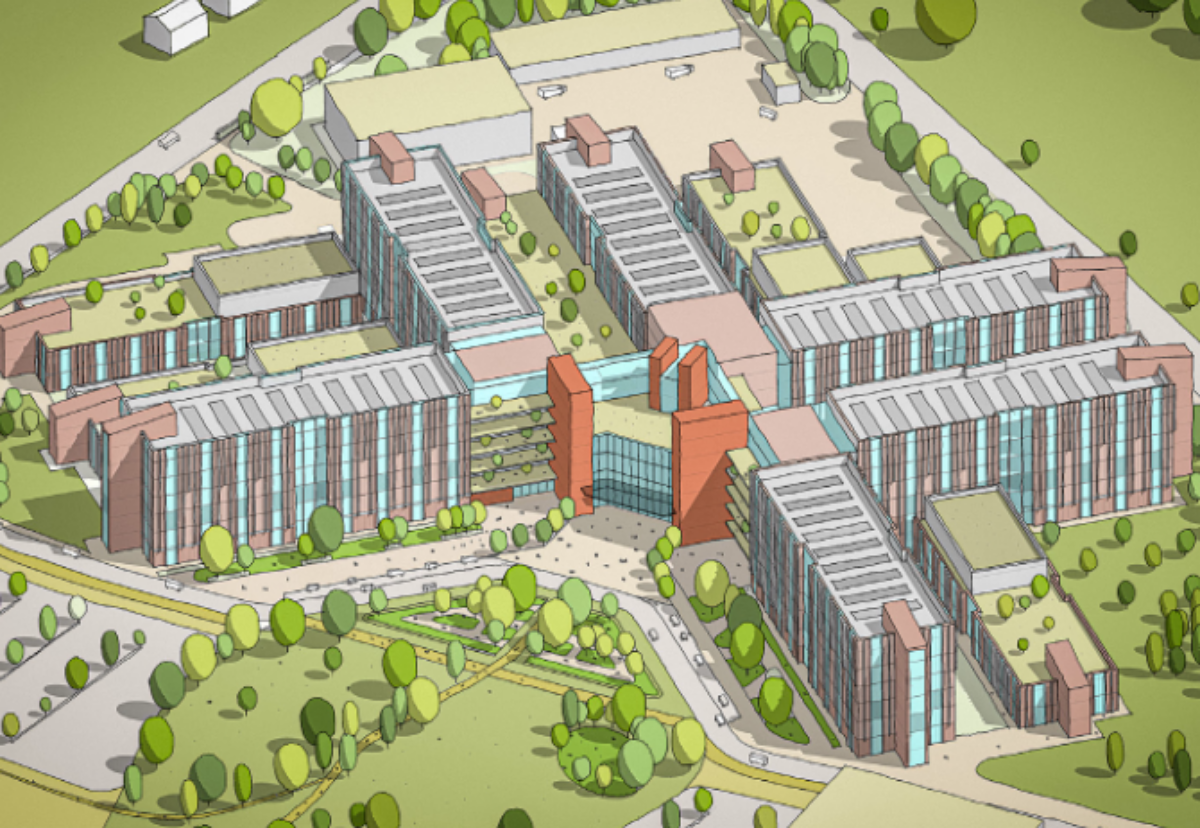
The scheme is being taken forward by Integrated Health Projects, the joint venture between Sir Robert McAlpine and Vinci Building. It will replace large parts of the existing hospital estate, around 80% of which has been affected by reinforced autoclaved aerated concrete, and create a new healthcare campus of around 1.2 million sq ft.
The redevelopment includes a six-storey main hospital building, a cancer care centre, a central sterile services department, an energy centre, plant buildings, and a multi-storey car park with around 1,000 spaces. Several existing facilities are expected to remain in use, including emergency department, audiology, ENT, satellite outpatient, and some ward provision.
With planning consent now secured, the project can move into detailed design and further business case development. Main construction is expected to run from 2027 to 2032, followed by demolition and site works through to 2034.
Leighton Hospital is one of the clearest examples of RAAC moving from an estates concern into a major construction programme. Replacement schemes of this scale are not conventional capital projects. They combine clinical continuity, infection control, logistics, temporary works, public accountability, and the physical challenge of building new healthcare capacity within or alongside a live acute hospital site.
The project also sits within the early wave of the New Hospital Programme, where standardised delivery models are being used to reduce repetition and improve consistency across major hospital schemes. Sir Robert McAlpine has already strengthened its healthcare leadership as the programme moves further into procurement and delivery planning.
Hospital replacement work places unusual pressure on design certainty. MEP systems, clinical adjacencies, utilities resilience, decanting, fire strategy, digital infrastructure, and energy performance all need to be resolved earlier than in many other building sectors. Changes made late in design or construction can carry operational consequences well beyond cost and programme.
The Crewe scheme will also test the practical value of standardisation. Repeatable components and common technical approaches can help reduce waste and improve procurement, but healthcare buildings still have to respond to local clinical models, constrained sites, existing infrastructure, and the operating requirements of NHS trusts. A standardised approach only works if it survives contact with the estate it is meant to replace.
RAAC replacement is likely to remain a defining driver of public estate construction during the next decade. Schools have dominated much of the public discussion, but hospital buildings carry deeper operational risk and heavier technical demand. The requirement is not simply to replace unsafe fabric; it is to keep essential public services running while new estate is designed, built, commissioned, and connected.
Leighton’s planning approval gives the project a clearer route into delivery. The harder work now moves to design maturity, procurement packaging, supply chain readiness, and the site planning needed to turn consent into a buildable hospital programme.