IN Brief:
- Haulotte and Builder Assist are developing robotic arm systems for use on mobile elevating work platforms.
- The Surface Assist system is being tested on real jobsites for overhead drilling, façade painting, coating, and repetitive work at height.
- The collaboration points to growing interest in automation that reduces exposure to repetitive, high-level, and physically demanding site tasks.
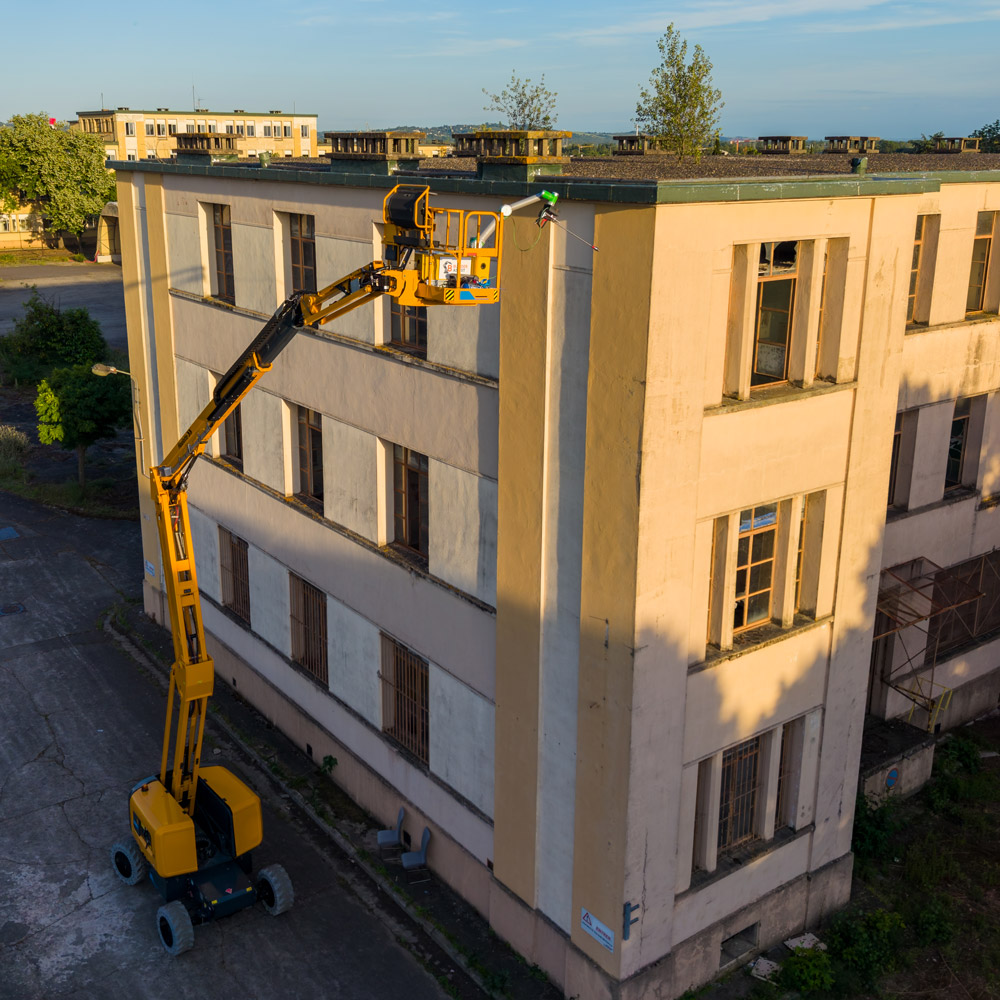
Haulotte and Builder Assist are developing a robotic arm system for mobile elevating work platforms, with testing under way on construction sites.
The Surface Assist system is being trialled on several Haulotte MEWP models and is intended for tasks including overhead drilling, façade painting, coating, and other repetitive work at height. The companies are using a pilot fleet to assess operational performance, contractor interest, and suitability for live jobsite conditions.
The collaboration addresses several persistent construction challenges at once: skilled labour shortages, repetitive manual tasks, access constraints, and the safety risks associated with work at height. By mounting robotic capability on MEWPs, the system targets jobs where positioning, repeatability, and operator exposure are central to productivity and risk.
The approach builds on previous robotic platform development in specialist applications such as cleaning, blasting, and painting, including use in shipyard environments. Construction adds a more variable operating environment, with changing workfaces, tighter access, inconsistent surfaces, and overlapping trades.
That variability is one reason construction robotics has often struggled to move from demonstration to daily use. Sites rarely offer the controlled conditions of a factory, and equipment must cope with uneven logistics, weather, changing access, and different levels of trade readiness. Testing Surface Assist on live jobsites should provide a clearer view of whether the system can handle those realities.
MEWPs provide a logical base for this type of automation because they already solve part of the access problem. Adding a robotic arm creates the potential to separate workers from the most repetitive or physically demanding part of the task while retaining human control over setup, positioning, supervision, and quality checks.
That hybrid model may prove more practical than fully autonomous construction robots. Contractors do not necessarily need machines that replace entire work packages; they need equipment that can reduce strain, improve repeatability, speed up difficult tasks, and lower exposure to risk without creating complicated deployment requirements.
Overhead drilling is a clear example. It is physically demanding, repetitive, and often carried out in awkward positions that increase fatigue and injury risk. Façade painting and coating present similar problems around access, consistency, weather, overspray, and operator exposure. A robotic system that can improve repeatability while remaining easy to deploy would have a practical role in specialist contracting.
The development sits alongside a broader equipment trend towards tools designed for constrained and repetitive site conditions. TRACTO’s compact Grundomat mole, launched for confined trenchless applications, reflects a similar equipment logic: reduce disruption, improve access, and make specialist work more efficient in difficult environments.
The commercial case for robotic MEWPs will still need to be proven. Contractors will examine hire models, training requirements, task speed, maintenance, transport, insurance, certification, and integration with existing MEWP procedures. Safety compliance and operator confidence will be as important as the robot’s technical capability.
Haulotte and Builder Assist are entering a market interested in automation but wary of technology that adds complexity without clear site benefit. If the pilot fleet demonstrates reliable productivity gains, robotic MEWPs could become a useful tool for repetitive, access-heavy work. Plant suppliers may then compete not only on reach and capacity, but on the productive systems their platforms can carry.