IN Brief:
- STRABAG, ZÜBLIN, and Bauer Spezialtiefbau will build the replacement Erlangen lock.
- The €380m contract covers a new 190m lock chamber and associated water-management structures.
- The project supports long-term resilience on one of Germany’s important inland waterway corridors.
STRABAG, its group company ZÜBLIN, and Bauer Spezialtiefbau will deliver a €380m replacement lock at Erlangen on Germany’s Main–Danube Canal.
The contract has been awarded by the Waterways Construction Office Aschaffenburg. STRABAG’s share of the contract is 90%, with ZÜBLIN working in consortium with Bauer Spezialtiefbau on the replacement of the existing Erlangen lock.
The project is the consortium’s second major lock scheme in the region, following the replacement of the Kriegenbrunn lock a few kilometres away. Work on the Kriegenbrunn project has been under way since 2024, giving the team recent experience of large-scale inland waterway construction on the same canal corridor.
The existing Erlangen lock opened to traffic in the early 1970s. Its structural condition has led to replacement rather than refurbishment, with the new structure to be built around 300 metres north of the existing lock using solid concrete construction methods. The design places emphasis on minimising joints to increase service life.
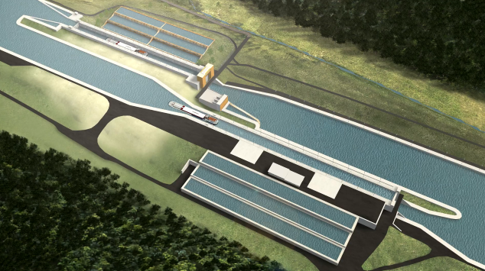
The new lock chamber will be 190 metres long and 12.5 metres wide, half a metre wider than the current structure. The project also includes an approach structure, upper head, lock chamber, outlet structure, lateral water-saving basins, and a bypass channel for managing water in the Main–Danube Canal.
The water-saving basins are designed to save around 60% of water during each locking operation. Construction is scheduled to run until 2033, with the Main–Danube Canal remaining fully operational throughout the works. The existing lock will only be closed once the replacement has been completed.
European inland waterways are gaining renewed attention as freight routes, climate resilience assets, and long-life infrastructure systems. Locks, canals, ports, embankments, and associated hydraulic structures receive less public attention than roads or railways, but they support industrial supply chains and offer an alternative to heavier road dependency for bulk movements.
Many of those assets are now decades old. Replacement and modernisation programmes have to deal with ageing concrete, changing vessel requirements, tighter environmental standards, water-management challenges, and the need to maintain operations during construction. In the case of Erlangen, keeping the canal open throughout the works will place heavy emphasis on sequencing, temporary works, logistics, and careful interface management beside an operational waterway.
The award also strengthens STRABAG’s recent European infrastructure pipeline. Its €177m D35 motorway contract in the Czech Republic showed continuing investment in continental transport infrastructure, while the Erlangen lock adds a major inland waterway scheme with a long programme and specialist civil engineering requirements.
Waterway construction creates technical demands that differ sharply from many land-based civils projects. Contractors must manage water pressure, cofferdams or excavation support, concrete durability, geotechnical behaviour, navigation safety, environmental protection, and operational continuity. The addition of bypass channels and water-saving basins further extends the work beyond a straightforward chamber replacement.
Bauer Spezialtiefbau’s role brings specialist foundation and geotechnical capability into the consortium, while STRABAG and ZÜBLIN provide the main civil engineering and delivery capacity. That blend is increasingly common on complex infrastructure projects where structural, ground, hydraulic, environmental, and operational risks overlap.
For Germany, the project contributes to the long-term viability of the Main–Danube Canal. For the wider European market, it shows how infrastructure renewal is broadening beyond headline rail and road schemes into strategic asset replacement. The most important construction programmes of the next decade may often be those that keep existing networks usable, resilient, and commercially relevant.
With completion scheduled for 2033, the Erlangen lock will be a long-duration test of construction alongside live infrastructure. Its success will rest on disciplined sequencing and technical execution as much as the headline value of the award.