IN Brief:
- The L30 and L35 receive their first major front- and rear-frame redesign since the compact loaders were introduced in 1998.
- New rear mounting points, easier hydraulic and electrical installation, improved service access, and revised cab entry are intended to broaden day-to-day versatility.
- Production of the updated machines is scheduled to begin in late 2026 following their public debut at GaLaBau in Nuremberg.
Volvo Construction Equipment has redesigned the front and rear frames of its L30 and L35 compact wheel loaders, marking the most substantial structural update to the two machines since the original models were introduced in 1998.
The revised loaders make their public debut at GaLaBau in Nuremberg this month, with production scheduled to begin in late 2026. Volvo has concentrated the redesign on rear-mounted equipment, service access, and operator entry while retaining the core hydraulic and driveline characteristics that define the existing machines.
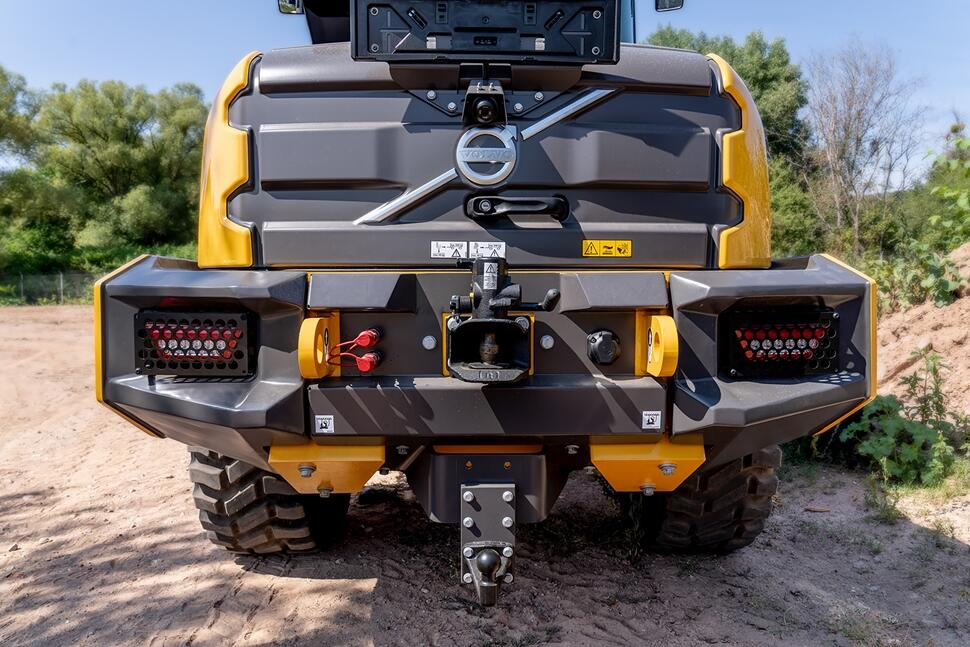
A new rear structure incorporates mounting points intended to simplify installation of equipment and trailer couplings. Hydraulic and electrical connections can also be added or retrofitted with less installation work, giving owners more scope to configure one loader for different site, industrial, agricultural, or municipal duties without extensive modification.
That approach reflects the way compact wheel loaders are commonly used on smaller and mixed sites. Rather than spending an entire shift on one repetitive loading cycle, a machine may move pallets, handle bulk material, tow equipment, clear a yard, work with sweepers or grabs, and support other trades. Attachment compatibility and the time needed to reconfigure the machine therefore have a direct influence on utilisation.
Volvo has retained adjustable auxiliary flow and high-flow hydraulic capability, with up to 100 litres per minute on the L30 and 110 litres per minute on the L35. The manufacturer also highlights the machines’ existing lifting and breakout performance, parallel movement for pallet-fork work, and portal axles with mechanical differential locks for traction.
The published specifications list the same 55.4kW Volvo D3.3H engine for both models. Operating weight is given as 5,600kg for the L30H reference configuration and 6,075kg for the L35H, while maximum standard travel speed is 20km/h and a high-speed configuration reaches 30km/h. Maximum hydraulic lifting capacity is listed at 60kN for the L30H and 63kN for the L35H.
Serviceability has been addressed through the redesigned rear end and changes to the frame. Split side-mounted counterweights can be removed when access is needed, while a larger opening in the front frame is intended to improve access to components and simplify the installation of extra hydraulic or electrical equipment.
Those changes sit alongside ground-level service points, long service intervals, machine monitoring, and Volvo telematics. For contractors, service access is rarely a headline specification, but it can decide how long a machine is unavailable for inspection, repair, or retrofit. Compact loaders are frequently deployed as general-purpose site assets, so an avoidable day off hire can remove several functions at once.
Cab access has also been revised. The new entrance uses three ergonomically positioned steps, handrails, and a wide-opening door, while the operator station retains a high seating position and all-round visibility. A five-inch display controlled through a jog wheel provides access to machine information, with heating as standard and air conditioning available as an option.
The update is evolutionary rather than a move to a new powertrain or machine class. Volvo is changing the structures and interfaces around an established platform while preserving familiar performance, with the emphasis on easier adaptation and maintenance rather than a different operating concept.
For fleet managers, the rear-mounting changes could be particularly useful where a compact loader moves between seasonal or specialist duties. The ability to fit auxiliary equipment, couplings, and connections with less fabrication or disassembly can reduce the friction involved in redeploying machines. It can also make retrofits more practical when the equipment requirement changes during ownership. On compact urban sites, maintenance yards, landscaping work, and smaller civil-engineering jobs, that flexibility can determine whether one machine covers several intermittent tasks or additional plant has to be brought in for short periods.
The redesign arrives as construction plant manufacturers put greater emphasis on uptime, versatility, operator ergonomics, and digital fleet support alongside headline power and capacity figures. Compact machines are often expected to earn their place by completing many small tasks efficiently rather than maximising output in one production cycle, so packaging and serviceability become part of the productivity calculation.
Volvo is retaining the established L30 and L35 identities while making their first major frame redesign in almost three decades. Production is due to begin in late 2026, with the revised machines centred on greater attachment flexibility, quicker maintenance access, and fewer practical barriers to using one compact loader across a broader range of work.