IN Brief:
- All 14 turbine foundations at the 63MW Clashindarroch II project were completed in an 11-week programme.
- The works used 11,256m³ of concrete incorporating supplementary cementitious material and around 1,190 tonnes of recycled reinforcing steel.
- Concrete was batched on site before turbine installation and first power planned for 2027.
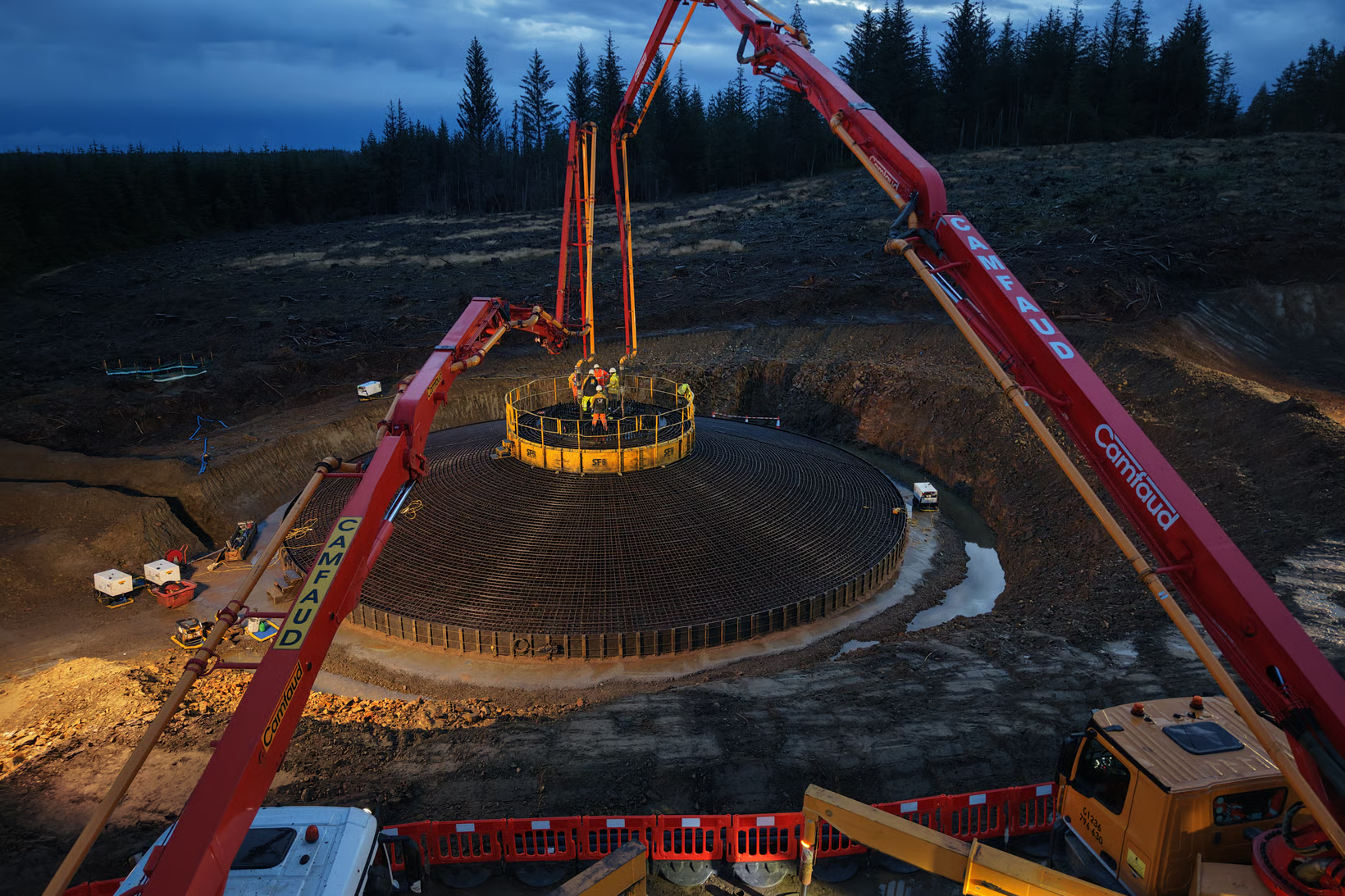
Vattenfall has completed all 14 turbine foundations at the 63MW Clashindarroch II wind farm in Aberdeenshire, finishing an 11-week concrete programme that combined recycled reinforcing steel, lower carbon binder material and temporary batching on site.
The foundation works consumed 11,256m³ of concrete in total, comprising around 10,136m³ in the main turbine bases and a further 1,120m³ for ducting and blinding. Approximately 1,190 tonnes of reinforcing steel was installed, equivalent to about 85 tonnes for each foundation.
Although the completed structures will ultimately support wind turbines, the engineering is primarily concerned with transferring large overturning and cyclic loads into the ground. Each base has to provide sufficient mass, stiffness and reinforcement while maintaining the positional accuracy required for the tower interface and associated electrical infrastructure.
The concrete mix incorporates at least 25% pulverised fuel ash as a partial replacement for Portland cement. Because cement manufacture accounts for a substantial share of concrete’s embodied carbon, reducing the conventional cement content lowers the emissions associated with the mix without removing the structural concrete needed for the foundation.
Vattenfall estimates that the formulation used on the project cuts embodied carbon by around 20% to 30% per cubic metre, depending on the final replacement level. Pulverised fuel ash acts as a supplementary cementitious material, allowing a proportion of the clinker intensive binder to be displaced while maintaining the required engineering performance.
Steel reinforcement was addressed separately. Recycled-content reinforcing steel was used across the foundations to provide the tensile capacity needed inside the concrete bases while reducing demand for virgin steel.
The reinforcing cages work with the concrete because the two materials perform different structural roles. Concrete carries compression efficiently, while steel reinforcement resists tensile and bending stresses generated through the base as turbine loads are transferred into the foundation.
Producing concrete close to the pour locations also changed the logistics of the programme. A temporary batching plant was established on site so aggregates, cementitious materials and water could be mixed near the foundations instead of bringing every load of ready mixed concrete from a distant permanent plant.
Shorter delivery distances reduce mixer-truck movements and fuel use while giving the construction team greater control during large pours. Concrete placement is also time sensitive because hydration begins after mixing, so shorter routes reduce the delivery risk created by traffic or other delays.
The first foundation was poured on 30 June, after which the project team completed all 14 over the following 11 weeks. Jones Bros Civil Engineering is delivering the balance of plant package, which includes foundations, access tracks, crane hardstandings, electrical infrastructure and cabling towards the Cairnford substation.
The wider civil engineering scope involves upgrading around nine miles of existing access tracks and constructing approximately five miles of new routes. Those tracks must carry abnormal-load deliveries and heavy lifting equipment before the turbines can be erected.
Crane hardstandings beside each foundation provide stable working areas for tower, nacelle and blade installation. Their design therefore has to accommodate concentrated loads that are very different from those generated by ordinary construction traffic.
Clashindarroch II will use 14 Vestas V136 turbines rated at 4.5MW each. Parts of the turbine towers are also expected to use lower emission steel, extending the project’s material strategy above ground.
The scheme is an extension of Vattenfall’s existing Clashindarroch development and is expected to reach first power in summer 2027. Once operational, its 63MW installed capacity is expected to generate electricity equivalent to the annual consumption of around 61,500 UK homes under RenewableUK’s methodology.
With the foundations complete, construction moves towards turbine delivery and erection. The concrete bases, reinforcement, tracks, hardstandings and buried electrical infrastructure will largely disappear beneath or around the finished wind farm, but together they form the physical system on which the generating equipment depends.