IN Brief:
- More than 2km of new track has been installed through the Huddersfield area.
- Teams also renewed 1.3km of track and more than 900m of railway drainage.
- Further Huddersfield station work will culminate in a 38-day closure over Christmas and January.
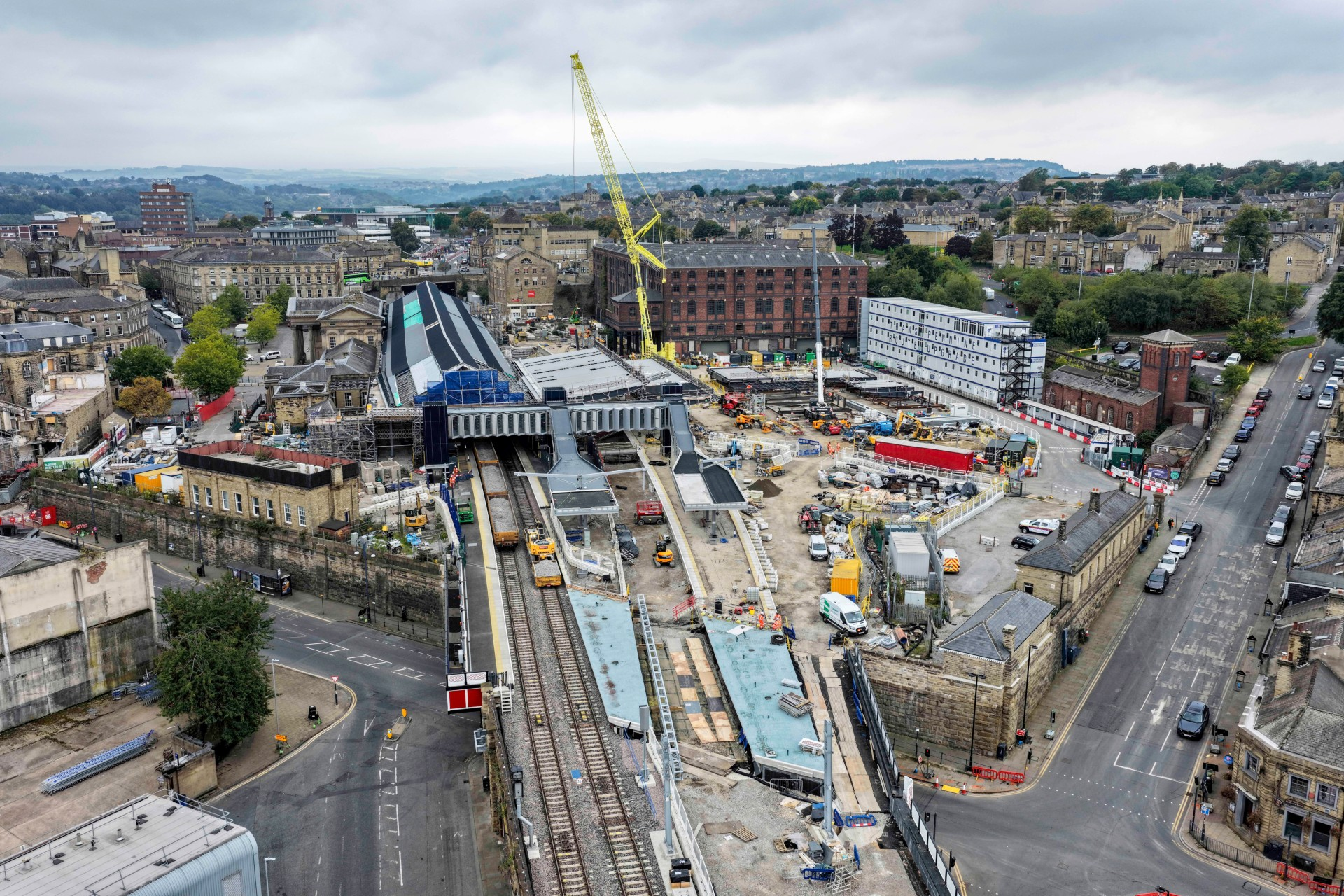
Network Rail and Transpennine Route Upgrade teams have completed 16 days of intensive construction around Huddersfield, installing more than 2km of new track while advancing station, drainage, signalling and electrification infrastructure.
The programme ran from 19 September to 4 October, using an extended railway closure to combine work that would have been considerably harder to deliver through short overnight possessions. Two new lines were installed through the Huddersfield area, increasing the physical capacity available once the wider route configuration is completed.
More than 1.3km of existing track was also renewed, while teams installed over 900m of new drainage. Those elements address different parts of railway performance: track renewal replaces worn infrastructure, whereas drainage controls water around the formation and reduces the risk of saturated ground, flooding or weakened track support affecting reliability.
At Huddersfield station, the closure allowed platform alterations and extensions to progress alongside restoration of the historic roof canopy and work on the pedestrian subway. The station is being remodelled around a revised track layout, with its underground route extended towards platforms 4, 5 and 6 as the wider upgrade changes how passengers and trains move through the site.
Construction at Deighton advanced in parallel. Platforms are being lengthened and a new accessible footbridge has been installed, with lifts due to provide step free movement between platforms when the structure is complete.
Coordinating those activities within the same blockade reduces the number of separate railway closures required for station, track and civil engineering packages. It also allows works that depend on one another to be sequenced together, particularly where platform edges, track alignment, access structures and signalling have to match the final railway geometry.
Electrification preparation moved forward at the same time, with more than 50 overhead line masts and over 50 steel support structures installed. Those structures will eventually carry the electrical equipment needed to supply trains, but their positions have to be coordinated with bridges, track clearances, signalling and other permanent infrastructure before wires can be commissioned.
That interaction is visible at the A62 Leeds Road bridge, where preparatory activity was undertaken ahead of future reconstruction. The structure has to provide sufficient clearance for overhead electrical equipment, so bridge work forms part of the electrification programme rather than a separate highway intervention.
Signalling installation also progressed during the closure, supporting the revised railway layout and the operational changes that will follow. Additional tracks provide limited benefit unless the signalling system can control train movements across them efficiently, particularly where stopping services and faster trains need to use different lines or overtake.
James Richardson, managing director of the Transpennine Route Upgrade, said: “Completing this latest phase of work is down to the dedication, skill, and teamwork of our teams. From infrastructure delivery to planning and keeping passengers on the move during the disruption to their journeys, every part of the programme has played a role in this latest work.”
The Huddersfield package forms part of the wider upgrade between Manchester, Huddersfield, Leeds and York. Across the route, the programme is combining electrification with additional tracks at constrained locations, station reconstruction, bridge modifications, signalling changes and renewals.
Those interventions are interdependent. Electric traction alone would not resolve the capacity constraints created where stopping and express trains share the same track, while extra running lines cannot achieve their intended effect without appropriate signalling, station layouts and junction arrangements.
The railway reopened on 5 October, but the current completion is only one stage in the Huddersfield programme. Further station closures are planned during October, November and December, followed by a substantially longer possession beginning after the final service on Christmas Eve.
Huddersfield station is then scheduled to remain closed for 38 days, reopening on 1 February 2027. That blockade will be used for another concentrated package of station and railway work before the principal station upgrade moves closer to completion.
With the September and October blockade finished, a substantial volume of permanent way, drainage, structural, accessibility and electrification preparation has moved into the completed programme. The next stages will build on those interfaces rather than treating each engineering discipline as a separate project.