IN Brief:
- More than 50 supply-chain partners worked on the Grade A-listed, 1,125-capacity theatre.
- The project extended the fly tower, levelled the stage, and renewed backstage and technical systems.
- Lifts now serve every public floor, providing step-free access from the street to seats and stage.
Robertson Construction has completed the restoration and refurbishment of Edinburgh’s King’s Theatre, returning the Grade A-listed venue to use after an extensive programme of heritage, structural, accessibility, and technical work.
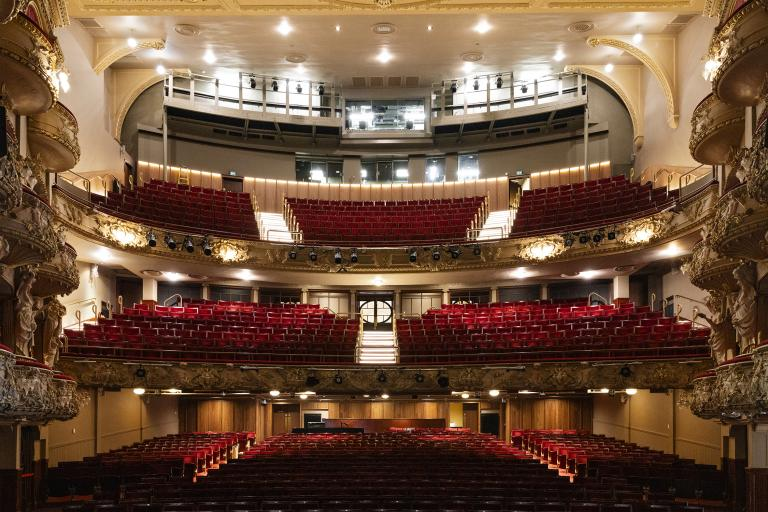
Robertson Construction delivered the scheme for Capital Theatres with more than 50 supply-chain partners. The 120-year-old building now provides a 1,125-person capacity across 9,184 sq m, retaining its Edwardian character while changing substantially behind the restored finishes.
The fly tower has been extended by 4.5 metres to accommodate larger touring productions, while the former raked stage has been replaced with a level structure. Backstage facilities, stage systems, and technical infrastructure have also been renewed.
Hospitality capacity has increased from 200 to 405 people. New foyers, bars, learning spaces, toilets, and a street-level café broaden the theatre’s use beyond performance times, while new feature windows increase daylight and visibility through the front-of-house areas.
Access inserted into a constrained historic building
The most consequential change is the introduction of step-free access from the street to seating and stage areas. Lifts now serve every public floor, wheelchair positions have increased across the auditorium, and the Dress Circle includes wheelchair accommodation for the first time.
Accessible toilets are available on every level, alongside a new Changing Places facility. The improvements address a long-standing weakness common to historic theatres, where changes in level, narrow circulation routes, and densely arranged seating can prevent parts of the building being used independently.
Retrofitting lifts and accessible routes into a listed theatre requires substantially more coordination than reserving space in a new structure. Shafts, landings, door openings, supports, fire compartments, and escape routes must pass through an inherited geometry whose most important decorative and spatial features cannot simply be removed.
The completed route must also work during live operation. Access that depends heavily on staff assistance or passes through service areas may comply with a drawing while remaining awkward in practice, particularly during busy arrivals, intervals, and evacuations.
Providing step-free movement to the stage recognises that accessibility applies to performers and employees as well as audiences. Backstage routes must accommodate equipment and production activity without forcing accessible users into circulation spaces designed primarily for scenery or servicing.
The new level stage changes the theatre’s production capability. A traditional rake can suit certain performances, but it restricts the scenery, machinery, and touring systems that can be installed. A level platform gives visiting productions a more familiar working environment and expands the range of events the venue can accept.
Replacing the stage required coordination with the auditorium, orchestra areas, backstage access, structural supports, and renewed technical systems. The work could not be treated as a simple floor replacement because even modest changes to stage height or geometry can affect sightlines, loading, scenery movement, and performance equipment.
The 4.5-metre extension to the fly tower provides additional vertical space for scenery and technical equipment. Although compact in plan, the tower is one of the most operationally important parts of the theatre and carries structural, weatherproofing, lifting, and alignment requirements directly above the stage.
Heritage conservation continued alongside those modern interventions. Original plasterwork, stained glass, and carved stone were repaired, requiring specialist trades to operate around new structure, services, and access routes without damaging retained fabric.
John Byrne’s All the World’s a Stage dome mural was stabilised and restored by specialist plasterers and Capital Theatres artists working approximately 100 feet above the auditorium floor. The access system had to place crews close enough for detailed conservation while protecting balconies, seating, decoration, and the artwork itself.
Robertson also used live progress-capture technology during the programme. Accurate visual records can be valuable during refurbishment because concealed conditions, temporary openings, and changes accumulate quickly, while later maintenance teams need reliable information on what remains behind completed finishes.
Digital capture cannot remove the uncertainty associated with a 120-year-old building, but it can reduce the number of decisions that survive only in informal recollection. That becomes particularly important where new services and fire-stopping pass through historic construction with limited access after completion.
The project created employment for 53 local people and supported 79 apprentices. Heritage construction depends on a relatively narrow pool of specialist skills, making training and supervised project experience important if plaster, stone, joinery, decoration, and conservation capacity is to remain available.
Completion transfers the building into an operational and seasonal-adjustment period. Audiences, performers, technical crews, catering staff, and maintenance teams will test the new systems at a scale that cannot be reproduced fully during commissioning.
Lifts, ventilation, lighting, stage systems, controls, acoustics, and accessibility routes now have to perform together during live events. Defects and operational conflicts will become visible more quickly than they would in a less intensively used building.
The theatre’s transformation is not simply the restoration of decorative surfaces. Robertson has adapted a listed building whose technical and access limitations were restricting its future use, retaining its recognisable character while replacing enough of the operational infrastructure to support modern productions.
The longer-term test will arrive through repeated touring schedules, maintenance cycles, and public use. The King’s must now prove that the systems inserted during refurbishment can remain accessible, reliable, and maintainable without requiring the historic building to undergo another major intervention prematurely.