IN Brief:
- Mace Construct will conclude its work on the Daubeny project at the end of 2026.
- Foster + Partners has redesigned the three partly built laboratory blocks as one interconnected research facility.
- The incoming contractor will inherit retained structure, altered interfaces, and a substantially revised delivery scope.
Mace Construct is set to leave the Daubeny laboratory project at Oxford Science Park at the end of 2026, with the Ellison Institute of Technology preparing to transfer the redesigned scheme into its next construction phase under a new contractor.
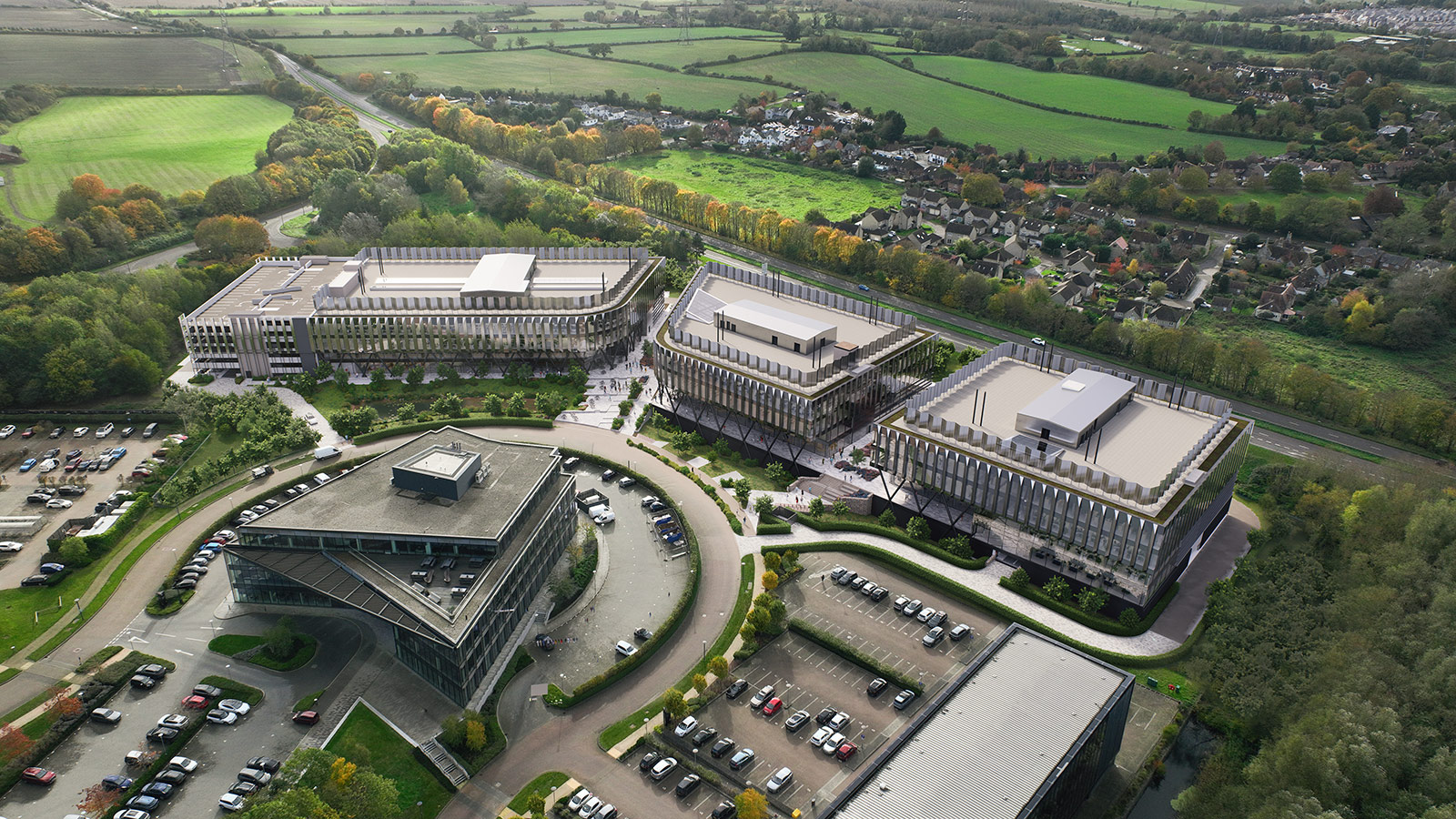
The change follows a major redesign of the partly built development, which was originally planned as three separate laboratory and office buildings. Foster + Partners has since reworked the scheme for the Ellison Institute, connecting the structures through two new atriums to create a single research and development facility.
Mace has worked on the project for around four years, initially for Oxford Science Park and subsequently following the Ellison Institute’s acquisition of the site. Its current package will conclude before handover at the end of the year, while the replacement main contractor has not yet been formally announced.
The contractor transition adds another delivery change to a project that has already undergone a substantial technical reset. The original development was designed by Scott Brownrigg and had progressed into construction before the site changed hands and the new owner decided to reshape the buildings around a different research programme.
Under the Foster + Partners proposals, the three structures will be linked to form one larger facility, with alterations to façades, internal arrangements, circulation, and building services. The revised scheme also requires changes to work already completed, including removal of parts of the existing envelope and rooftop plant before the new configuration can be built out.
The redesign had already shifted the project from completing three independent buildings to adapting a substantial partly built structure. Changing contractor now adds a new handover boundary across existing works, revised design information, temporary conditions, warranties, and outstanding construction interfaces.
Mace’s original project material describes a £191 million development providing around 454,000 sq ft of laboratory space, with floors capable of supporting a high proportion of wet or dry laboratory use. Structural design work had also reduced embodied carbon through changes including an alternative raft solution that cut piling and reinforcement requirements.
Those engineering decisions remain embedded in the structure despite the subsequent redesign. Retaining completed foundations and frame can preserve part of the embodied carbon already invested in the project and avoid wholesale demolition, but it also places greater emphasis on verifying what has been built before new work is connected to it.
Surveys, as-built information, tolerances, temporary works, and structural assessments become increasingly important when a new design is imposed on a partly completed building. Elements conceived for three independent blocks must now accommodate connections and loads arising from a single integrated facility.
Laboratory buildings add further coordination demands. Ventilation, power, cooling, resilience, vibration control, specialist gases, containment, and other research services can influence structural and spatial decisions throughout the building. Connecting previously separate blocks requires those systems to be reconsidered across new atriums, altered floorplates, and revised circulation routes.
The handover between contractors will therefore involve considerably more than transfer of an occupied site compound. Responsibility for completed work, design information, outstanding defects, temporary arrangements, procurement status, warranties, subcontract packages, and construction interfaces will need clear boundaries before the next delivery phase accelerates.
Retained work also has to be reconciled with the latest design model. Where installed components are removed or altered, the project team will need to establish how those interventions affect adjacent work and whether warranties or certification require additional inspection.
The change creates a particular challenge around building services because laboratory projects often require substantial plant capacity and dense distribution routes. Rooftop and internal equipment installed or procured for the earlier layout may not align cleanly with the revised research brief, increasing the importance of coordinated surveys before new packages are released.
The Daubeny development forms part of the Ellison Institute’s wider Oxford expansion, which includes further research facilities around the science park. The revised building therefore has to integrate with a broader campus strategy while its own construction sequence is reorganised around work already completed.
Mace will remain responsible for concluding its current package and preparing the project for transfer. A controlled handover will be critical if the redesign is to move from planning and enabling activity into sustained construction without creating further uncertainty over completed work or outstanding scope.
The replacement contractor and revised completion programme have yet to be formally confirmed. Until then, the immediate milestone is the planned year-end transition on a project that has already changed ownership requirements, architect, physical configuration, and delivery strategy since construction began.