IN Brief:
- Sections of the M42 and connecting motorway links will close from Friday evening until Monday morning.
- The possession supports beam installation for the M42 Motorway Box and deck work on the Water Orton viaducts.
- Further closures will follow as HS2 completes structures crossing the strategic road network.
HS2 construction work will require a full weekend closure of substantial sections of the M42 and connecting motorway links while major bridge and viaduct operations progress in Warwickshire and Solihull.
The northbound M42 will close between junctions 6 and 9, while the southbound carriageway will be shut between junctions 7a and 6. Restrictions will also affect the M6 junction 4a southbound link to the M42, the M6 northbound junction 3a connection to the M6 Toll at T1, and sections of the southbound M6 Toll.
Most closures are scheduled to run from 9pm on Friday 24 July until 5am on Monday 27 July 2026. A separate restriction on the southbound M6 Toll at T2 is planned from 10pm on Friday until midday on Saturday.
Balfour Beatty Vinci, HS2’s main works civil engineering joint venture for the West Midlands, will use the possession to continue installing beams for the M42 Motorway Box in Solihull. Work will also progress on deck installation for the Water Orton viaducts, where the new railway crosses the motorway in North Warwickshire.
The Motorway Box is a major structure carrying the M42 above the HS2 alignment. Its construction requires substantial temporary works, lifting capacity, traffic management, and survey control because permanent railway and motorway assets are being built within the same constrained corridor.
At Water Orton, the viaducts form part of an extensive network of bridges and elevated structures carrying the railway through an area already crossed by motorways, conventional railways, local roads, waterways, utilities, and established communities. Each interface reduces the available working space and increases the consequences of delay.
Fully signed diversion routes will operate throughout the closure, which has been scheduled across a weekend to reduce weekday disruption. The affected motorway links nevertheless carry substantial regional and long-distance traffic, including airport, freight, and distribution-centre movements.
Large road–rail interfaces cannot usually be delivered through short nightly closures alone, because beam installation, temporary restraint, surveying, deck placement, inspection, and carriageway handback require continuous access within a protected working area. Dividing the operation into several short shifts would add repeated mobilisation and safety checks while reducing productive installation time.
The work follows the transfer of A43 traffic onto a newly completed bridge above the HS2 alignment, where permanent highway infrastructure had to enter service before excavation and railway construction could continue beneath it.
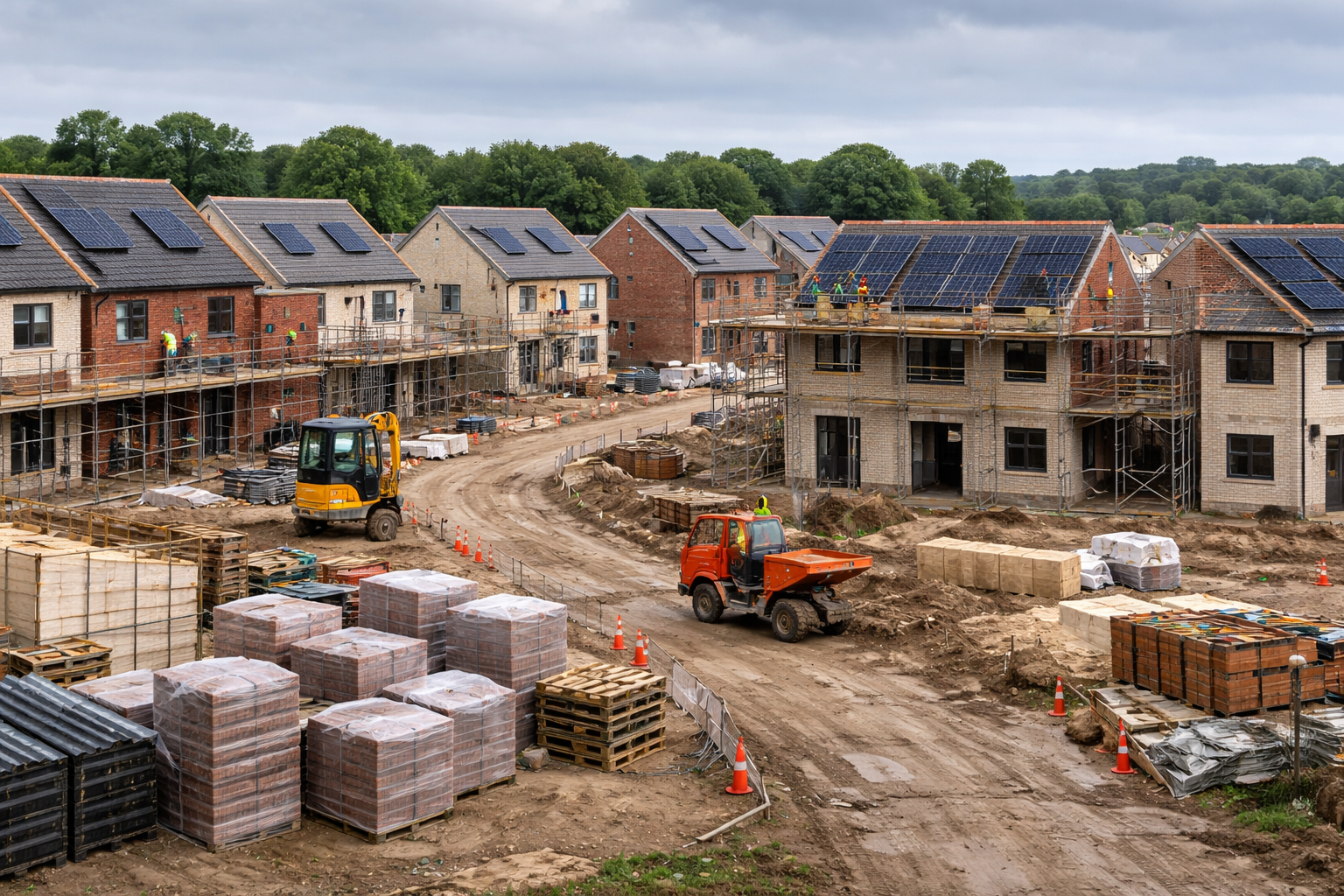
Motorway boxes, local-road diversions, utility corridors, drainage systems, temporary bridges, retaining structures, and environmental works account for a substantial part of rail megaproject delivery. Many must be completed before the main alignment becomes accessible, even though they sit outside the railway itself.
Risk is concentrated around possessions because a missed handback can disrupt thousands of road users and generate extensive knock-on costs. Lift plans, temporary-works checks, weather limits, plant redundancy, delivery sequencing, recovery arrangements, and inspection hold points must therefore be resolved before traffic is removed.
Beam installation also depends on fabrication and logistics well beyond the immediate site. Components must arrive in the correct order, with transport permits, escort arrangements, lifting accessories, identification records, and quality documentation complete.
A defect discovered after the motorway closes can consume a substantial part of the possession before installation has properly begun. Pre-delivery inspection, dimensional checks, contingency lifting equipment, and rehearsed recovery sequences reduce exposure during the limited closure window.
The contractor must balance construction productivity with the obligation to reopen the motorway at the published time. Conservative decision points may be required during the weekend, allowing enough time to secure incomplete work, remove equipment, inspect the carriageway, and restore traffic management where the full scope cannot be finished.
Public communication forms part of the traffic-management strategy because diversions can transfer congestion onto other motorways and local roads. Sat-nav systems may also direct drivers through communities that are not designed for motorway volumes, particularly when several routes close simultaneously.
Early coordination with freight operators, airports, emergency services, councils, and neighbouring schemes can reduce conflicting work and unmanaged traffic. The value of the closure is undermined if another project restricts the principal diversion route or if operators only discover the possession after vehicles are already committed.
Further closures are expected as the structures progress. Repeated possessions allow high-risk work to be divided into controlled stages, although each intervention increases pressure to demonstrate visible progress and maintain confidence in the wider programme.
The operations are continuing while HS2 undergoes a broader reset intended to improve control of scope, cost, and delivery. Existing contracts and partially completed structures still require safe, logical progression, particularly where leaving work incomplete would prolong disruption or create greater future cost.
Once the beams and deck elements are in place, follow-on activity will include structural completion, waterproofing, drainage, barriers, surfacing, systems installation, inspection, and eventual integration with the railway earthworks. The July closure marks a major construction stage rather than completion of either interface.
The possession gives BBV a continuous window for work that cannot proceed above live motorway traffic. Its success will be measured through both the structures installed and the controlled return of the road network before Monday’s peak traffic begins.