IN Brief:
- The Dynapac SD25 80C e placed 240.32 tonnes across two asphalt courses without intermediate charging.
- Its 294kWh battery provides peak system output of 235kW, with electric drives replacing major hydraulic functions.
- Live highway deployment shifts the commercial test towards charging provision, repeat utilisation, and fleet economics.
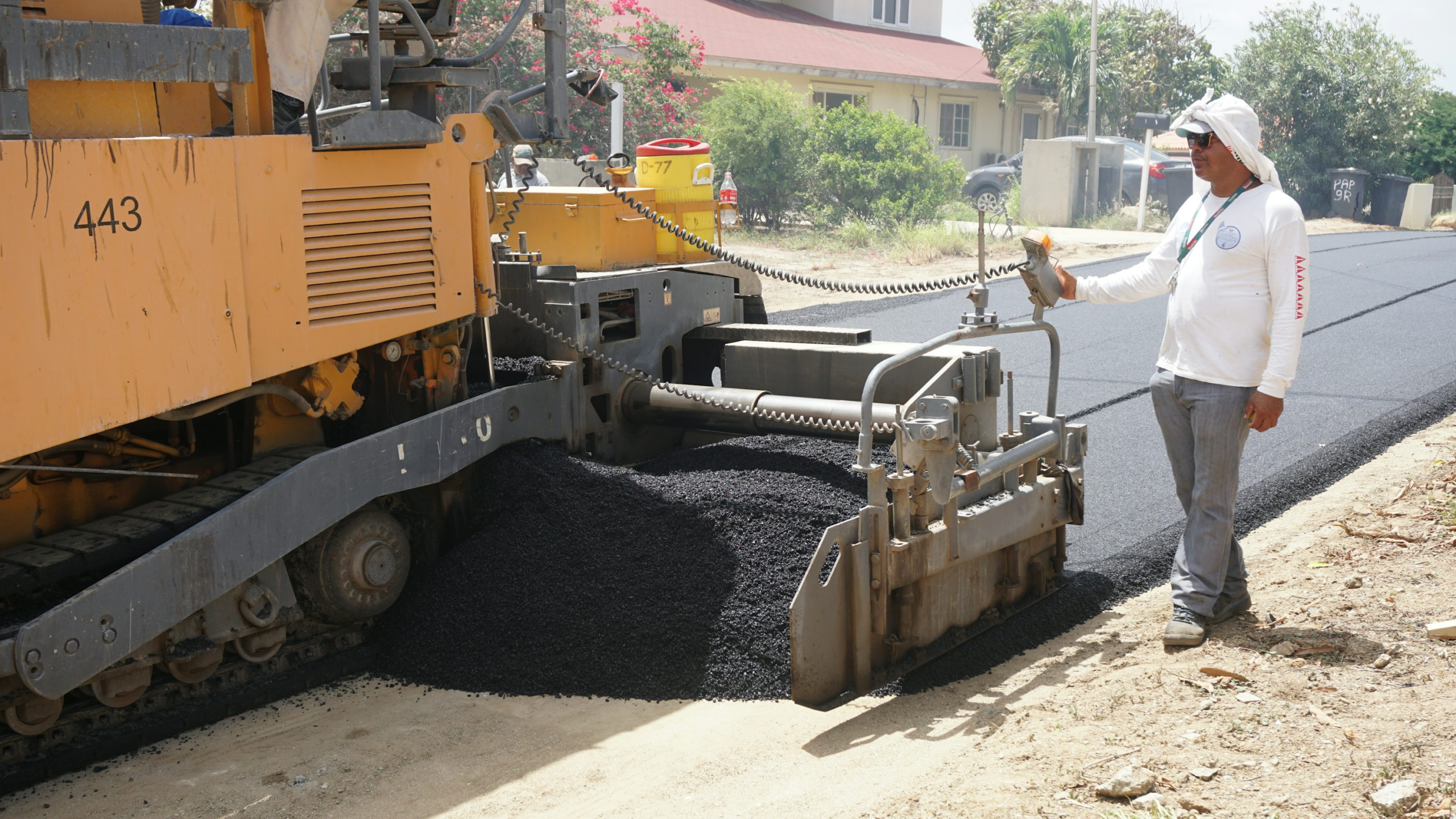
Eurovia Surfacing has completed an overnight trial of a battery-electric Dynapac SD25 80C e highway paver on the A128 in Essex, laying 240.32 tonnes of asphalt without an intermediate charge.
The machine finished the two-course resurfacing operation with 57% battery capacity remaining. Eurovia carried out the trial with Dynapac and SMT GB on an Essex Highways scheme at Tilbury Road in Brentwood, using the paver for both binder and surface courses.
Binder-course work began at 22:05, with the machine placing 139.58 tonnes of AC 20 HDM 40/60 Tempera warm-mix asphalt. It then laid 100.74 tonnes of Fibrovia 10 PMB 68 PSV surface course, completing the final load at 01:08 after operating the electrically heated screed throughout the shift.
The trial gives a useful duty-cycle figure because paving equipment works as part of a production train rather than in isolation. A paver has to remain synchronised with asphalt deliveries, compaction equipment, traffic-management windows, material temperatures, and the preparation and finishing work around it.
Dynapac specifies the SD25 80C e with a gross battery capacity of 294kWh and peak system output of 235kW. Five permanent-magnet synchronous motors supply the electric drive functions, while the machine retains a basic paving width of 2.55 metres, a maximum width of six metres, and a theoretical placement capacity of 800 tonnes per hour.
Those figures put the machine into highway-scale surfacing rather than light urban paving. Contractors considering electric plant still need equivalent production capability because reduced local emissions offer little operational advantage if the paver cannot keep pace with asphalt deliveries or complete work within a road-closure window.
The Essex test suggests battery capacity need not be the immediate constraint on every overnight resurfacing shift. More than 240 tonnes were installed while less than half of the available charge was consumed, although energy demand will change with paving thickness, material temperature, screed configuration, gradients, waiting time, weather, and the pace of the wider operation.
Charging infrastructure remains the more complicated fleet issue. Dynapac lists a 5% to 80% direct-current charge time of around 40 minutes where a 235kW supply is available. On a 43kW AC connection, the same charge range takes about four and a half hours.
That difference becomes material when electric equipment is deployed across changing highway sites rather than from a fixed depot. Temporary compounds may not have high-capacity grid connections, and a contractor operating several electric machines at once has to manage charging demand alongside lighting, welfare, and other site loads.
Surfacing also leaves limited tolerance for an unplanned stop. Asphalt arrives hot and has a finite workable period, so a charging interruption can affect delivery vehicles, paving continuity, joints, and the compaction sequence as material cools. Predictable state of charge is therefore part of production control rather than simply a fleet-management statistic.
Telematics and energy monitoring will become increasingly useful as contractors build operating data across different jobs. Dynapac includes its Dynalink Advanced Telematics platform and digital operating systems on the machine, giving fleet teams a way to compare actual consumption with tonnage, shift length, waiting time, and other site conditions.
The material used during the Essex trial adds a second decarbonisation measure. Eurovia laid warm-mix asphalt for the binder course, reducing production and paving temperatures compared with conventional hot-mix material, while the paver itself removed diesel exhaust emissions from one of the principal machines at the workface.
Electrifying the paver does not make the resurfacing operation emission-free. Asphalt production, haulage, rollers, traffic-management vehicles, lighting, and electricity generation all remain part of the carbon account, but the trial shows how equipment and material changes can be combined within the same construction process.
Local air quality and noise may also influence deployment on urban night work. Removing a diesel engine from the paver reduces direct exhaust emissions around the crew and changes the machine’s noise profile, potentially improving working conditions where resurfacing is carried out close to homes or businesses.
The commercial question is more difficult. Battery-electric heavy plant carries a higher capital cost than established diesel equipment, and the whole-life calculation depends on utilisation, charging assets, electricity prices, maintenance, residual value, and whether the machine can complete enough productive shifts to justify the additional investment.
Eurovia’s A128 trial does not settle that calculation, but it supplies a more useful piece of evidence than a demonstration run. A highway-class electric paver completed a live two-course resurfacing shift without recharging and retained more than half of its battery at the end.
The next stage for fleet operators is to repeat that performance across different sites, shift lengths, weather conditions, and production rates. The A128 operation has established the machine’s paving capability; charging provision and utilisation will determine whether the same result can be repeated economically at fleet scale.