IN Brief:
- Procore introduced AI Go at Groundbreak 2026, with voice-based access to drawings, RFIs, submittals, logs and other project information.
- A Meta AI glasses integration is in closed beta, while the AI Go phone application is in open beta for eligible North American customers.
- Separately, an NVIDIA Omniverse integration in closed beta links project models with 3D visualisation and potential simulation of construction and scheduling risks.
Procore has introduced a voice operated mobile application for construction project records and outlined separate integrations with Meta AI glasses and NVIDIA digital twin technology. Announced at Groundbreak on 21 October 2026, the developments cover two distinct tasks: obtaining reliable information during site operations and testing project scenarios before changes are implemented in the field.
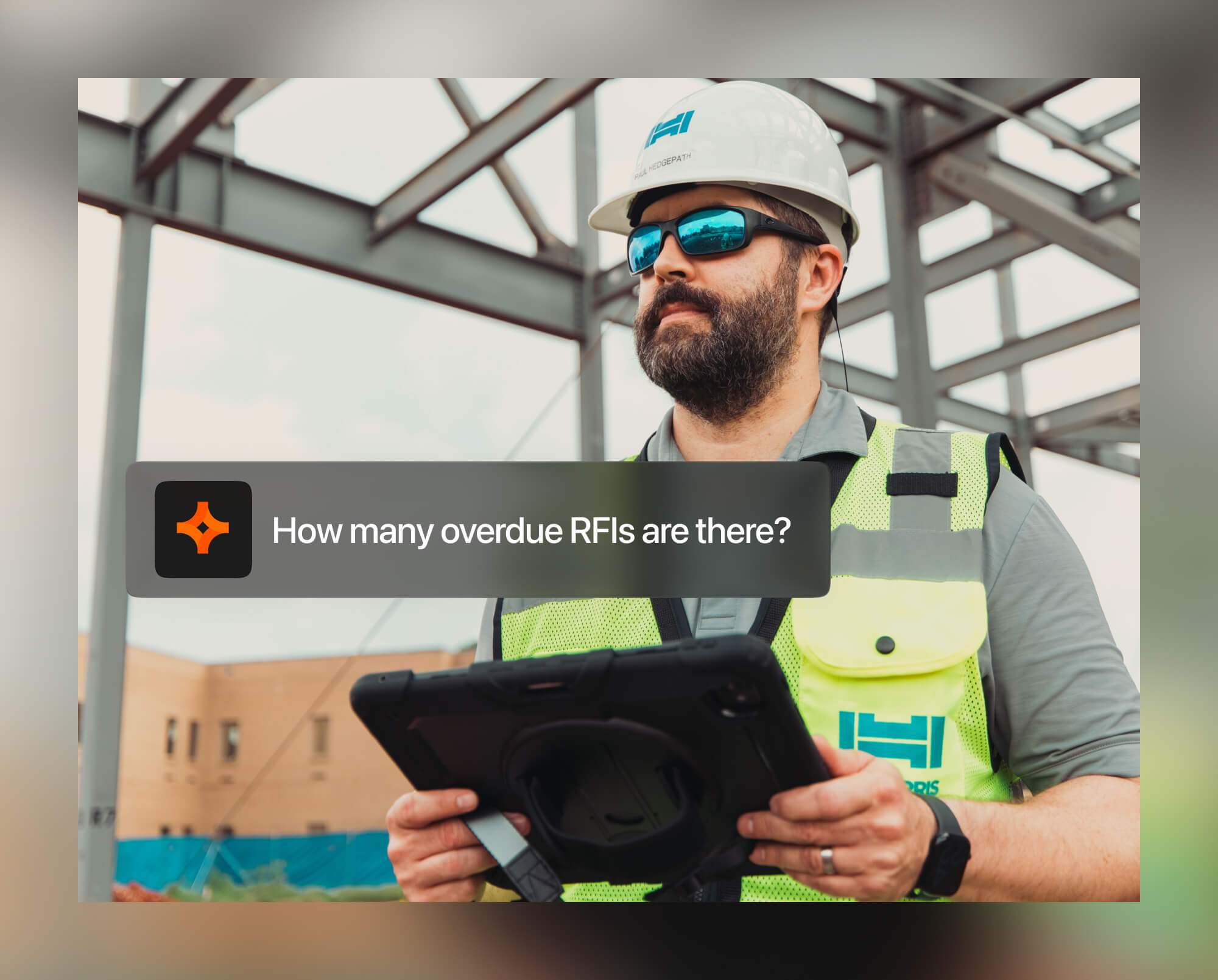
Procore AI Go is designed to answer spoken questions using information already held within a contractor’s project environment. The user can query drawings, specifications, requests for information, submittals, inspections, observations and daily logs without opening each document individually. Procore says the system can return supporting project evidence and respond to follow-up questions, so that the answer can be traced back to the material on which it is based.
That traceability is an important limit on what a voice interface can achieve. A current drawing revision and a superseded drawing may describe different site conditions; a request for information may still be awaiting an engineer’s response. Retrieving either record more quickly does not settle which instruction governs the work. The application therefore depends on normal document controls, permissions and the quality of project records, rather than replacing the technical review undertaken by the project team.
The mobile application uses push-to-talk controls intended to reduce accidental activation in noisy site environments, while conversation history is retained on the user’s device. AI Go is in open beta for eligible North American customers on Procore’s Digital Coworker Starter, Pro and Enterprise packages. That is a limited release, not evidence that the service is generally available to UK contractors or that it has passed evaluation under every site operating condition.
Procore’s work with Meta would extend parts of the interface to AI glasses. The planned integration is intended to let a worker request information or capture a first-person site photograph using spoken commands while keeping a phone out of their hands. The glasses integration remains in closed beta. The announcement does not establish that the equipment is appropriate for all tasks involving personal protective equipment, plant movements or restricted visibility; those questions remain dependent on site rules and the conditions in which it is used.
Evidence of any operational benefit is being sought through a study involving Moss Construction and independently designed by SBK Technologies. The programme is examining AI agents, the AI Go application and wearable equipment to see whether time spent on administrative tasks can be reduced. Procore has identified the study’s purpose, but has not released comparative results proving a particular time saving or a reduction in programme delays.
Further functions are planned for the mobile software, including creating daily logs and observations, preparing draft RFIs and converting spoken notes and photographs into structured records. Procore also describes future agents intended to organise information for a daily report or flag potential safety hazards for human follow-up. These functions belong to the roadmap, rather than to every capability already available in the current AI Go beta. Their practical usefulness will depend on how proposed entries are checked before becoming part of the contractual project record.
The NVIDIA collaboration addresses a different information problem. Its current closed beta connects Procore’s Model Manager with Realism Mode, using NVIDIA Omniverse libraries to represent project models in a more detailed three-dimensional setting. The aim is to examine how site conditions, changes and construction sequencing could affect delivery while design and programme decisions can still be adjusted. This is a simulation capability under development, not a verified prediction of what will occur on any particular project.
One proposed input is reality capture associated with Procore’s DroneDeploy business. Aerial and ground-level site imagery can be considered alongside design information to expose discrepancies between planned and observed conditions. The companies also describe linking 3D models to procurement and programme information, for example to assess the consequences of a delayed equipment delivery or installation on following activities. In each case the model depends on current records of site progress, supply dates and task dependencies.
Scenario testing could additionally represent extreme weather, sun exposure and the movement of workers or construction equipment. Such visualisations may help planners identify an access conflict or a sequence that requires modification before crews encounter it on site. They do not calculate a definitive project outcome: weather assumptions, geometric accuracy, activity durations, site constraints and the reliability of captured conditions all affect what a simulation can usefully show.
Large data centre construction is one context cited by the companies because electrical distribution, cooling, computing infrastructure and building works must be coordinated within demanding programmes. Procore cites a projection of nearly $7 trillion in global data centre infrastructure investment by 2030, although that estimate has not been independently established in the supplied announcement. Switch, a data centre developer and operator using both companies’ products, has commented on the potential value of clearer three-dimensional project visibility; it has not supplied independently measured savings from the new integration.
Steve Davis, president of product and technology at Procore, said: “Construction is inherently physical, but in the future, the most successful and resilient megaprojects will be built digitally first.” The company’s published availability terms are narrower than that ambition. The NVIDIA integration is in closed beta, while other spatial functions, including Model Manager and Commissioning, are progressing through beta and a separate integration with IBM Maximo remains planned.
Voice retrieval and spatial simulation both rely on consistent project information, even though they address different users and workflows. A field worker needs the correct revision of a specification; a project planner needs an accurate picture of what has been built, what remains to be procured and what work is dependent on other activities. Faster access or more realistic imagery does not compensate for a missing inspection result or an outdated construction programme. These information controls will determine whether either technology produces useful decisions rather than more convincing displays of uncertain data.
The immediate commercial position is therefore limited. AI Go can be trialled by specified North American customers, and both the Meta wearables and NVIDIA digital twin integrations remain in closed beta. The Moss Construction study and later product releases may establish how the tools perform under site conditions, but no verified productivity or schedule benefit has yet been published for the combined initiatives.