IN Brief:
- The A38(M) Tame Valley Viaduct strengthening programme has reached completion after work on the 620m structure.
- Steel-plate strengthening, protective coatings, digital inspection, and confined-space controls were used while the route remained operational.
- Birmingham City Council delivered the scheme with VolkerFitzpatrick, Arcadis, AtkinsRéalis, and specialist subcontractors.
Strengthening work on Birmingham’s A38(M) Tame Valley Viaduct has reached completion, with Arcadis confirming the end of its project management and supervisory role on the live-infrastructure programme.
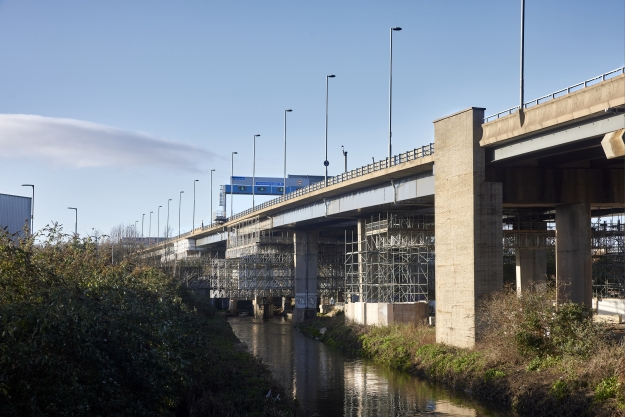
Birmingham City Council awarded the main strengthening and refurbishment contract to VolkerFitzpatrick in spring 2022. The 620m viaduct forms the northern end of the Aston Expressway near Junction 6 of the M6 and carries more than 90,000 vehicles a day between the motorway network and Birmingham city centre. Built in the early 1970s, the 22-span composite structure is around 25m wide and operates with a tidal-flow traffic system during peak periods.
The core engineering work strengthened the superstructure by adding steel plates secured through a combination of welding and bolting. The programme also included anti-corrosion coating and wider refurbishment intended to preserve the structure and reduce the need for further major intervention. Birmingham City Council reported in May that planned strengthening and refurbishment works had been completed, with the remaining activity focused on demobilisation, reinstatement, and handing back work areas.
Delivery conditions made the programme more complicated than the structural scope alone suggests. The viaduct passes above live electrified rail lines, the River Tame, major roads, local businesses, and constrained land. Keeping the A38(M) operational while work progressed required high-level access platforms spanning between piers, staged closures and traffic management, and careful control of work inside and beneath the structure.
Arcadis says digital tools formed part of the delivery approach, including 360-degree imaging, data-driven quality management, and platforms that allowed remote access to constrained work areas. Those tools were used alongside enhanced confined-space controls for work inside the viaduct’s box girders. The project team also included Birmingham City Council, AtkinsRéalis, VolkerFitzpatrick, and a range of specialist subcontractors responsible for access, steelwork, coatings, and reinstatement.
Ageing urban infrastructure increasingly has to be treated as an asset-management problem rather than a straightforward replacement opportunity. A full rebuild of a structure carrying tens of thousands of vehicles each day would create a different order of traffic, cost, carbon, land, and programme impact. Targeted strengthening can preserve capacity while avoiding that disruption, provided inspections, structural assessment, and intervention design give the asset a credible extended service life.
That logic places more emphasis on information quality. When work is concentrated on specific structural weaknesses, the project team needs a detailed record of existing condition, completed repairs, welds, bolts, coatings, access constraints, and emerging defects. Digital imagery and data-led quality systems are particularly useful on structures where large areas are difficult to inspect repeatedly in person and where evidence has to remain accessible after scaffolding and temporary access are removed.
Confined-space work adds another layer. Box girders create limited access, restricted movement, ventilation requirements, rescue planning, and close coordination between trades. Combining those hazards with live traffic above, rail infrastructure below, and work around the River Tame means construction sequencing is inseparable from safety planning. The project therefore depended on managing access windows and work fronts as carefully as the strengthening design itself.
The council’s project information shows how long that sequence has run. Works started in June 2022, with strengthening, painting, access, and reinstatement moving through multiple phases while the viaduct remained in service. By May 2026, the final strengthening and refurbishment activities were complete and teams were removing materials, dismantling the last scaffold sections, restoring stakeholder land, and clearing the Aston Hall Road compound.
There is also a procurement lesson in the scheme’s duration. Multi-year strengthening projects on strategic routes have to absorb changes in access, traffic management, subcontractor availability, and asset condition without losing control of the core engineering outcome. The ability to keep the viaduct open meant temporary works and sequencing carried unusual importance throughout delivery. That is often where life-extension schemes differ most from new build: the finished intervention may be relatively targeted, but the construction system needed to install it safely around an operating asset can be extensive and technically demanding.
Completion removes a major maintenance intervention from a route linking the M6 directly with Birmingham city centre. The scheme also illustrates a broader approach to ageing transport assets: more intrusive inspection, better digital records, targeted structural work, and longer periods of construction around live networks. Where replacement would impose greater cost and disruption, similar strengthening strategies are likely to remain central to the management of bridges and viaducts built during the same era.