IN Brief:
- The Kirklevington Grange expansion will add 152 prison places across three two-storey accommodation blocks.
- Reds10 will use 181 modules, with more than 85% of the accommodation completed off-site.
- Prisoners are working on foundations and manufacturing activity as construction progresses.
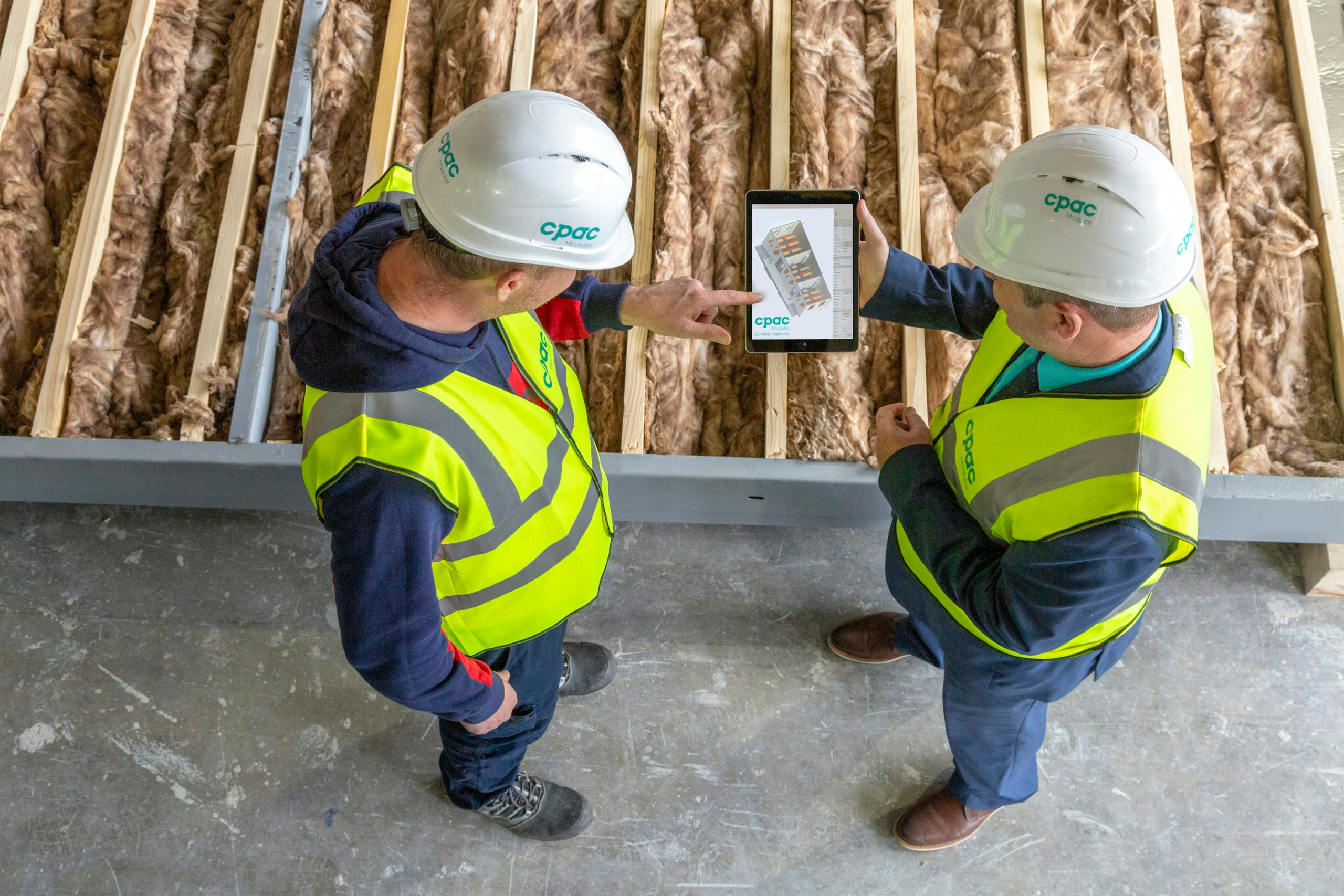
Construction has started on 152 additional places at HMP Kirklevington Grange near Yarm, where Reds10 is using an off-site manufacturing model in which more than 85% of the new accommodation will be completed away from the prison.
The expansion will deliver three two-storey accommodation blocks with supporting facilities and infrastructure. The accommodation is being assembled from 181 modules under the Ministry of Justice’s Rapid Deployment Cells programme, with Reds10 acting as principal works contractor. A groundbreaking event took place on 10 September, bringing the project formally into construction.
The scheme also includes a workforce element unusual even for public-sector modular construction. Two prisoners are working on the foundations at Kirklevington Grange through Release on Temporary Leave arrangements, while prisoners on temporary release are also working with Reds10 on the manufacture of rapid deployment units used across the wider estate. The Ministry of Justice says three prison leavers are now permanently employed by the contractor.
Rapid Deployment Cells are designed to add accommodation to existing prison sites faster than conventional houseblock construction. The approach uses factory-built units that can be installed on comparatively small parcels of land within operational estates, reducing the amount of work that has to be undertaken inside secure sites and allowing a larger share of production to take place in controlled manufacturing conditions.
At Kirklevington Grange, that manufacturing ratio is central to the delivery strategy. Completing more than 85% of the accommodation off-site shifts a substantial part of structural assembly, internal work, quality control, and sequencing away from the prison. Site activity still has to cover foundations, service connections, lifting operations, interfaces, external works, and final commissioning, but the critical path is less dependent on completing every trade sequentially inside the live establishment.
Kirklevington Grange provides a practical test of modern methods of construction in an environment where programme certainty matters as much as speed. Prisons impose additional access, security, logistics, and safeguarding constraints that can complicate conventional construction. Manufacturing modules in parallel with groundworks can shorten the period in which those constraints affect the main build, while standardised components allow repeated work to be controlled more closely than on a one-off traditional block.
The Ministry of Justice has committed to delivering 14,000 additional prison places by 2031 and says 3,300 have been delivered since July 2024. The wider programme includes a recently opened 1,500-place prison at HMP Millsike near York, additional accommodation at HMP Northumberland, HMP Humber, HMP Holme House, and HMP Deerbolt, and early works towards a new 1,700-place prison in Lancashire.
That pipeline gives industrialised construction a role beyond an isolated modular demonstration. Repeat demand creates the conditions in which design standardisation, factory loading, procurement, and learning between projects can start to influence cost and programme. The benefit depends on discipline: repeated modules only create efficiency if design changes are controlled, interfaces are resolved early, and factory production is matched to foundations, utilities, transport, and lifting capacity on site.
Kirklevington Grange also adds a skills dimension to that delivery model. Prisoner participation in foundations and manufacturing work is intended to provide practical experience and qualifications that can transfer into employment after release. The arrangement gives Reds10 a direct link between the construction programme and a potential workforce pipeline, although its effectiveness will depend on sustained training, supervision, and routes into paid work rather than participation during a single project.
Off-site delivery also changes the supply-chain profile of the job. Instead of concentrating labour almost entirely at Kirklevington Grange, the project divides activity between factory production, transport, cranage, and site installation. That can improve repeatability, but it creates its own coordination requirements: modules must leave the factory in the correct sequence, arrive when lifting capacity and foundations are ready, and connect cleanly to services and external works. A delay in one location can quickly transfer to another, so logistics planning becomes part of production control rather than a separate site function.
HMP Kirklevington Grange is an open prison focused on preparing men for release and resettlement in the North East. That makes the combination of new accommodation and construction employment particularly aligned with the site’s existing role. The physical works will add capacity, but the more interesting construction test is whether a highly standardised off-site system can deliver quickly while still accommodating secure-estate requirements, live-site logistics, and a workforce model that reaches beyond the immediate build.