IN Brief:
- GPE completed 30 Duke Street St James’s on time and on budget, with all office and retail space pre-let.
- Recovered steel makes up 78% of the structural frame, cutting its associated carbon by around 90% against an all-new frame.
- The completed project provides a commercial-scale reference for structural material reuse in high-value office construction.
Great Portland Estates (GPE) has completed 30 Duke Street St James’s in central London, delivering a fully pre-let office and retail development in which 78% of the structural steel frame has been sourced from recovered material.
The development was completed on time and on budget, with global investment firm CD&R having committed to the office accommodation more than a year ahead of completion. The building’s two retail units have also been pre-let, to Australian menswear company M.J. Bale and restaurant group L’Eto.
Average rents across the completed scheme were secured 6.7% ahead of estimated rental value, according to GPE. The developer expects the project to deliver a development profit on cost of 37.1% and an ungeared internal rate of return of 30.5%, giving the circular-construction elements a commercial context beyond their embodied-carbon performance.
Designed by Make Architects and delivered with Mace as construction partner, 30 Duke Street provides column-free office floorplates and more than 3,700 sq ft of roof terraces. Its more unusual engineering feature is the decision to make recovered structural steel a major component of the permanent frame rather than confine reused material to secondary finishes or non-structural elements.
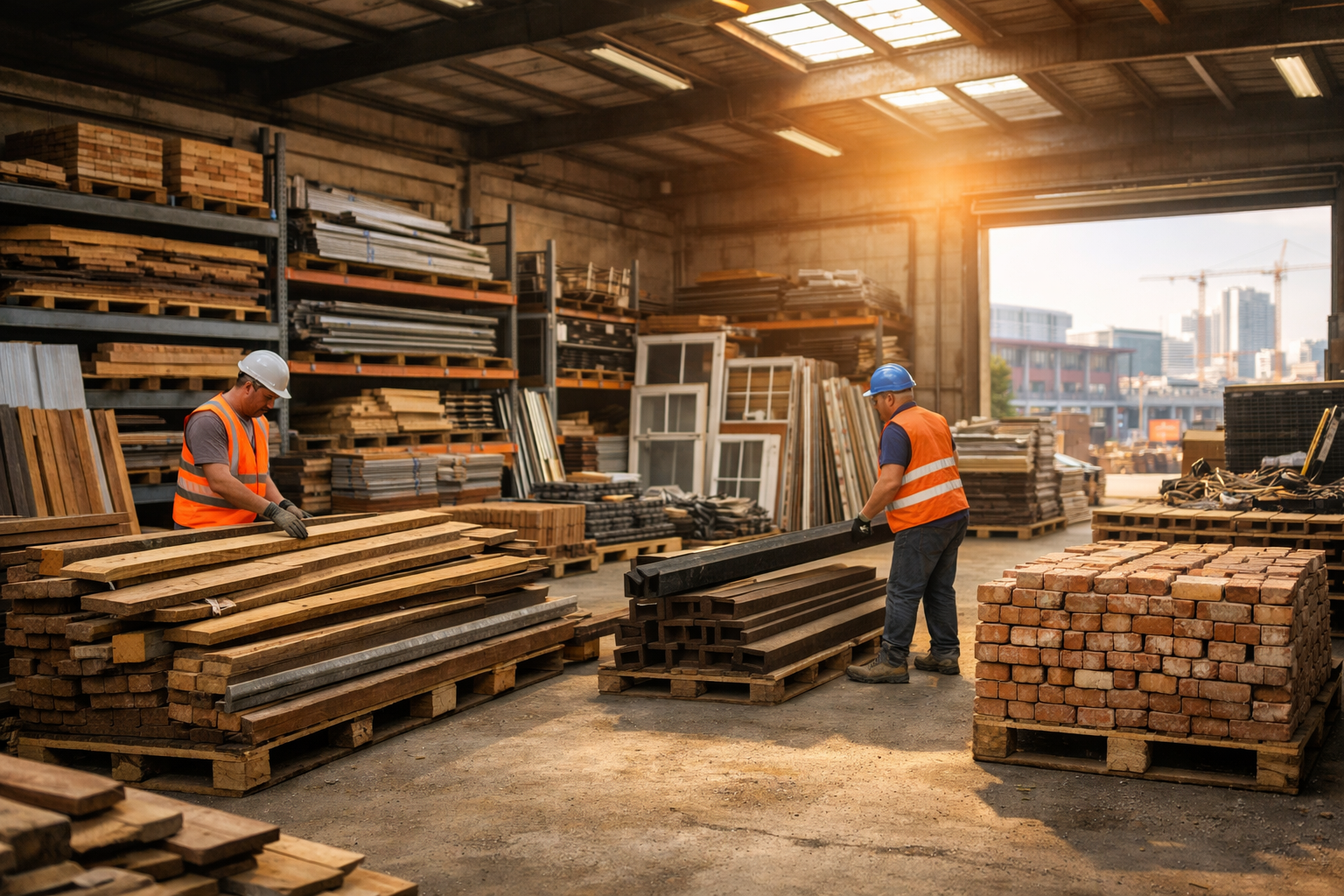
Most of the reused steel was recovered from City Place House, another GPE asset that was deconstructed as part of the redevelopment now known as 2 Aldermanbury Square. Structural members were removed, assessed, processed, re-certified, and incorporated into the new St James’s building rather than being sent directly into conventional scrap recycling.
GPE says the approach reduced the carbon associated with the steel frame by around 90% compared with constructing the same frame entirely from new material. The developer believes the project to be the UK’s largest office steel-reuse scheme, giving it relevance beyond the immediate West End development.
The principle behind structural reuse is straightforward. A steel beam that remains suitable for service already contains the energy and emissions generated during mining, steelmaking, rolling, fabrication, and its first construction cycle. Reusing the member preserves more of that embedded value than melting it down and producing another section.
The practical delivery model is less simple. Reused steel has to arrive with enough information for structural engineers, fabricators, insurers, building-control teams, and clients to treat it as a specified construction product rather than uncertain demolition salvage.
That requires traceability, dimensional checks, condition assessment, testing where necessary, and re-certification. Available sections also have to be matched to a new structural design, creating a procurement process in which the receiving project cannot assume that every member will be available in the exact grade, size, and length normally ordered from a new-steel supplier.
The construction sequence changes as a result. New steel can be purchased against a completed fabrication schedule, while reused members become available according to the deconstruction programme of the donor building. Removal, storage, transport, inspection, processing, redesign, and fabrication therefore have to be coordinated across two developments rather than one.
GPE has an advantage because both the donor and receiving schemes sat within its own development pipeline. That gives the company visibility over when structural material will become available and allows engineers to consider future reuse before the existing building has been taken apart.
The developer has said around 450 tonnes of recovered structural steel were reused at 30 Duke Street, with more material from the donor project returned to the market for use elsewhere. The building also incorporates other circular measures, including reused stone, recycled aluminium, recycled glass, and reused or remanufactured internal materials.
For the wider construction market, however, steel is the more significant test because the structural frame sits much closer to the critical path than reclaimed finishes. A failure to secure the right sections at the right time can affect fabrication, erection, follow-on trades, and ultimately practical completion.
That means material reuse has to influence design earlier. Engineers cannot simply optimise a frame around unrestricted new-steel availability and then look for second-hand sections that happen to match it. Grid dimensions, member selection, connections, tolerances, and fabrication strategy have to respond to the recovered inventory.
Circular construction therefore becomes partly an information and project-management exercise. Clients, demolition contractors, structural engineers, designers, fabricators, logistics providers, and main contractors need visibility of material condition and availability at stages where conventional projects have historically operated through a more linear sequence.
30 Duke Street is particularly useful because that additional complexity was absorbed within a prime commercial scheme whose programme and leasing expectations remained conventional. The project still had to finish to the required standard, meet its completion date, satisfy occupier requirements, and produce an acceptable financial return.
The completed building does not remove the barriers to wider structural reuse. Developers without suitable donor assets may have to purchase recovered sections on the open market, while storage, insurance, certification, warranties, design liability, and reliable digital material records remain uneven.
Transport and handling can also erode part of the carbon and cost advantage if members have to move through several temporary storage or processing locations. The business case depends on the relationship between new-steel pricing, demolition costs, re-certification, fabrication, logistics, and the value a client places on embodied-carbon reduction.
Even so, completion changes the nature of the evidence. The development is no longer an engineering proposal or a circular-economy trial under construction: recovered steel has been incorporated into a completed, fully pre-let commercial building delivered on programme and budget.
For the industry, that is the more transferable result. Structural reuse becomes considerably easier to specify on the next project once a completed scheme has demonstrated that the material strategy can survive the commercial disciplines that normally kill experimental ideas long before practical completion.