IN Brief:
- Select Plant Hire is spending £5m on JCB excavators, site dumpers, and Loadall telehandlers.
- The order includes reduced-tailswing excavators and 9T dual-drive dumpers designed for constrained working areas and improved visibility.
- Fleet performance will depend on utilisation, reliability, maintenance demand, and how effectively machine types are matched to site tasks.
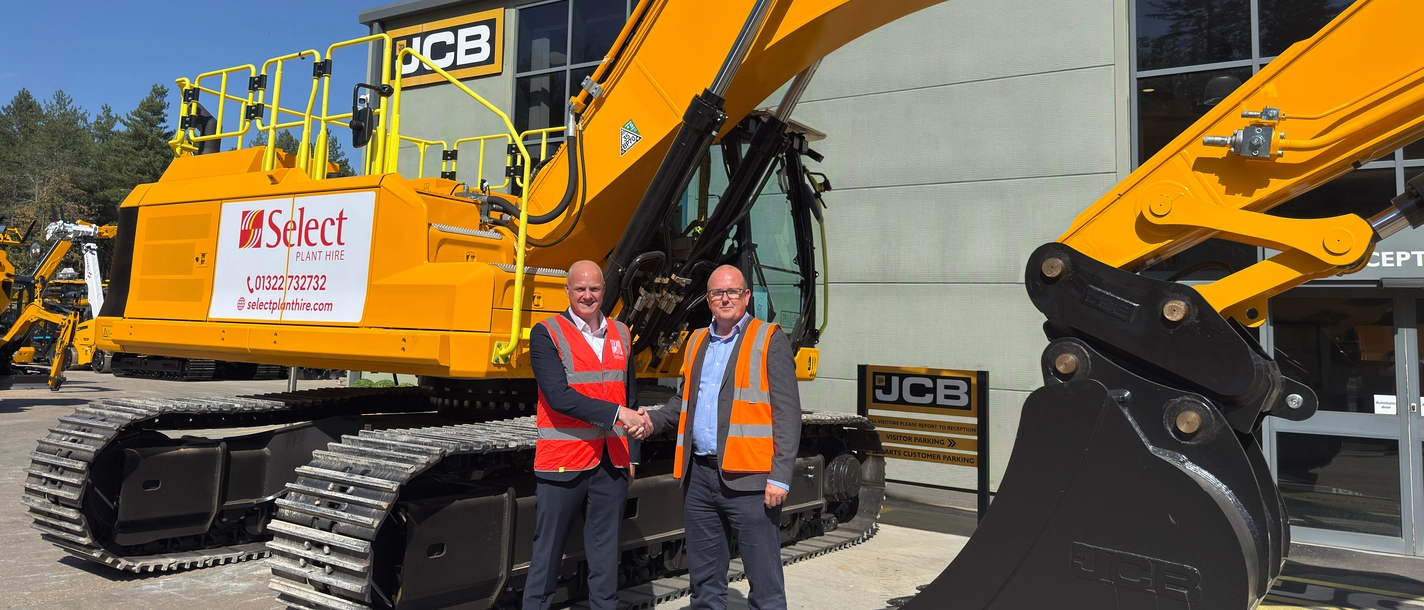
Select Plant Hire is investing £5m in new JCB machinery as it expands the fleet supporting major UK construction and infrastructure projects. The order, supplied through Greenshields JCB, covers tracked and reduced-tailswing excavators, site dumpers, and telescopic handlers, adding capacity across earthmoving, materials handling, and site logistics.
The excavator element includes JCB 370X tracked machines alongside 245XR and 145XR reduced-tailswing models. The order also includes 9T dual-drive dumpers and Loadall telescopic handlers, broadening the purchase beyond heavy excavation. Select is part of the Laing O’Rourke Group and supplies plant, equipment, accommodation, lifting, logistics, and other services to construction and infrastructure projects.
The 9T dual-drive dumper is one of the newer products in the package. JCB introduced the model in 2026 with a rotating seat and control unit that allows the operator to face the direction of travel rather than repeatedly reversing with a loaded skip restricting the view. The machine uses a 55kW DieselMAX engine, a two-speed hydrostatic transmission, and has a maximum travel speed of 30km/h.
For Select, the purchase is intended to maintain a modern fleet while supporting current customers and a growing project pipeline. Large plant businesses carry significant capital and maintenance costs, so fleet age, reliability, utilisation, and dealer support all affect the economics of the operation before a machine reaches the working area.
Machine mix matters more than headline fleet size
The £5m order is notable because it spreads investment across machine types used at different stages of a project. Excavators support bulk earthworks, foundations, and utilities; dumpers move material through constrained site routes; and telehandlers handle pallets, components, and attachments where fixed lifting systems are not practical. A mixed purchase gives the fleet manager more flexibility to match equipment to programme demand.
Reduced-tailswing excavators are particularly useful where contractors need productive digging capacity without a large rear overhang. Keeping more of the machine within its track width can reduce the working envelope beside traffic routes, temporary works, structures, and other trades, although lift capacity, stability, attachment choice, and exclusion zones still govern safe operation.
Visibility and operator workload are also becoming more prominent in site dumper design. Conventional forward-tipping dumpers can leave the operator looking around a raised or loaded skip when reversing or manoeuvring, while repeated head and body movement contributes to fatigue over a long shift. JCB’s rotating control position is designed to let the operator face the direction of travel, reducing one of the recurring visibility problems associated with dumper operation.
The machine specification still has to translate into site practice. Routes, gradients, ground conditions, pedestrian segregation, loading arrangements, and supervision remain central to dumper safety, and no cab or camera system removes the need for a properly designed traffic plan. Better visibility can reduce exposure, but it sits within the wider controls applied by the contractor.
Fleet standardisation can also influence whole-life cost. Similar machine families simplify operator familiarisation, parts stocking, maintenance procedures, and telematics, while a stable dealer relationship can improve response times when equipment is spread across several projects. Those factors matter more to a national plant operator than the purchase price of an individual machine.
Select’s broader role within Laing O’Rourke also gives the equipment a direct route into major building and infrastructure programmes. The company provides plant and lifting services across complex sites where equipment availability is closely tied to programme sequencing, and a breakdown on a critical earthworks or material-handling activity can delay several downstream trades.
The investment lands at a point when contractors are trying to improve utilisation while reducing idle time, fuel use, and unscheduled maintenance. A newer fleet does not guarantee those outcomes, but it can give planners better visibility of machine condition and reduce the amount of contingency needed for unreliable equipment, particularly when utilisation is high.
The order will now be judged through operating data rather than the size of the purchase announcement. Availability, productive hours, fuel consumption, maintenance demand, safety performance, and residual value will determine whether the £5m delivers the expected return. For projects using the machines, the practical benefit will be simpler: equipment arriving when scheduled, remaining serviceable, and fitting the space and task it was selected to perform. Consistency at that level is what turns fleet investment into programme value.