IN Brief:
- Willmott Dixon has completed the £60m Greenheys laboratory and workspace building at Manchester Science Park.
- The 131,000 sq ft development contains Containment Level 2 laboratories and specialist environmental systems.
- UK Biobank will relocate staff and around 11 million biological samples into the new headquarters.
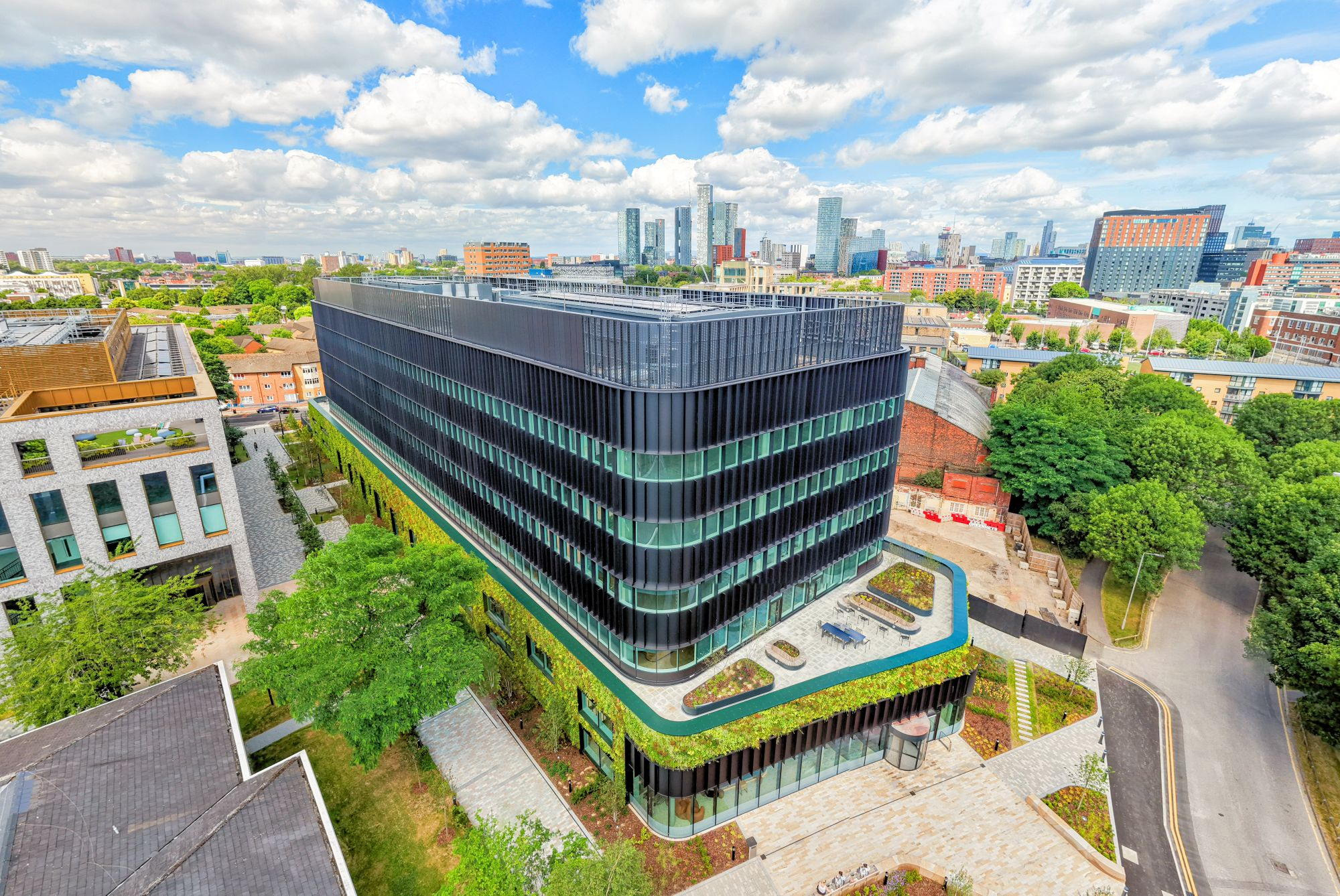
Willmott Dixon has completed the £60m Greenheys laboratory and workspace development at Manchester Science Park, providing a new headquarters and research facility for UK Biobank.
The 131,000 sq ft building has been handed over to Bruntwood SciTech following completion on programme and within budget. UK Biobank will use the facility for laboratory work, offices, sample storage, and management of its biomedical research resource.
Containment Level 2 laboratories sit alongside specialist local exhaust ventilation, fume extraction, advanced air handling systems, controlled chemical and clinical waste storage, goods lifts, loading facilities, and enhanced security.
The building will support the relocation of approximately 11 million biological samples from UK Biobank’s existing facility in Stockport. Around half of the organisation’s 400 employees are also expected to move to the Manchester site.
Designed as a fully electric development, Greenheys is targeting BREEAM Excellent. Its external treatment includes a living wall covering approximately 1,700 sq m and containing around 160,000 plants selected to support urban biodiversity and provide habitat for invertebrates.
Construction also carried a substantial regional procurement commitment, with Willmott Dixon reporting that 99% of project expenditure was placed within 40 miles of the site. The programme created 21 jobs, supported more than 1,100 apprenticeship weeks, and provided over 100 weeks of work placements.
Anthony Dillon, managing director for Willmott Dixon in the north, said the development combined specialist scientific requirements with an ambition to create a lasting economic and social contribution in Manchester.
Laboratories place engineering at the centre
Scientific buildings impose demands that differ considerably from those of conventional offices. Laboratory layouts must accommodate changing equipment, controlled workflows, high servicing densities, vibration limits, specialist gases, resilient power, extraction, and stable environmental conditions.
Containment Level 2 spaces require careful coordination of finishes, penetrations, ventilation, access control, and cleaning regimes. Effective performance depends on the architectural, structural, mechanical, electrical, laboratory equipment, and operational teams resolving interfaces before installation begins.
Air handling systems often account for a large proportion of a laboratory’s operational energy use. High ventilation rates and tightly controlled internal conditions can make science buildings difficult to reconcile with carbon reduction targets, particularly where facilities operate continuously or contain substantial heat generating equipment.
Greenheys’ all electric design places future carbon performance on the efficiency of its systems and the changing carbon intensity of the electricity supply. Detailed commissioning will be essential because poor control settings, excessive air volumes, and inaccurate occupancy schedules can undermine an otherwise efficient design.
Research facilities must also accommodate changing scientific practice. Fixed installations can become obsolete more quickly than the base structure, so accessible services, adaptable layouts, and sufficient plant capacity can provide greater long term value than a design optimised solely around the initial equipment schedule.
The UK life sciences estate is generating a growing pipeline of technically demanding work. Public bodies, universities, commercial laboratories, and specialist developers are seeking space for diagnostics, biomedical research, advanced manufacturing, and secure sample storage.
Plans to advance the UK Health Security Agency’s Harlow biosecurity campus illustrate the scale and complexity of other projects entering the market. Such developments require contractors to coordinate containment, process engineering, security, and resilient building services at a level beyond conventional commercial construction.
That pipeline creates opportunities for companies with laboratory experience, while concentrating demand for a relatively narrow pool of designers, commissioning specialists, controls engineers, containment advisers, and equipment installers. Repeated work helps teams retain knowledge, whereas uncertain project starts make specialist capacity difficult to sustain.
Greenheys strengthens the cluster around Manchester Science Park and the wider Oxford Road corridor. Proximity between UK Biobank, universities, healthcare organisations, and commercial life sciences companies may support collaboration while reducing the physical separation between research data, biological samples, and scientific expertise.
The reported level of local expenditure is notable for a specialist building because laboratory equipment and systems often depend on national or international suppliers. A 99% spend within 40 miles indicates that much of the principal construction, building services, and supporting work was sourced regionally.
Attention will now shift from construction completion to migration, commissioning, and occupation. Moving millions of biological samples without compromising their integrity requires carefully controlled transport and storage, while staff use will provide the first sustained test of the building’s environmental systems.
Operational performance will ultimately determine the value of the design. Stable laboratory conditions, accessible maintenance, reliable services, adaptable spaces, and controlled energy consumption will decide whether Greenheys supports the research programme as effectively as its completed structure suggests.