IN Brief:
- WMCA and CITB have signed an MoU to develop a National Skills Academy for Construction in the West Midlands.
- CITB forecasts that the region needs more than 3,800 additional construction workers each year for the next five years.
- The proposed model will link live site data, employer demand, training provision, and regional investment more closely.
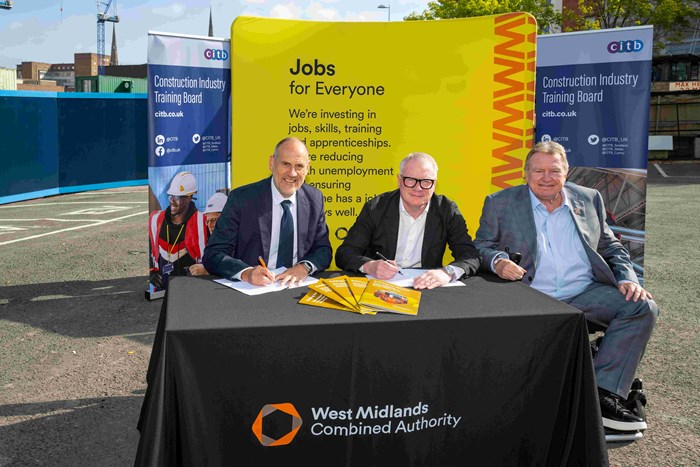
West Midlands Combined Authority and the Construction Industry Training Board have signed a memorandum of understanding to develop a National Skills Academy for Construction in the region, linking workforce planning more directly with future construction demand.
The agreement is among the first partnerships being developed under CITB’s programme for a connected construction skills ecosystem across England. It is intended to bring employers, training providers, local decision makers, government, and skills bodies into a more coordinated regional model rather than treating training demand as a series of isolated courses.
CITB forecasts that recruitment in the West Midlands needs to increase by more than 3,800 construction workers each year for the next five years. WMCA has separately identified an estimated requirement for around 12,000 additional workers over the next three years as housing, regeneration, and infrastructure programmes move forward.
The memorandum is designed to improve intelligence sharing, align investment, and connect workforce planning with Local Skills Improvement Plans, mayoral priorities, employers, and government. WMCA says the agreement will also give it access to live data from construction sites across the region so that gaps can be identified against actual project demand.
That data element matters because construction skills shortages are rarely uniform. A headline deficit of several thousand workers can conceal very different pressures across site management, bricklaying, carpentry, building services, civil engineering, plant, retrofit, and specialist trades. Training capacity only helps delivery when it produces people with the competencies that active projects require at the point those projects need them.
The academy proposal follows a £75 million commitment for construction skills training over three years. It also comes shortly after the opening of The Skills Centre at Coventry City Centre South, a £450 million regeneration programme being delivered by The Hill Group with public sector partners.
The Coventry centre provides a practical example of the model the wider academy is intended to support. Training is connected to an active construction programme, giving learners a clearer route from classroom activity into site experience and employment. For contractors, that connection can make training more responsive because project teams can signal demand before vacancies become critical.
Construction has struggled for years with the gap between national workforce forecasts and local delivery. A region may have substantial college capacity while individual contractors still cannot recruit the people required for a particular programme. Training providers can also produce qualifications for roles where local demand is weaker than expected if project pipelines change or employers are not involved early enough.
A regional academy model cannot eliminate those problems, but it can reduce the lag between market intelligence and training provision. Better data on project starts, procurement pipelines, trade packages, and workforce needs gives providers a basis for changing course volumes and content before shortages become acute on live sites.
Employer participation will be central. Construction businesses control work placements, apprenticeships, mentoring capacity, and much of the site experience needed to turn classroom learning into competent employment. If employers treat the academy simply as a public training service, the system will struggle to create the practical routes into work that the memorandum is intended to strengthen.
The West Midlands has a substantial pipeline across housing, transport, city centre regeneration, public buildings, and infrastructure. WMCA says 7,237 new homes were contracted over the last year, including 2,452 affordable homes and 1,086 for social rent. That housing programme sits alongside regeneration schemes such as Coventry City Centre South and wider transport and development investment.
Those programmes compete for many of the same core construction skills. They also create demand over different timescales, which makes workforce visibility important for contractors bidding several years ahead. Framework appointments and long-term regeneration programmes can support better planning, but only if the likely volume of work is translated into realistic labour requirements early enough for training to respond.
CITB has already agreed a similar mayoral partnership with Liverpool City Region, where the estimated workforce shortfall is around 9,000 people. The West Midlands agreement therefore forms part of a wider attempt to build regional skills systems around local project pipelines while retaining national coordination.
The memorandum is still an enabling step rather than the opening of a fully specified academy. Governance, delivery partners, training locations, employer commitments, performance measures, and the detailed relationship with existing colleges and centres will determine whether the model adds capacity or simply reorganises programmes that already exist.
The test will be visible on construction sites rather than in partnership documents. If live project data leads to earlier training decisions, more placements, and workers entering shortage occupations at the right time, the academy will have addressed a genuine delivery constraint. If the data remains separate from procurement and project planning, contractors could still report the same labour gaps despite more training activity.