IN Brief:
- VIVACycle has a 100% recycled gypsum core, typically comprising 97% post-consumer and 3% pre-consumer material.
- Siniat says the board matches standard plasterboard performance and can be installed using conventional drywall methods.
- The product can be combined with Siniat’s takeback service to support closed-loop gypsum recovery.
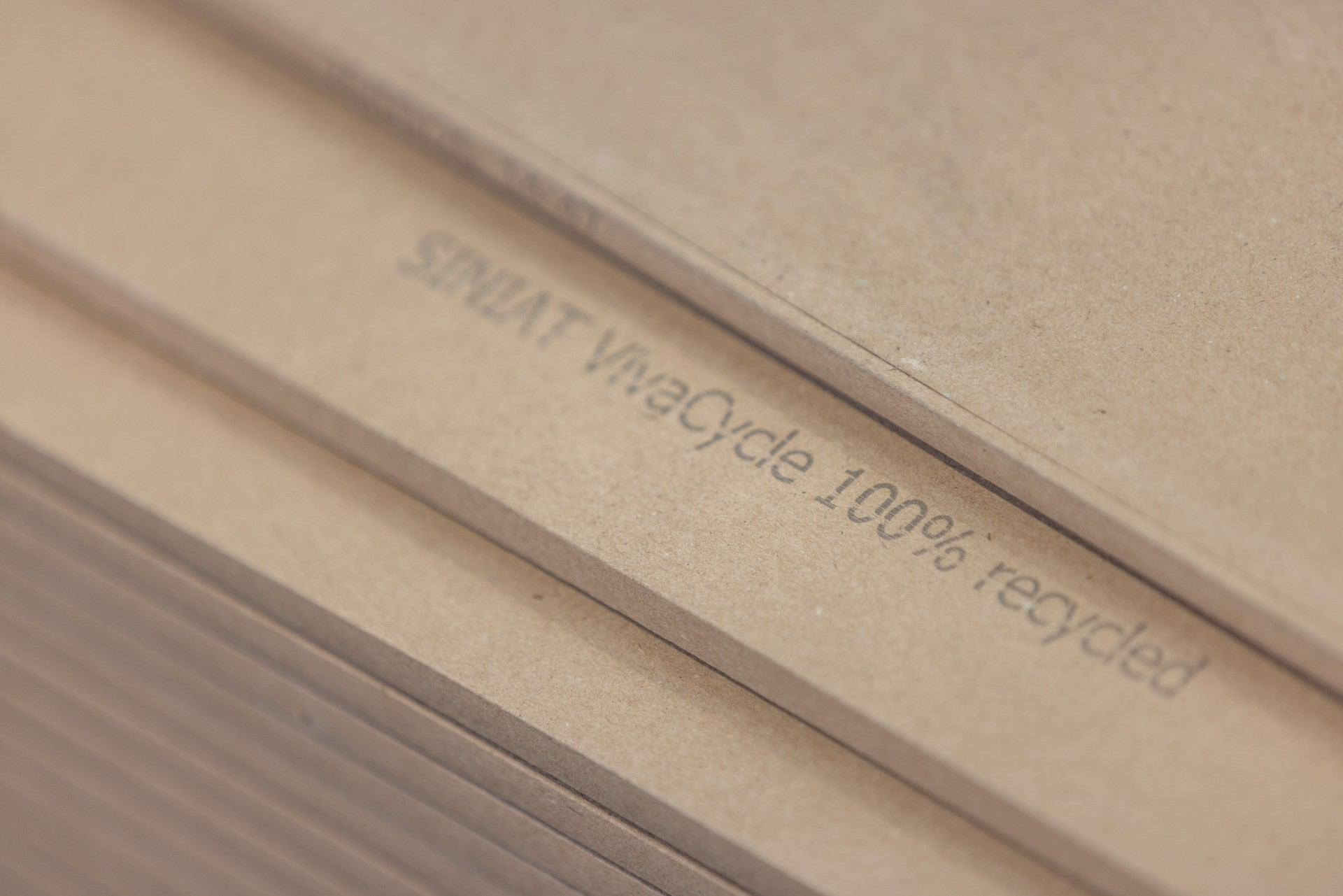
Siniat has introduced VIVACycle to the UK market, offering a standard plasterboard with a core manufactured entirely from recycled gypsum.
The core typically comprises 97% post-consumer gypsum recovered after use and 3% pre-consumer material generated during manufacturing. The paper facers contain 96% recycled fibre, according to the launch information supplied by the manufacturer.
Siniat says the board offers the same performance as its conventional standard plasterboard and can be installed using established drywall methods. It is intended for partitions, wall linings, and ceilings, with multiple layers available where the selected system requires additional performance.
The product is classified as a Type A board and carries an A2-s1,d0 reaction-to-fire classification. Its smooth surface is designed for conventional finishing, reducing the need for contractors to adopt a separate installation process solely because the gypsum content has changed.
Recycled content requires controlled material flows
Gypsum can be reprocessed repeatedly where the recovered material remains sufficiently clean. The practical constraint is the collection system around it: offcuts and strip-out material must be separated from insulation, timber, adhesives, fixings, packaging, and general site waste before they can return to plasterboard production.
VIVACycle is therefore being positioned as part of a wider circular service rather than as an isolated product claim. Siniat’s plasterboard takeback operation can collect suitable waste for reprocessing, linking material specification with site segregation and the return of usable gypsum to manufacturing.
That arrangement requires planning before deliveries begin. Contractors need defined storage areas, collection frequencies, contamination controls, responsibilities between trades, and evidence showing how much material was returned. A board with high recycled content does little for circularity where clean offcuts are placed in mixed skips.
Andy Mudie, head of marketing at Siniat, said: “Gypsum is completely recyclable and can be processed infinitely without losing quality.”
The statement describes the material’s technical potential rather than the outcome of every project. Transport distances, sorting, contamination, processing energy, damaged stock, and incomplete takeback arrangements can all reduce the benefit available from a closed-loop system.
The product’s recycled-content declaration also needs to be represented accurately in specifications and environmental submissions. The gypsum core is described as 100% recycled, while the paper facers have a separate recycled-fibre percentage. Neither figure should be presented as though every component of the finished board has identical recycled content.
Siniat states that its recycled-gypsum claim is calculated under ISO 14021, which addresses self-declared environmental claims. Project teams should retain the supporting product information and ensure that tender documents distinguish verified material content from broader claims about operational energy, embodied carbon, or whole-life environmental performance.
VIVACycle is intended to support BREEAM assessments and project Circular Economy Statements, including those required through planning policy in London. Its contribution will depend on the assessment method, the evidence available, the quantity specified, and whether waste recovery is implemented rather than merely proposed.
Product selection must still begin with technical suitability. Fire, acoustic, moisture, impact, structural, and lining requirements apply to the complete tested wall or ceiling system, not the gypsum core in isolation. A standard board should not be substituted where the design requires a specialist fire-resistant, moisture-resistant, acoustic, or impact board.
Availability is another practical consideration. Siniat’s UK product page lists VIVACycle as a current product, allowing contractors and merchants to assess it against live requirements rather than a future development programme. Lead times, regional distribution, minimum quantities, and project-specific documentation will still need to be confirmed through procurement.
Design coordination can improve the circular outcome before materials reach site. Board dimensions can be aligned with room layouts, partition heights, and framing centres to reduce cutting, while accurate quantity take-offs can limit surplus stock and handling damage.
Installation teams then determine whether those design decisions survive contact with the programme. Protected storage, correct sequencing, controlled cutting, and clearly marked recovery containers can reduce avoidable waste without changing the underlying drylining method.
The takeback proposition also creates a measurable project record. Ordered quantities, installed areas, returned offcuts, damaged material, and unrecovered waste can be compared, giving clients a clearer view of material efficiency than a recycled-content percentage alone.
VIVACycle provides a conventional plasterboard format with a defined recycled-gypsum content and a potential route back into manufacturing. Whether it functions as a circular product will be decided less by the label on the board than by specification accuracy, site discipline, and the recovery chain operating after the first sheet is cut.