IN Brief:
- Siniat reports a 5% reduction in carbon intensity across its UK operations compared with 2024.
- The manufacturer links the improvement to more efficient production technology at Bristol and operational changes across its UK sites.
- The supplied Siniat release says verified Environmental Product Declarations now cover more than 86% of its products.
Siniat has reported a 5% reduction in carbon intensity across its UK operations compared with 2024, linking the improvement to more efficient plasterboard production technology and operational changes at its manufacturing sites.
The measure covers Scope 1 and Scope 2 emissions per unit of output rather than simply total emissions. That distinction allows production efficiency to be tracked even where manufacturing volumes change, providing a clearer indication of how much operational carbon is associated with the material leaving the factory.
The reduction follows major investment in Siniat’s Bristol operation, where parent company Etex officially opened a €200m plasterboard manufacturing expansion in March 2025. UK material has also described the programme at approximately £170m.
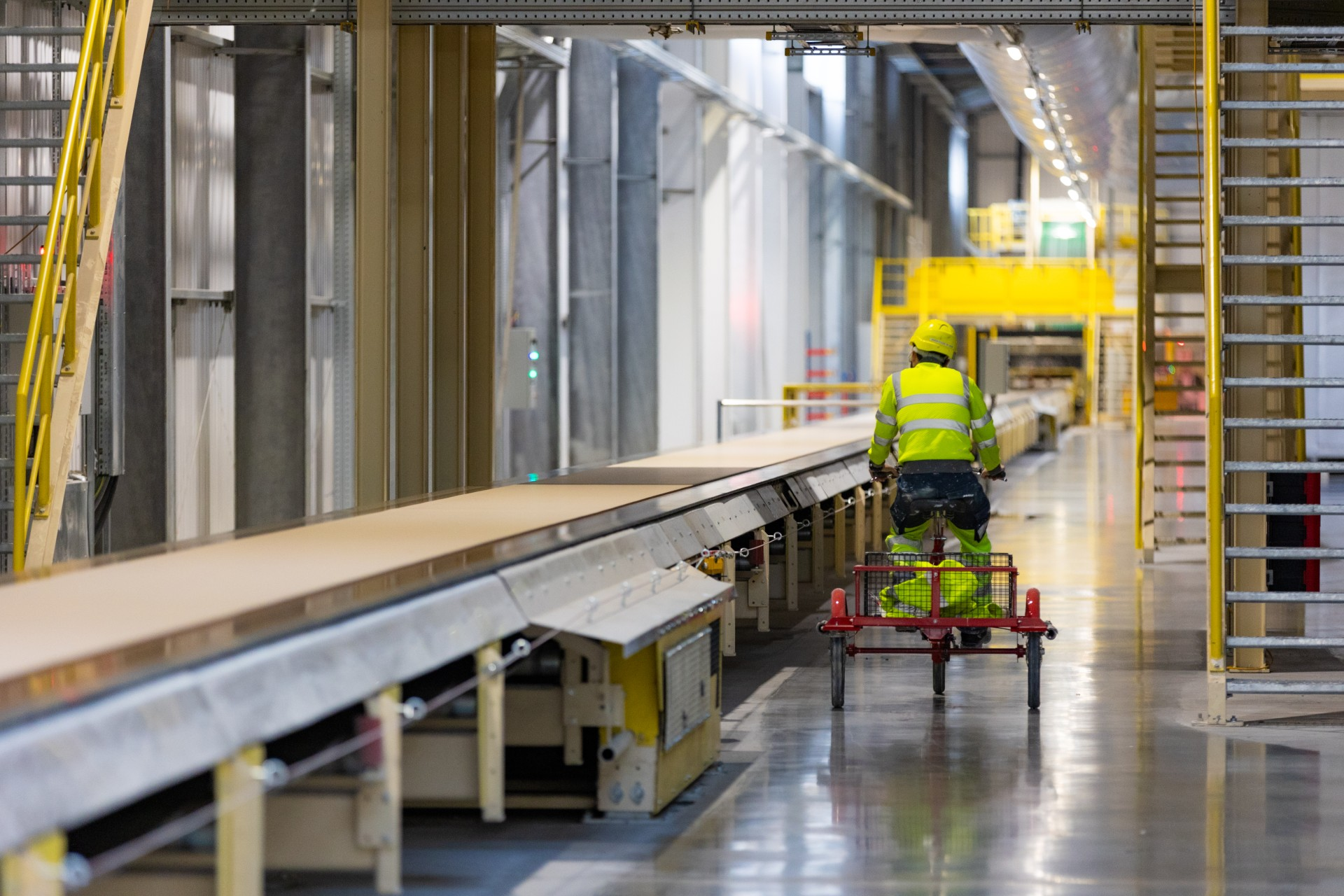
Etex describes the new Bristol line as its most efficient plasterboard production line in Europe when its size, speed, and complexity are considered. The additional capacity allows the facility to manufacture more than 98% of the group’s plasterboard portfolio for the UK and Ireland.
Siniat says transferring more production onto newer equipment has reduced energy intensity per tonne of output. The manufacturing process requires substantial thermal energy, particularly during drying, making line efficiency, heat management, air movement, production speed, and moisture control significant parts of the carbon calculation.
Small improvements in those variables become material when multiplied across continuous industrial production. A plasterboard plant operates at a scale where a reduction in energy demand per tonne can produce a substantial annual effect without changing the specification of the board reaching site.
The company also points to operational improvements at Ferrybridge as part of the wider reduction. Siniat has been increasing monitoring and process control across its UK plants alongside the larger capital investment at Bristol.
The latest result contributes to Etex’s broader target of reducing Scope 1 and 2 carbon intensity by 35%. Measures across the group include manufacturing efficiency, renewable electricity, recycled material, and waste reduction rather than relying on a single change in production technology.
For designers and contractors, the factory improvement becomes useful only when it can be translated into reliable product information. Siniat’s supplied announcement states that verified Environmental Product Declarations now cover more than 86% of its products.
EPDs provide quantified environmental information across defined life-cycle stages using standardised assessment rules. They do not automatically establish that one product is sustainable or preferable to another, but they give project teams evidence that can be incorporated into whole-building carbon calculations.
That is increasingly relevant as embodied carbon becomes a more explicit part of project briefs, procurement, planning requirements, and voluntary building standards. Structural frames and façades attract much of the attention because of their mass, but internal partitions, linings, ceilings, and fire-protection systems can consume large quantities of material across hospitals, schools, offices, hotels, and residential schemes.
Drywall specification is also performance-led. Boards are selected according to requirements including fire resistance, acoustics, moisture exposure, impact performance, and structural application, so environmental data has to sit alongside the technical properties necessary for the completed wall or ceiling system.
Oliver Cripps, head of sustainability at Siniat, said the company was continuing to evaluate its targets while improving the information available to customers.
“EPDs help to identify low carbon options and give confidence to our customers in their purchasing decisions,” he said.
Siniat is now reviewing its declarations so that improvements in current manufacturing can be reflected in published environmental data. That update matters because an EPD represents the inputs and production conditions used during its underlying assessment period rather than automatically changing when a factory becomes more efficient.
If energy consumption, electricity sourcing, recycled content, or manufacturing processes change materially, updated declarations are needed before project teams can confidently assign those improvements to current products.
Siniat already publishes independently verified EPDs across its plasterboard range. Current declarations identify the Bristol plant as the manufacturing location for products including Megadeco and provide quantified information covering global warming potential, secondary-material inputs, energy, and other environmental indicators.
The Bristol investment also supports a wider circular-material strategy. Plasterboard production can use recovered gypsum, provided site waste is collected, processed, and kept sufficiently clean for return to manufacturing.
That creates an increasingly direct connection between construction-site waste management and factory performance. Material that is segregated properly can become manufacturing feedstock; contaminated gypsum is far harder to recover and may leave the circular system entirely.
Siniat’s manufacturing programme is therefore operating on several fronts at once: newer production equipment reduces energy intensity, recycled gypsum addresses raw-material demand, and EPDs provide the data through which those changes can be reflected in project carbon assessments.
The reported 5% improvement does not remove the energy requirements of plasterboard manufacture, nor does extensive EPD coverage by itself reduce emissions. The industrial significance lies in linking capital investment with measurable production data, giving contractors and specifiers a clearer basis for judging whether claimed factory improvements are reaching the construction products they actually buy.