IN Brief:
- Four affordable homes at Closeburn have secured planning consent using VASO’s recycled-glass panel system.
- Structural panels will be manufactured at a 60,000 sq ft Dumfries facility before being flat-packed and assembled on site.
- Construction will provide a live test of manufacturing, logistics, installation, and building performance beyond factory development.
VASO Global has secured planning permission for four affordable homes at Closeburn, north of Dumfries, giving its recycled-glass structural panel system a consented project on which to demonstrate factory production and site assembly.
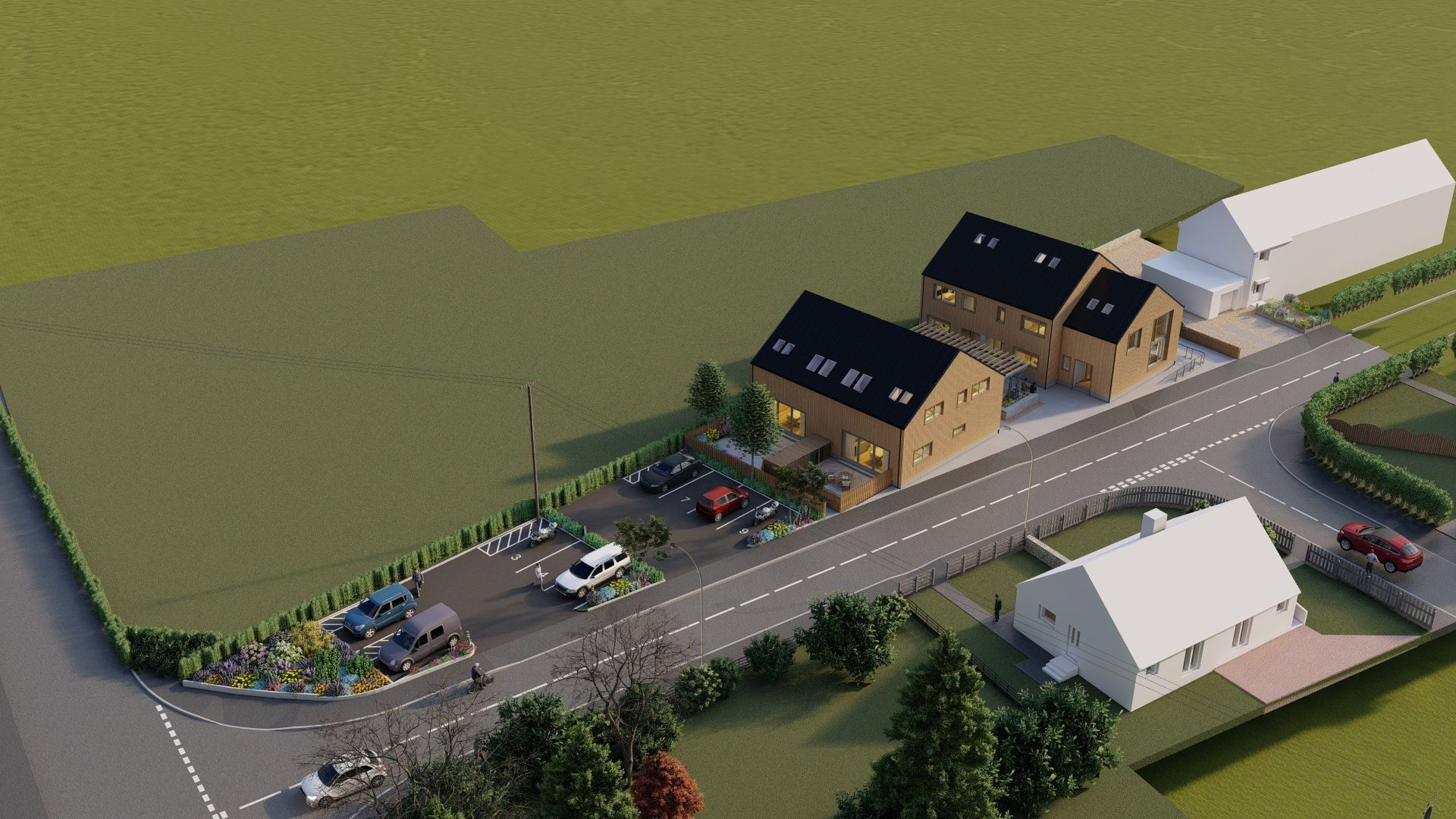
The brownfield development includes four homes alongside a home-working space and visitor bedroom. Nith Valley Leaf Trust and South of Scotland Community Housing are working with VASO on the scheme, while South of Scotland Enterprise previously commissioned a feasibility study covering development of the site.
The homes will be built using structural composite panels manufactured from recycled glass. VASO plans to produce the panels at its 60,000 sq ft Irongray Park facility in Dumfries, manufacture and prepare them off site, transport them in flat-packed form, and reassemble the system at Closeburn.
Planning consent allows the community partners to progress funding, land acquisition, and delivery rather than beginning construction immediately. Nith Valley Leaf Trust has said the next steps include securing funding and purchasing the land before work can begin.
Planning consent moves the system towards site delivery
Closeburn is a four-home development, so it does not establish whether the technology can support volume housing. It does, however, provide a live project in which manufacturing tolerances, transport, installation, interfaces, programme, and building performance can be tested together rather than assessed as separate factory exercises.
Off-site construction shifts a larger proportion of work into a controlled environment, but it also places more pressure on early design coordination. Panel dimensions, openings, connection details, services, transport limits, foundations, and erection sequencing need to be settled before manufacturing progresses too far, because changes made after fabrication can erase part of the efficiency gained in the factory.
VASO’s model also depends on the relationship between its production facility and the installation process. A 60,000 sq ft factory can provide repeatable panel manufacture, but commercial scaling will depend on throughput, quality assurance, logistics, site preparation, and the availability of teams capable of assembling the system consistently beyond the immediate Dumfries area.
The company began recruiting for production at Irongray Park in August and expects the site to support up to 70 jobs over five years. VASO has also secured more than £5m from investors and public-sector bodies to develop the manufacturing process, with a demonstration home forming another stage of its technical and commercial development.
The Closeburn scheme gives that manufacturing investment a direct construction application. Factory output will have to arrive on site in the correct sequence, connect accurately with foundations and adjoining elements, accommodate weatherproofing and services, and ultimately meet the certification, warranty, insurance, and regulatory requirements applied to permanent housing.
Material provenance adds another layer. Recycled glass is established as a recoverable material, but converting it into a structural composite panel creates a different construction product and therefore a different performance case. Structural capacity, fire behaviour, durability, thermal properties, moisture control, acoustic performance, and manufacturing consistency all become part of the specification presented to designers, building control, funders, and warranty providers.
VASO promotes lower operational energy demand and improved thermal comfort as benefits of the system. Those remain company claims until supported by completed-building performance data, and Closeburn offers a route to produce that evidence once homes are occupied rather than relying solely on laboratory testing and modelling.
The project is also relevant to smaller rural housing schemes, where development economics can be difficult and conventional construction does not always benefit from the scale enjoyed by large housebuilders. Off-site systems can reduce some on-site labour and weather exposure, but they still have to compete on total project cost, finance, planning, certification, logistics, and long-term maintenance.
Local manufacture gives Closeburn a relatively favourable first deployment because the project sits close to VASO’s production base. Future work farther from Dumfries will place greater weight on transport efficiency and installation capacity, particularly if the system progresses from small community schemes into larger programmes.
The planning decision therefore moves VASO beyond product development without yet proving repeatability at scale. The more useful evidence will arrive when manufactured panels leave Irongray Park, are assembled on the brownfield site, and begin operating as occupied homes.