IN Brief:
- RWE and TotalEnergies have installed the first of 53 monopile foundations for the 795MW OranjeWind offshore wind farm.
- The transition piece-less foundations are approximately 90 metres long and eight metres in diameter.
- Jan De Nul's Les Alizés is carrying out installation, with foundations due to complete by early 2027 before turbine installation during 2027.
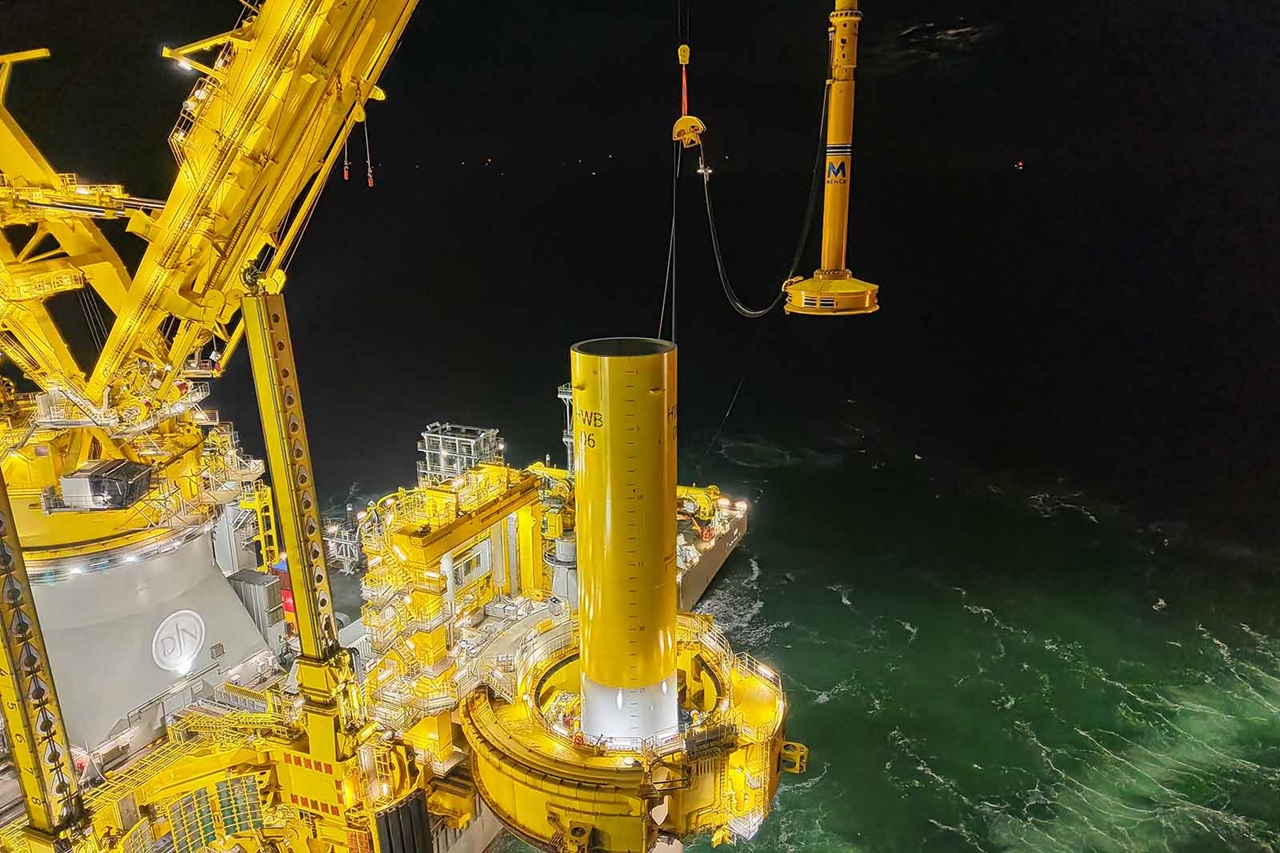
RWE and TotalEnergies have installed the first monopile foundation for the 795MW OranjeWind offshore wind farm in the Dutch North Sea, moving the project into its offshore construction phase.
The first foundation was loaded out from Sif’s terminal at Maasvlakte near Rotterdam and transported approximately 53 kilometres offshore before installation by Jan De Nul’s heavy-lift vessel Les Alizés. The complete campaign covers 53 monopiles and is expected to continue until early 2027.
OranjeWind is using transition piece-less foundations, which allow the turbine tower to connect directly to a flange at the top of each monopile rather than requiring a separate transition piece. Secondary steel components, including the main access platform, internal cassette, and boat landing, will be installed directly onto the monopiles during a separate offshore campaign.
Each foundation is approximately 90 metres long and eight metres in diameter. Sif’s package covers 53 monopiles with a combined steel weight of about 76 kilotonnes, making fabrication, storage, marshalling, and vessel loading substantial construction activities before the foundations reach their final positions offshore.
Removing the conventional transition piece reduces one major fabricated component from each turbine location, but it increases the importance of the interface between the monopile and the later tower installation. Flange position, verticality, dimensional tolerances, and seabed installation all have to be controlled closely because subsequent packages will connect directly to the installed foundation.
Les Alizés is equipped with a 5,000-tonne crane capable of reaching 160 metres at full height. The dynamically positioned vessel lifts and upends the foundations before a hydraulic impact hammer drives them into the seabed. Dynamic positioning allows the vessel to maintain the required installation location without an anchor spread around each turbine position.
The vessel arrangement has to combine lifting capacity with a repeatable installation sequence. Monopiles need to arrive from the fabrication and marshalling operation in the correct order, while lifting, positioning, driving, surveying, and vessel movements have to remain aligned with weather windows and the overall offshore programme.
Piling noise adds an environmental constraint to that sequence. OranjeWind is using a bubble curtain around each installation location, pumping compressed air through a hose to create a wall of bubbles intended to absorb and reflect underwater sound. Measurements outside the curtain are used to confirm that piling remains within applicable noise limits.
Those controls mean foundation output cannot be judged purely by the lifting capacity of the vessel. Sea state, wind, visibility, equipment availability, environmental restrictions, survey results, and the performance of the piling system all affect how quickly the installation team can move from one position to the next.
Once a monopile has been driven and accepted, further contractors still have to return to the location. Secondary steel components need to be fitted, inter-array cables connected, and turbines erected before the foundation becomes part of an operating generation system. RWE expects inter-array cable installation to begin towards the end of 2026, with all 53 turbines due to be installed during 2027.
The division of work creates a series of handovers between specialist suppliers. A tolerance problem left by the foundation campaign can affect secondary steel or tower installation months later, while delays to foundations can compress the programme available to cable and turbine vessels. Offshore projects therefore depend heavily on accurate completion records and interface control between contractors that may never operate on the site simultaneously.
Sif’s manufacturing programme is equally important to maintaining that sequence. Producing 53 large foundations requires a steady flow through plate forming, welding, coating, storage, and load-out, with units then available at Maasvlakte when the installation vessel is ready. The approximately 76-kilotonne steel package has to feed the offshore campaign without creating excessive storage or leaving the vessel waiting for foundations.
The first installation confirms that the project has passed from fabrication and logistics planning into physical offshore construction. It does not remove the programme risk associated with the remaining 52 foundations, where maintaining a consistent cycle across repeated operations will matter more than the speed of the inaugural installation.
OranjeWind is expected to be fully commissioned in 2028. Before then, the project has to complete its foundation campaign, fit secondary steel, install the inter-array network, erect 53 turbines, and move through offshore testing and commissioning. The first monopile establishes the construction method; the next measure is whether that method can be repeated reliably through early 2027 without pushing pressure into the cable and turbine programmes that follow.