IN Brief:
- The £40m programme will bring the vacant 108,576 sq ft Princes Exchange building back into use.
- Works include façade, roof and window replacement, public realm, staff facilities, and basement cycle accommodation.
- Rail organisations will occupy three floors, with five floors prepared for commercial letting from mid-2027.
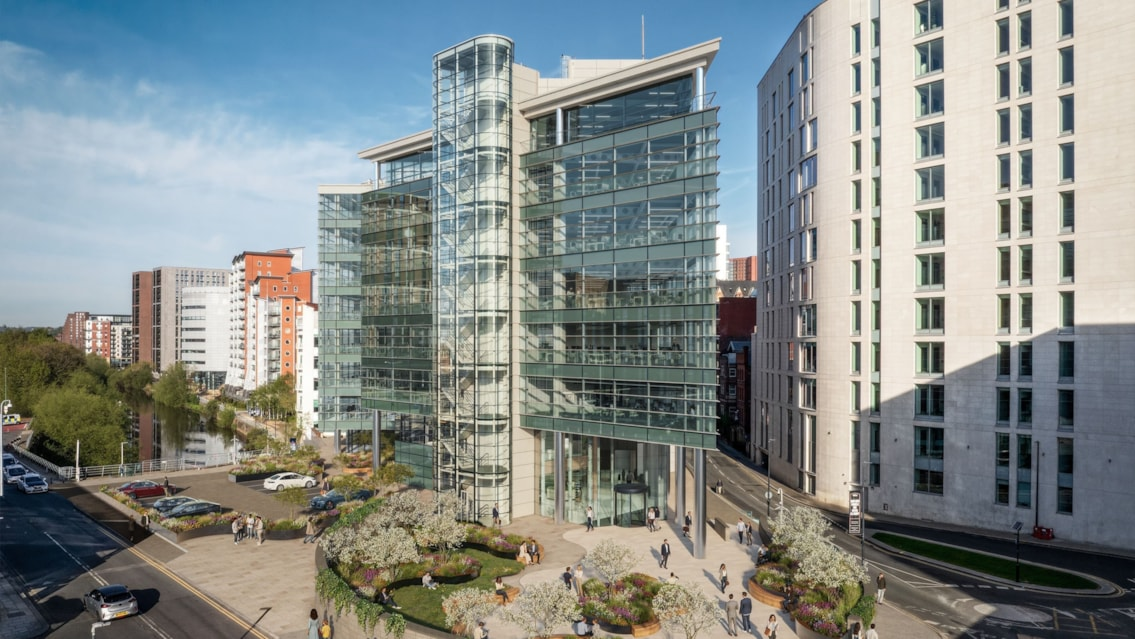
Network Rail has started a £40m refurbishment of Princes Exchange beside Leeds station, bringing the vacant eight-storey office building back into use as a rail-industry hub with five floors of commercial accommodation.
Willmott Dixon is delivering the work with Network Rail and its property development company Platform4, backed by funding from Network Rail and the Department for Transport. The 108,576 sq ft building was acquired in 2024 and is scheduled for completion in June 2027.
The construction programme reaches well beyond a conventional office fit-out. The main entrance and external façade are being refurbished, all windows and the roof will be replaced, and the public realm facing the station’s Aire Street entrance will be upgraded. A separate rail-hub entrance and reception, new welfare space, cycle storage, and changing facilities are also included.
Three floors will accommodate Network Rail and other rail-industry teams, consolidating staff currently working at different locations in Leeds. The remaining five floors are being prepared for the commercial office market and are expected to become available from mid-2027.
That split requires the refurbishment to support two occupation models within one building. Access control, reception arrangements, vertical circulation, digital infrastructure, services distribution, and welfare provision must work for the rail operation without limiting the flexibility of floors intended for tenants that have yet to be secured.
The sustainability brief is similarly tied to the fabric and services work rather than to finishes alone. Network Rail is targeting EPC A, BREEAM Excellent, Fitwel, and WiredScore accreditation, which places energy use, digital connectivity, occupier wellbeing, and the performance of the refurbished envelope within the project specification.
Replacing the windows and roof will have a direct influence on heat loss, air leakage, moisture performance, and internal comfort, while the services strategy will determine whether the building can achieve the operational performance expected from an EPC A office. Retaining the existing structure avoids wholesale redevelopment, but the retained fabric still has to be upgraded sufficiently to compete with newer city-centre stock.
Material reuse forms another part of the programme. Network Rail estimates that reusing furniture and materials removed from the site will save around 80 tonnes of carbon, while approximately £10,000 of equipment is expected to be donated to charitable organisations instead of entering the waste stream.
Princes Exchange’s position immediately beside Leeds station adds a more practical constraint. Façade access, deliveries, temporary works, pedestrian segregation, material storage, and construction traffic have to be managed in a dense city-centre location beside an operating transport interchange rather than across an isolated commercial site.
Envelope work is particularly exposed to those restrictions because scaffolding, mast access, lifting operations, and temporary protection all interact with the public edge of the building. Window and roof replacement must also be sequenced so that internal areas can move progressively towards fit-out without allowing weather exposure to disrupt later packages.
The rail-industry floors bring their own fit-out requirements. Network Rail has identified digital connectivity as one of the development’s priorities, alongside workplace and welfare provision, while the commercially let accommodation must remain sufficiently neutral to accommodate tenants with different layouts and servicing requirements.
Preparing speculative office floors alongside operational accommodation can create tension between certainty and flexibility. Core building services have to be installed and commissioned, but excessive tenant-specific fit-out would reduce the attraction of the space to companies seeking different workplace configurations. The project team therefore has to take each floor far enough for letting without prematurely fixing every detail.
Platform4’s involvement connects the refurbishment with Network Rail’s wider property strategy. Railway-owned land and buildings occupy some of the country’s most constrained urban locations, and underused assets can carry significant operating and maintenance costs even before their development value is considered.
Princes Exchange gives Network Rail an opportunity to consolidate railway staff while keeping the majority of the building available for commercial occupation. That creates a revenue-producing element within an asset that would otherwise remain empty, although the success of the model will ultimately depend on securing tenants once construction is sufficiently advanced.
The programme also coincides with continuing redevelopment around Leeds station, where transport infrastructure, commercial property, and public realm are increasingly being planned as connected pieces of the city centre. Princes Exchange is already part of that environment, so refurbishment avoids the lengthy process of assembling and constructing an entirely new workplace elsewhere.
The choice to retain the building does not make delivery straightforward. Existing structures impose fixed floor heights, cores, column positions, risers, and façade interfaces, while refurbishment teams frequently encounter conditions that cannot be fully established until finishes and redundant systems are stripped out.
Completion in June 2027 leaves the project less than a year to finish the external envelope, services, internal accommodation, public realm, certification, and commissioning. Commercial floors are due to become available from mid-2027, leaving little separation between completion of the principal works and the point at which the building is expected to return to the letting market.
Princes Exchange is therefore being treated as an existing asset to upgrade rather than a site to replace. By next summer, Network Rail expects the empty building to contain both a permanent rail-sector workplace and five floors capable of attracting commercial tenants — a considerably harder test than simply making an old office block look new.