IN Brief:
- Skanska's CZK2.1bn contract covers complete construction and non-IT technologies at Prague Gateway DC.
- Initial works include site infrastructure, foundations, and the load-bearing precast concrete frame.
- CRA plans more than 2,000 racks across 12 data halls with a secured 26MW power supply and capacity for high-density AI workloads.
Skanska has signed a CZK2.1bn contract with CRA Prague Gateway DC to deliver the main construction and non-IT technology package for the Prague Gateway data centre on the outskirts of the Czech capital. The contract, equivalent to about SEK930m, will be included in Skanska’s European order bookings for the third quarter of 2026.
The initial works cover site infrastructure, foundations, and the load-bearing precast concrete frame. Skanska says construction under its contract starts in August 2026 and is scheduled for completion in 2028. Client CRA says the appointment follows earlier preparation including secured optical connectivity and initial capacity reservations from prospective customers.
The wider Prague Gateway DC campus is designed for more than 2,000 racks across 12 data halls, with more than 4,000 sq m of data-hall floor area and a secured 26MW power supply. The first building is planned for nearly 700 racks. CRA is positioning the development for high-density computing, including artificial-intelligence workloads with high power and operating requirements.
Physical work on the site began before Skanska’s appointment, after CRA secured its building permit and started the first phase of the development in 2025. The new contract is therefore a main-construction milestone rather than the first start on site, bringing a defined structural and technical package under a major contractor as the project moves into heavier delivery.
Power and structure set the construction sequence
Data centre construction is shaped less by conventional floor area than by the density of systems that have to operate continuously once the building is live. Electrical intake, distribution, cooling, standby power, fire protection, controls, security, and communications all compete for space and have to remain accessible for maintenance. The building structure must accommodate those systems without restricting later installation or replacement.
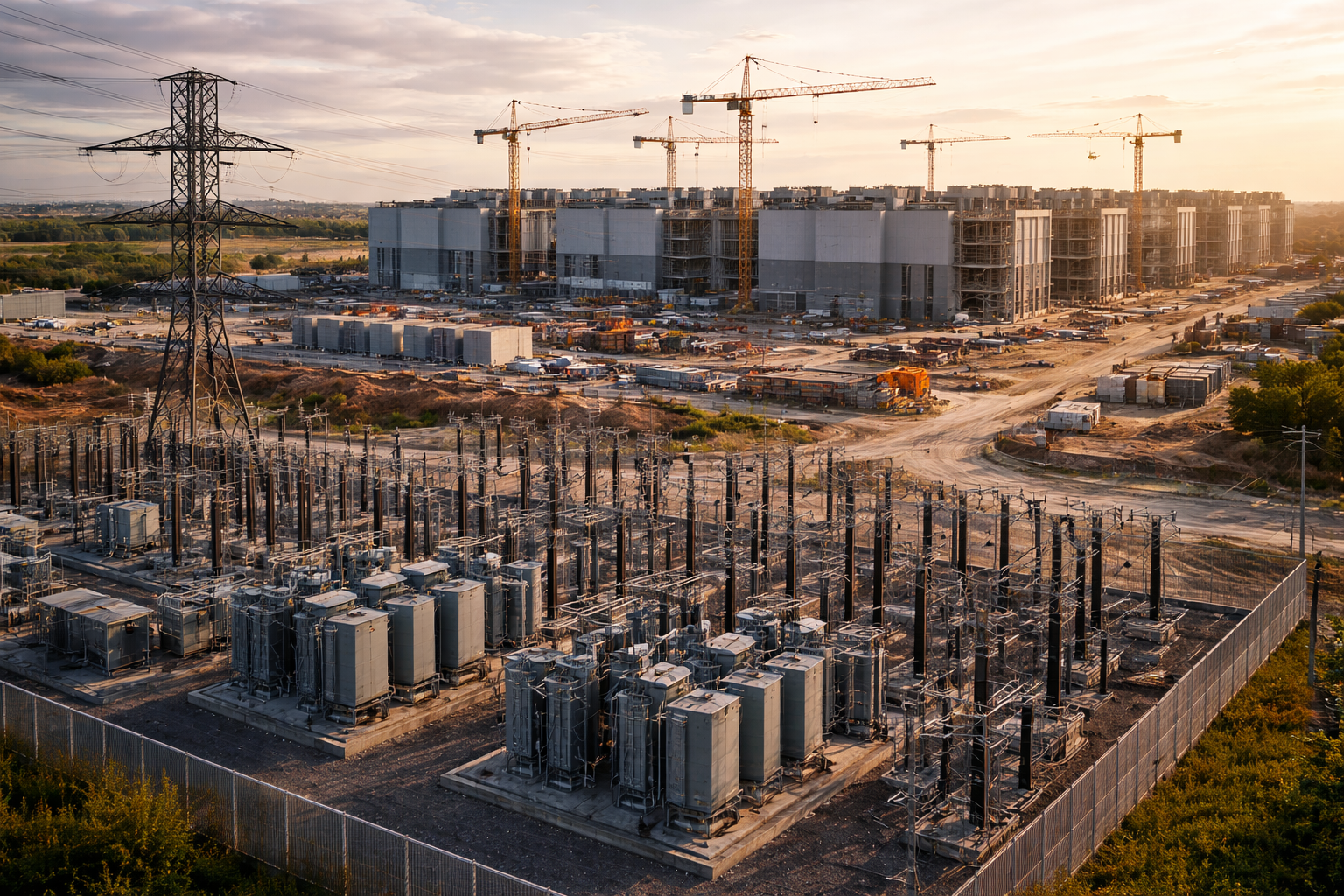
The secured 26MW power supply is therefore a construction parameter as much as an operational one. Electrical rooms, switchgear, transformers, generators, cooling equipment, cable routes, and external plant all require foundations, structural support, separation, and service access. Decisions made during the frame and infrastructure stages can constrain the technical installation long before servers arrive.
Skanska’s use of a precast concrete structural frame brings programme advantages where large numbers of repeatable bays are required, but it also demands early coordination. Openings, embedded items, loading requirements, service penetrations, crane access, and delivery sequencing need to be fixed before components are manufactured. Late design changes become more difficult once precast production and erection are under way.
The non-IT scope increases the number of interfaces managed within the construction package. A data hall cannot be commissioned simply because its structure and envelope are complete; power, cooling, controls, fire systems, security, and monitoring have to operate together and demonstrate the required resilience. That shifts significant programme risk towards systems integration and staged testing at the end of each phase.
CRA plans to bring capacity online in stages rather than wait for the entire campus to be finished. Phased occupation can bring commercial capacity into service earlier, but it creates a more complicated site once the first halls become operational. Construction traffic, temporary routes, noise, dust, fire arrangements, and service interruptions then have to be controlled around live technical spaces with strict availability requirements.
The project is also being designed around changing computing density. CRA has cited artificial-intelligence training among the workloads the campus is intended to support, and the current Skanska appointment follows capacity reservations from early prospective customers including Multiverse Computing. Higher-density equipment can increase local power and cooling requirements, making flexibility in distribution and heat rejection important even before specific tenant configurations are finalised.
Customer reservations and optical connectivity reduce some commercial uncertainty but do not simplify the physical programme. Specialist electrical and mechanical equipment can have long manufacturing lead times, while grid capacity, transformers, generators, cooling plant, and controls have to arrive in a sequence that supports commissioning. The computing hardware itself may be one of the last elements installed, but much of the project’s delivery risk sits in the infrastructure required to keep it running.
CRA is developing the site on land previously used for AM radio transmission in the Zbraslav-Jíloviště area. Reusing an established infrastructure site provides a defined landholding, but the new use requires a very different combination of power, structure, connectivity, security, and environmental controls. The project is being built in several stages, allowing capacity to expand as the campus develops.
The CZK2.1bn Skanska contract gives that programme a clearer construction structure. Foundations and the precast frame will establish the geometry for the technical spaces that follow, while non-IT systems will determine whether each completed hall can operate at the resilience and density expected by customers.
Completion is scheduled for 2028, and the immediate test is whether structural progress, equipment procurement, and systems design remain aligned as the first building develops. Data centres are often described through megawatts and racks, but neither figure becomes useful capacity until concrete, electrical systems, cooling, controls, and commissioning have been delivered in the right sequence.