IN Brief:
- Anchor has selected Bridgestone Construction for the £18m Park House development in Waterloo, Sefton.
- The scheme combines 52 extra-care apartments with 38 independent-living homes across three buildings.
- RIBA Stage 4 work will address structure, MEP coordination, BIM, buildability, and programme before construction.
Bridgestone Construction has been selected by Anchor to progress the £18m Park House development in Waterloo, Sefton, with the 90-home later-living scheme moving through a pre-construction services agreement before a planned start in early 2027.
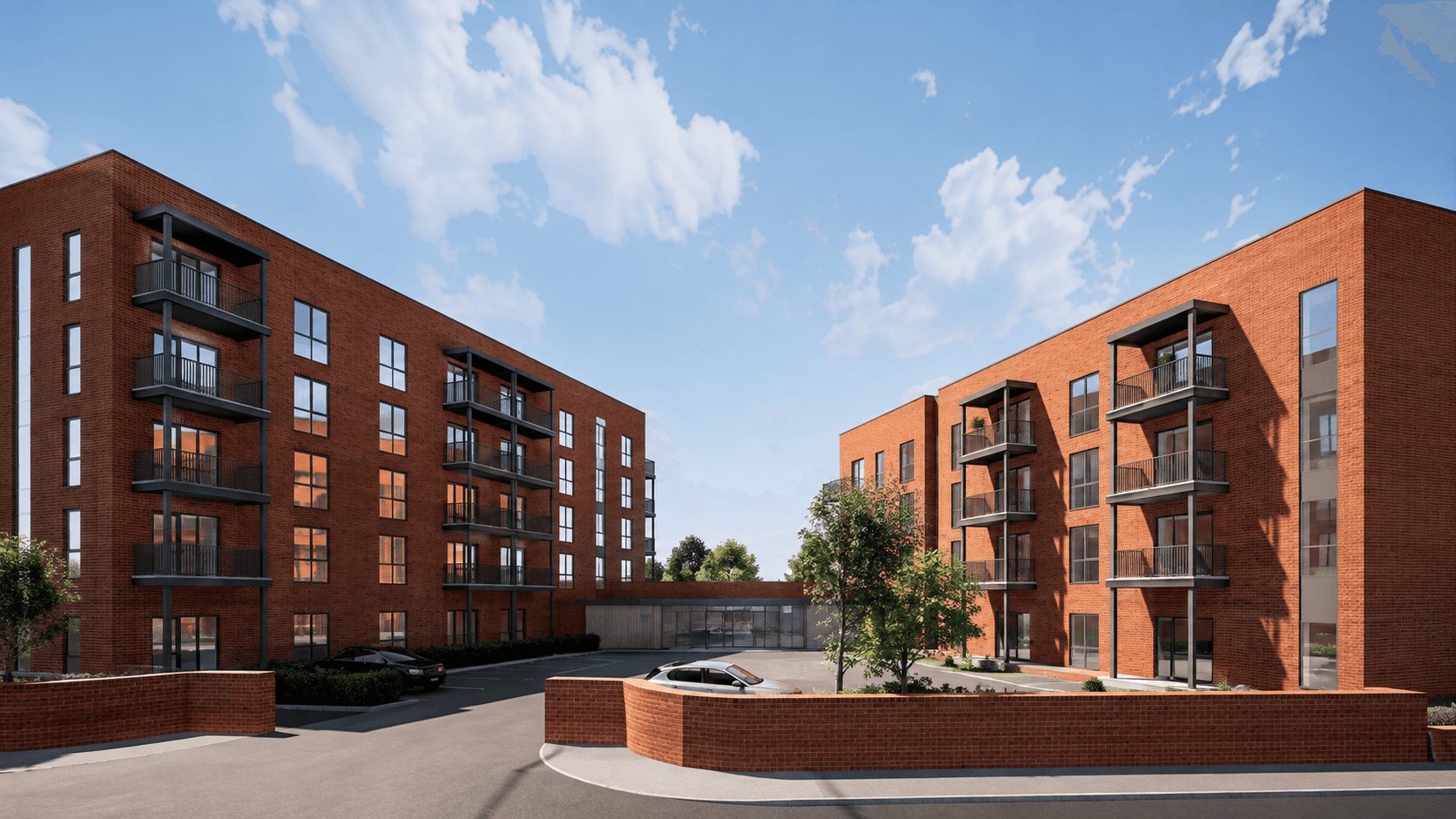
The project will provide 52 extra-care apartments and 38 independent-living homes in a mix of one- and two-bedroom accommodation. Three buildings of four and five storeys are planned, with two connected by a single-storey communal element.
Extra-care accommodation will include communal facilities, a central kitchen, and on-site offices, while residents in the independent-living apartments will have a separate level of support. The wider site works include landscaping, improvements around the existing pond, a wheelchair-accessible route, new incoming utilities, and an electrical substation.
Bridgestone is working with Anchor, Brewster Bye Architects, Civic, and BWA (Europe) to develop the design through RIBA Stage 4. Its pre-construction, compliance, and in-house mechanical and electrical teams are contributing to BIM coordination, buildability, value engineering, structural development, and programme planning.
The PCSA is an important distinction from the final construction contract. Bridgestone has been selected to progress the scheme, but the start on site remains subject to completion of the pre-construction process, project approvals, and agreement of the main works contract.
That period gives the project team time to resolve specialist housing requirements before they become expensive site changes. Accessibility, fire safety, circulation, building services, communal facilities, care operations, and resident needs all influence the basic arrangement of a later-living development, making early technical coordination more useful than attempting to retrofit operational requirements after structural work has begun.
The three-block layout offers some repetition across the residential accommodation but still creates interfaces between homes, communal spaces, services, and external areas. Selecting the structural system will affect floor zones, wall build-ups, programme, crane requirements, façade interfaces, and the routes available for mechanical and electrical services.
Building services will be particularly important because the scheme combines private accommodation with shared and staffed facilities. Domestic hot water, heating, ventilation, life-safety systems, communications, access control, catering services, and maintainability have to work around a resident population whose accessibility requirements may change over time.
The inclusion of a new substation underlines the load and infrastructure requirements. Incoming power cannot be treated as a minor utility connection late in the programme because the substation, cable routes, site distribution, and energisation sequence need to be coordinated with groundworks and the building programme.
Landscaping around the existing pond carries its own technical considerations. The proposed level wheelchair-accessible route has to align with gradients, drainage, edge protection, surfacing, landscape design, and long-term maintenance while remaining integrated with the wider external works.
Planning information for the site has evolved through earlier versions of the scheme, and a further amendment was submitted during 2026 covering floorplates, elevations, roof plans, bay studies, and parking. That places added emphasis on design control as the project moves into technical coordination, ensuring that consultants and contractors work from the same approved and current information.
The project has been procured through the Innovation Chain North framework, through which Bridgestone has also secured the Chestergate scheme in Stockport. Framework appointment can shorten the process of selecting an appropriate contractor, although it does not remove the need to establish a viable price and resolved design for the individual scheme.
The reported £18m value should therefore be read as the scale of the proposed Park House development rather than expenditure already committed under an unconditional main works contract. The current task is to convert the design into a package that Anchor can approve and Bridgestone can price with sufficient certainty to proceed.
Later-living housing also has a longer operational brief than a conventional apartment project. Maintenance access, component replacement, communal areas, resident movement, care provision, and energy use will continue to shape costs long after practical completion, so decisions made at Stage 4 can transfer directly into the building’s operating model.
The combination of extra-care and independent-living homes means those requirements are not identical across every apartment. Shared systems have to serve different levels of resident support without creating an unnecessarily institutional environment, while staff and service routes must function alongside private domestic space.
Construction logistics will become more prominent as the scheme approaches mobilisation. Three mid-rise blocks, external infrastructure, and landscaped areas have to be phased within one site, with crane positions, material storage, utility work, access, and later external finishes planned so that one package does not obstruct another.
The project is expected to reach site in early 2027 if the PCSA and approvals are completed successfully. Before then, Bridgestone’s more important output is not physical construction but a coordinated technical design, structural strategy, services solution, and programme against which the final contract can be agreed.
Park House has therefore moved closer to delivery without yet crossing the main-contract threshold. The next milestone is whether the Stage 4 work can remove enough technical and commercial uncertainty for Anchor and Bridgestone to turn the £18m scheme into a live construction programme next year.